What's inside
As an Amazon Associate I earn from qualifying purchases. This post may contain affiliate links at no extra cost to you.
Soft maple and cherry can both produce warm interior finishes, but they get there differently. Cherry brings its own reddish-brown color and deepens with age. Soft maple starts pale and relatively neutral, so the stain has to supply most of the warmth. That makes maple more flexible—and more likely to turn blotchy if you rush the prep.
For doors, cabinets, trim, or furniture, choose cherry when you want natural color and are comfortable with its changing appearance. Choose soft maple when you want a lighter base, a painted-grade hardwood, or a specific stain color and are willing to test and prepare the surface carefully.
As an Amazon Associate we earn from qualifying purchases at no extra cost to you.


Our Top Picks
 Minwax PolyShades Wood Stain + Polyurethane Finish0.25 Quart2.9 x 2.9 x 3 Inches0 PoundsCheck on Amazon


How the woods take stain
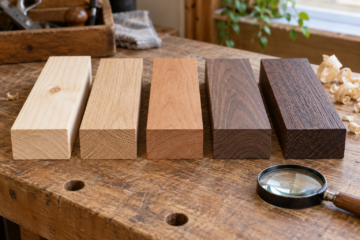
Soft maple is a broad label for several maple species, commonly red maple and silver maple. It is usually light-colored, with a fine, closed grain. That smooth surface can look clean under a clear finish, but stain may absorb unevenly. A board can have pale patches beside dark ones, especially around end grain, figure, or areas sanded differently.
Cherry has a fine, fairly even texture too, but its starting color is warmer. Stain can make it browner or redder, though a heavy dark stain may muddy the grain instead of making it look richer. Cherry also darkens as it is exposed to light. A freshly finished sample can look noticeably lighter than the same piece after months or years in a bright room.
| Factor | Soft maple | Cherry |
|---|---|---|
| Starting color | Pale cream to light tan, sometimes with gray or pink tones | Light pinkish brown to reddish brown |
| Stain risk | Blotching and uneven absorption | Color shift with age; dark stain can look muddy |
| Best fit | Custom color, pale finishes, or painted work | Warm natural finish with moderate color variation |
| Relative cost | Often less expensive, though local prices vary | Often costs more, especially for clear, color-matched stock |
Choosing a warm color
If you want a honey, amber, or light brown finish, cherry often needs only a clear finish or a restrained color adjustment. A clear oil or oil-based varnish adds warmth, while water-based clear coats tend to preserve a lighter look. Neither keeps cherry from changing color over time. Place a sample in the room where the finished piece will live; a sunny window can speed up the visible shift.
Soft maple is the more controllable starting point for a particular color, but it takes more testing. For a pale warm tone, try a lightly tinted finish or a thin stain rather than a heavy dark application. If you need to compare off-the-shelf colors, start with a wood stain color sampler, then test the actual product on scrap from the project. Color on a store card is not a reliable prediction of color on maple.
For a deeper, more even color on maple, a dye can be easier to control than a pigment stain because dye colors the wood without leaving as much material in the grain. It can still highlight uneven absorption, and it offers less protection than a topcoat. A washcoat—a thin sealing coat applied before stain—can reduce blotching, but it also reduces color uptake. Too much sealer makes the result weak or patchy.
Prepare and test before finishing
Sand both woods evenly. A practical starting sequence for furniture parts is 120 grit, then 150, then 180. Stop at 180 for most stains unless the product label says otherwise; sanding much finer can leave maple too smooth to take color evenly. Use the same grit and pressure across each face, and remove dust before testing. Scratches that are hard to see on bare wood often stand out after stain.
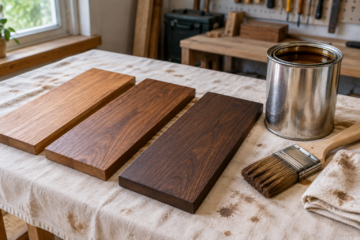
Make test boards from offcuts of the same stock. Sand, condition or seal, stain, and topcoat them exactly as you plan to treat the finished piece. A raw stained scrap does not show the final color: clear finish usually deepens the tone and can make a warm stain look more orange or brown. Test at least two applications or strengths if you are working with maple.
For blotch-prone maple, a pre-stain wood conditioner is an easy first experiment. Follow its label for timing and compatible stain types. Conditioner can improve uniformity, but it may make the color lighter; it is not a guarantee against blotching. A sanding sealer or washcoat can also help, but requires more control over film thickness. If a test still looks uneven, consider a gel stain, which tends to sit closer to the surface, or choose a clear finish instead.
For either species, wipe off excess stain as directed and keep a wet edge on large surfaces. Let the stain dry fully before applying a clear coat. Trapping solvent or moisture under the topcoat can cause poor adhesion, tackiness, or an unexpectedly cloudy finish.
Cost and project fit
Soft maple is often the practical choice for painted cabinets, utility furniture, or a custom stain when the budget is tight. If the project will be opaque, maple’s color and blotching matter much less; good sanding and a suitable primer matter more. Cherry is worth the added expense when its natural warmth and grain are part of the design, not simply because it is a more expensive hardwood.
For a matched set of doors or panels, buy enough stock from the same batch when possible. Both woods vary from board to board, and cherry’s natural color differences can be obvious beside one another. On maple, differences in density and grain can make the same stain look different across adjacent pieces. A small test on each board is the safest route for a visible, multi-piece job.
A practical decision
Pick cherry for a warm-toned interior finish that looks good with little or no stain and can age into a deeper color. Pick soft maple for a lower-cost or lighter-colored base when you want to specify the final tone, especially if you can test a conditioner, washcoat, or gel stain first. If you need a dark, perfectly uniform finish with minimal experimentation, neither is an effortless choice: use samples to confirm the result, or consider a paint-grade finish instead.
0 Comments