What's inside
- What “Hard Maple” and “Soft Maple” Actually Mean
- Hard Maple vs. Soft Maple at a Glance
- Start With the Lumber Label and Supplier
- Use Visual Clues, but Treat Them as Evidence
- Compare Weight and Resistance to Dents
- Notice How the Board Machines
- Plan for Different Finishing Behavior
- Choose Based on the Job
- Related Guides
- What “Hard Maple” and “Soft Maple” Actually Mean
- Hard Maple vs. Soft Maple at a Glance
- Start With the Lumber Label and Supplier
- Use Visual Clues, but Treat Them as Evidence
- Compare Weight and Resistance to Dents
- Notice How the Board Machines
- Plan for Different Finishing Behavior
- Choose Based on the Job
- Related Guides
As an Amazon Associate I earn from qualifying purchases. This post may contain affiliate links at no extra cost to you.
What “Hard Maple” and “Soft Maple” Actually Mean
Hard maple usually means sugar maple or black maple, both dense North American species commonly sold as hard maple, rock maple, or sugar maple. Soft maple is a trade category covering several species, including red maple, silver maple, bigleaf maple, and box elder. “Soft” does not mean weak or unsuitable for furniture. It means the wood is generally less dense and easier to dent than hard maple.
The names are confusing because soft maple is not one species. A particularly dense red maple can feel closer to hard maple than a lightweight silver maple. Lumber grading, board width, moisture content, and whether the board came from the heartwood or sapwood also affect its appearance and working properties.
Hard Maple vs. Soft Maple at a Glance
| Characteristic | Hard maple | Soft maple |
|---|---|---|
| Typical Janka hardness | About 1,450 lbf | About 750–950 lbf, depending on species |
| Typical appearance | Usually pale, fine-grained, and fairly uniform | More color variation; often stronger grain and heartwood contrast |
| Weight | Heavy for its size | Light to moderately heavy |
| Best-known uses | Flooring, workbenches, cutting boards, durable furniture | Furniture, painted parts, trim, shelving, general shop projects |
| Cost and workability | Often more expensive and harder on blades | Usually cheaper and easier to machine |
Start With the Lumber Label and Supplier
The most reliable identification is the supplier’s species designation. Ask whether the board is hard maple, red maple, silver maple, or another named species. A retail label reading only “maple” is not enough if hardness matters.
Do not assume a premium-looking board is hard maple. Soft maple can have attractive curl, quilt, spalting, or figured grain, and some dealers sell it simply as maple. If the board is important to the project, save the invoice or species label. Once the board is cut into small parts, visual identification becomes much harder.
Use Visual Clues, but Treat Them as Evidence
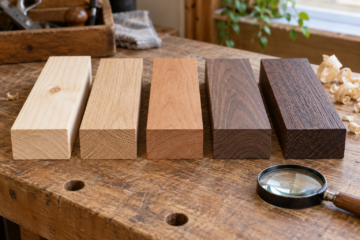
Hard maple commonly has a very light cream to pale tan color and a tight, subdued grain. The growth rings may be difficult to see on a plain-sawn board. It often looks clean and consistent, although figured hard maple can show strong flame, curl, or birdseye patterns.
Soft maple tends to show more variation. Red maple may have a creamy sapwood and pinkish, gray, or reddish heartwood. Silver maple can be pale but often has a more open, irregular grain. Some soft maple boards have darker mineral streaks or noticeable color changes between sapwood and heartwood.
These clues are not a test. A pale red maple board can resemble hard maple, and a stained hard maple board can resemble almost anything. End grain is also not a dependable field identifier for most buyers; the pores and rays are too subtle to distinguish confidently without a hand lens and experience.
Compare Weight and Resistance to Dents
Weight is one of the useful practical clues. Hard maple is commonly around 44 pounds per cubic foot when dry. Soft maple varies widely, often roughly 33 to 38 pounds per cubic foot. Two boards with the same dimensions can therefore feel noticeably different, though moisture content can change the result.
Weigh boards of the same size if possible. A bathroom scale is adequate for a rough comparison. Calculate density by dividing weight by board volume; this will not identify the species with certainty, but it can expose a lightweight board being sold as hard maple.
A controlled dent test is more useful than pressing a fingernail into the face. On an offcut or hidden area, press a sharp edge or the rounded end of a screwdriver into the wood with similar force. Hard maple usually resists a visible dent better. This is only a relative test, and it permanently marks the sample. Do not test the show face of a finished board.
A Janka hardness rating measures the force needed to press a steel ball halfway into the wood. It is a comparison tool, not a guarantee about an individual board. Hard maple’s typical rating is about 1,450 pounds-force, while common soft maples range from approximately 750 to 950 pounds-force.
Notice How the Board Machines
Hard maple feels dense under a plane and can quickly dull an inexpensive blade. Dull cutters may leave burn marks, especially when feeding slowly or taking a very light cut. Sharp carbide tooling, a moderate feed rate, and shallow passes reduce burning. A carbide router bit set is a sensible purchase if you routinely machine hard maple.
Soft maple cuts more easily and usually sands faster, but it can tear around knots, fuzzy areas, or reversing grain. Its softer surface also shows planer knife marks and sanding scratches readily. Start around 120 grit and progress through 150 or 180 grit for most clear finishes. Sanding much finer than 180 grit can reduce stain absorption and create a blotchy result rather than improving it.
Both types can burn during routing or sawing. Burning is not proof that the board is hard maple; a dirty blade, slow feed, or misaligned fence can cause it in either species.
Plan for Different Finishing Behavior
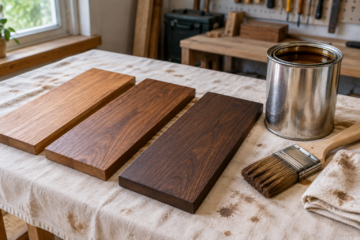
Both hard and soft maple have relatively low natural porosity and can look blotchy under penetrating stain. Soft maple often absorbs stain less evenly because density varies more between earlywood, latewood, and heartwood. Test the complete finishing schedule on an offcut, including sanding, conditioner, stain, and topcoat.
For a more even color, use a wood stain pre-conditioner or choose a gel stain. A washcoat made from finish diluted according to the product instructions can also reduce uneven absorption, but it may make the final color lighter. Dye generally produces clearer, more uniform color than pigment stain, though it can highlight sanding defects.
Clear water-based finishes preserve maple’s pale appearance but may leave a cool or slightly gray cast. Oil-based finishes add amber color and can make soft maple’s heartwood variation more obvious. For painted parts, soft maple is often the better buy: it machines cleanly, holds screws adequately with proper pilot holes, and its extra dent resistance is unnecessary under paint.
Choose Based on the Job
Buy hard maple for flooring, cutting boards, workbench tops, high-wear drawer parts, and furniture surfaces that will receive frequent impact. Its higher hardness costs more and requires sharper tools, but it stays cleaner-looking longer under abuse.
Choose soft maple for painted furniture, cabinet components, trim, signs, shelves, and general-purpose projects where moderate hardness is sufficient. It is often the cheaper option, and the savings can be meaningful on a large project. For a clear-finished tabletop, compare actual boards rather than relying only on the species name. A straight, stable soft maple board may be a better purchase than a warped or defect-filled hard maple board.
When identification matters, combine the supplier’s species information with weight, appearance, and a hidden-area dent test. No single visual clue reliably separates every maple board, but several consistent clues usually provide enough information to buy intelligently and choose the right finish.
0 Comments