What's inside
As an Amazon Associate I earn from qualifying purchases. This post may contain affiliate links at no extra cost to you.
Choosing the substrate for a lacquered built-in
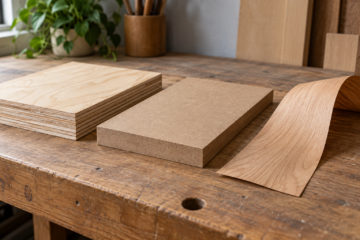
For a painted or lacquered built-in, MDF is usually the better starting material. It is flat, stable, consistent, and has no grain that can telegraph through a smooth finish. Hardwood is stronger and more attractive when left visible, but much of that advantage disappears under opaque lacquer.
The choice is not simply MDF versus “wood.” A built-in may use MDF for doors and panels, hardwood for face frames or edging, and plywood for large cabinet boxes. The best material depends on which parts will be seen, handled, screwed into, or exposed to moisture.
As an Amazon Associate we earn from qualifying purchases at no extra cost to you.
| Factor | MDF | Hardwood |
|---|---|---|
| Surface under lacquer | Very smooth and grain-free | Grain and pores may show |
| Dimensional stability | Good in a dry interior | Moves across the grain with humidity |
| Edge treatment | Needs sealing; corners can be fragile | Can be routed, sanded, or solid-edged |
| Strength and screw holding | Moderate; weak near edges | High, depending on species |
| Cost and waste | Usually economical and predictable | More expensive, with more visible defects |
| Moisture tolerance | Poor if water reaches the core | Better, but not waterproof |
When MDF is the right choice
Use MDF for cabinet doors, drawer fronts, end panels, applied trim, and face frames that will receive an opaque finish. Its fine fibers machine cleanly, and a properly prepared panel can produce the dead-flat appearance associated with sprayed lacquer.
Standard interior MDF is adequate for a normal living room, bedroom, office, or hallway. Moisture-resistant MDF is worth considering for a kitchen, laundry room, or bathroom, especially near a sink. It still must be sealed on every exposed edge; “moisture resistant” does not mean waterproof.
Choose a panel at least 3/4 inch thick for most doors and large visible panels. Thin MDF can work for small applied details, but long, unsupported pieces are more likely to bow or break. MDF is heavy, so include adequate hinges, drawer hardware, and wall anchoring in the design.
The weak point is the edge. MDF edges absorb primer heavily and can become fuzzy or swollen if sanded aggressively. They also do not hold ordinary screws as well as hardwood. For hinges, use screws designed for MDF or install solid-wood mounting blocks where hardware will be repeatedly removed.
For a dependable starting point, compare moisture-resistant MDF board with standard panels based on the room’s exposure, not just price.
When hardwood makes sense
Hardwood is the better choice for exposed clear-finished parts, structural rails, narrow stiles, hand-grab edges, and areas that will take abuse. It also makes sense when the built-in must match existing oak, maple, cherry, or another visible species.
Under lacquer, hardwood needs more preparation than MDF. Open-grained species such as oak, ash, and walnut can leave visible pores after several coats. If you want a completely level surface, plan on a suitable grain filler or high-build surfacer, followed by sanding. Even then, seasonal movement can reveal joints or slight texture changes.
Wood movement is the main trade-off. A 12-inch-wide hardwood panel can change noticeably in width as indoor humidity moves from a dry winter level to a humid summer level. Do not glue a wide solid-wood panel tightly into a fixed opening. Use elongated screw holes, clips, or another method that allows cross-grain movement.
Hardwood is not automatically a better cabinet-box material. Solid boards are difficult to keep flat over large widths and can be wasteful. Hardwood plywood is often a more practical choice for carcasses, with solid wood reserved for exposed edges and frames.
Preparing either material for lacquer
Start with clean, sharp joinery. Fill dents, nail holes, and open joints before priming. Sand MDF faces to approximately 180 grit; sanding much finer can reduce primer adhesion. Break sharp MDF corners lightly with 180 or 220 grit because a razor edge is easy to damage and difficult to cover.
MDF edges need special attention. Apply a suitable MDF edge sealer or primer to cut edges, let it dry, then sand flat. Two thin applications are often better than one heavy coat. Do not flood the edge, since water-based products can raise the fibers.
On hardwood, remove mill marks and finish-sanding scratches before primer. Sand with the grain, progressing through 120, 150, and 180 grit as needed. Vacuum thoroughly and wipe according to the coating manufacturer’s instructions. Silicone, wax, oil, and household polish residue can cause fisheyes or craters in lacquer.
Use a compatible primer rather than assuming any primer will work beneath lacquer. A lacquer sanding sealer can be useful with compatible lacquer systems, while a waterborne system may require its specified primer. Test the complete stack—substrate, filler, primer, lacquer, and topcoat—on scrap before building the unit.
Application and common failure modes
Spraying generally gives the most even lacquer finish, but it requires ventilation, suitable respiratory protection, and control of dust. Brushing or rolling can work with some waterborne products, though it is harder to avoid texture on broad panels. Follow the coating’s recoat window; sanding too soon can gum the paper, while waiting too long may require additional scuffing.
Common MDF failures include swollen edges, chipped corners, exposed fibers, and screw pull-out. Prevent them with edge sealer, careful handling, pilot holes, and solid blocking at hardware locations. A dropped MDF door is more likely to suffer a crushed corner than a hardwood door.
Common hardwood failures include resin bleed from some species, grain telegraphing, end-grain absorption, and cracks where a solid panel is trapped. Seal end grain, use an appropriate stain-blocking primer when needed, and allow panels to move. Do not expect extra lacquer coats to correct movement or poor joinery.
A practical specification
For most opaque-lacquered built-ins, use 3/4-inch MDF for doors, drawer fronts, and visible flat panels; use plywood for large cabinet boxes when weight and screw holding matter; and use hardwood only for durable edges, narrow frames, or details that benefit from its strength. If the room is damp, upgrade the MDF and seal all faces and edges before installation.
Choose hardwood throughout when the finish will be transparent, the design includes substantial exposed trim, or the built-in must survive heavy contact at thin edges. Otherwise, MDF is not a compromise—it is often the more predictable material for a smooth lacquer finish.
0 Comments