What's inside
- Key takeaways
- Best woods for acoustic guitars: what each part of the guitar needs
- Spruce, cedar and the guitar top
- Mahogany and rosewood for back and sides
- Fretboard and bridge woods
- Laminate, solid and HPL: what construction really means
- Woods for electric guitars
- What matters to a woodworker: moisture, seasoning and finish
- If you are buying tonewood to build or repair
- How to choose: a short decision guide
- Frequently Asked Questions
- Sources
As an Amazon Associate I earn from qualifying purchases. This post may contain affiliate links at no extra cost to you.
The best woods for acoustic guitars are spruce for the top, mahogany or rosewood for the back and sides, and ebony or rosewood for the fretboard, because each species does a specific mechanical job. Spruce is light and stiff, so the top can vibrate freely. Mahogany and rosewood are denser, so the back and sides reflect and shape the sound. Laminate is not a “bad wood”, it is a different construction that trades some responsiveness for stability and price. This guide explains why from a woodworker’s point of view: density, stiffness, grain and moisture, rather than tone clichés.
Our Top Picks

As an Amazon Associate we earn from qualifying purchases at no extra cost to you.


Key takeaways
- The top does most of the work. A solid spruce or cedar top matters more to an acoustic guitar than the choice of back and sides.
- Back and sides are about reflection and character: mahogany sounds focused and woody, rosewood sounds broader with more complex overtones, according to maker descriptions.
- Janka hardness numbers explain wear, not tone. Use them for fretboards and bridges, and use stiffness-to-weight ratio when thinking about tops.
- Laminate and high-pressure laminate (HPL) are legitimate construction choices for travel guitars, beginner guitars and humid or dry climates.
- Rosewood is restricted. Buy and sell instruments with that in mind.
Best woods for acoustic guitars: what each part of the guitar needs
A guitar is a box with a vibrating lid. The strings drive the bridge, the bridge drives the top, and the top moves the air inside the body. Everything else has a supporting role. That is why makers talk about tops first, then back and sides, then neck and fretboard. The same reasoning works for woodworkers who build or repair instruments: pick each wood for the job its part does.
The wood properties below come from the Wood Database (Janka hardness figures are rounded and approximate), maker websites such as Martin and Taylor, and luthier guidance. We have not built or played these instruments ourselves, so the tonal descriptions are what makers and published reviews say, not our own listening tests.
| Wood | Typical role | Approx. Janka hardness (lbf) | Character per makers and reviewers | Workability note |
|---|---|---|---|---|
| Sitka spruce | Top | About 510 | Clear, strong and versatile | Straight grain, easy to bend and brace |
| Engelmann spruce | Top | About 390 | Lighter and quicker to respond | Softer, dents easily |
| Western red cedar | Top | About 350 | Warm, responsive, earlier “played-in” feel | Very soft, fragile edges |
| Mahogany | Back, sides, neck | About 800 (Honduran) | Focused, woody, strong midrange | Stable and easy to work |
| Indian rosewood | Back, sides, fretboard | About 2,400 | Broad, rich overtones | Oily, dense, can affect gluing and finishing |
| Hard maple | Back, sides, neck | About 1,450 | Bright, clear and tight | Hard, takes a fine finish |
| Koa | Back, sides, top | About 1,200 | Warm and bright, opens with playing | Figured grain, valuable |
| Ebony | Fretboard, bridge | About 3,000 | Smooth, dense and durable | Hard on tools, rarely used for large parts |
| Laminate (plywood layers) | Top, back and sides | Depends on layers | Even and consistent, less responsive | Resists cracking and humidity swings |
Spruce, cedar and the guitar top
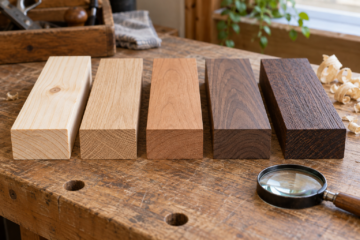
A guitar top is typically about 2.5 to 3 millimetres thick and braced from below. It has to be light enough to move easily and stiff enough not to collapse under the pull of the strings. Spruce is the standard answer because it has a high stiffness-to-weight ratio and a straight, even grain. Luthiers also care about how the wood was cut: quartersawn billets, where the growth rings stand almost vertically in the sheet, give stability and uniform stiffness across the top.
Within the spruce family, the differences are subtle. Sitka spruce is plentiful, strong and widely used, and it handles hard strumming without losing clarity. Engelmann spruce is a bit lighter and gives a quicker response, which suits fingerstyle. Red (Adirondack) spruce is known for headroom under hard playing and is often seen on higher-end guitars. Cedar is softer and weaker, and it gives a warm tone with a fast response, but it can lose clarity under aggressive strumming.
For a woodworker, the key point is that top wood is chosen for mechanical properties, not by name alone. Two boards of the same species can behave differently if one has wider rings or runout. This is why top billets are tapped and flexed by hand in a workshop before they are used.
Mahogany and rosewood for back and sides
Back and sides are thin, usually about 2 millimetres, and mostly act as a rigid frame that reflects sound inside the body. Dense woods reflect more and absorb less, which is the traditional explanation for why rosewood is considered richer and mahogany more focused.
- Mahogany is stable, easy to bend and widely available. It is often described as having a strong fundamental and a pronounced midrange. It is also the usual choice for necks because it is light and stable.
- Indian rosewood is much denser and oilier. It is associated with a broad, complex sound with strong bass and treble, as described by makers such as Martin and Taylor. It is difficult to glue and finish because of its oils, and woodworkers often wipe the joint surface with solvent before gluing.
- Maple is hard and bright. It is often paired with a spruce top for a clear, articulate tone.
- Koa is a Hawaiian species that makers describe as bright at first and warmer with playing.
Best mahogany guitars are often found in the mid-priced tier because mahogany is plentiful and works well in all-solid construction. That is one reason an all-mahogany guitar is a popular first “serious” instrument.
Fretboard and bridge woods
These parts need hardness and wear resistance more than tonal influence. Ebony is the premium choice, very hard and very stable, and it has become scarce and expensive. Rosewood is a common alternative, and some makers use pau ferro, richlite or other substitutes. Maple fretboards are usually lacquered and need less care. If you are restoring or repairing a guitar, remember that unfinished ebony and rosewood benefit from light conditioning, but a lacquered maple board does not.
Laminate, solid and HPL: what construction really means
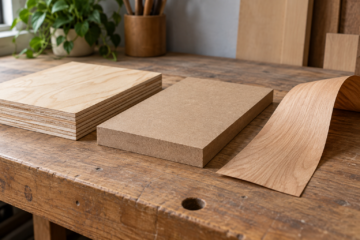
A laminate guitar is built from thin layers of wood glued with alternating grain, the same principle as plywood. It does not crack easily, it responds less to humidity, and it can be cheaper to make. A solid-wood guitar uses single pieces and vibrates more freely, which is the reason most makers favour it for top wood in particular.
| Construction | What it is | Strengths | Trade-offs |
|---|---|---|---|
| Solid top, laminate back and sides | Single-piece top, plywood body | Most of the tone benefit at lower cost | Body is less responsive than all-solid |
| All solid | Every large part is a single piece | Best response, matures with age | More sensitive to humidity and impact |
| All laminate | Plywood top, back and sides | Durable, affordable, stable | Less volume and dynamic range |
| HPL (high-pressure laminate) | Resin-bonded layered composite, sometimes wood-patterned | Weather resistant, consistent | Different feel from solid wood |
| Carbon fibre | Resin and carbon weave | Immune to humidity, very durable | Cost and tonal character differ from wood |
Best carbon fiber guitars are generally from specialist makers and are aimed at travel, outdoor use and players in extreme climates. They do not suit every taste, and many players prefer the sound of wood, but they remove humidity as a concern. If you want a guitar that can stay in a car or a boat, carbon fibre or HPL is worth a look.
Woods for electric guitars
An electric guitar’s sound depends much more on pickups and amplification, so wood choice is more about weight, comfort and looks. Alder and ash are classic body woods for bolt-on guitars, and mahogany and maple are common for set-neck designs. Basswood is light and easy to shape, and is widely used on lower-cost instruments. Some players believe the wood makes a clear difference and others do not, and that argument has run for decades. As a practical matter, weigh the wood in your hands: a heavy body can tire you out at a long gig, and a light one may feel less solid.
What matters to a woodworker: moisture, seasoning and finish
- Moisture content. Instrument woods are commonly dried to roughly 6 to 8 percent moisture content and built in a room held near 45 percent relative humidity, so the instrument matches typical indoor conditions. A guitar made with wetter wood will shrink and crack.
- Seasoning. Air-dried, aged tonewood is preferred by many luthiers because it is more stable. Kiln drying is common and works if it is done carefully.
- Grain orientation. Quartersawn parts are more stable than flatsawn. Slab-cut or flatsawn wood warps more readily.
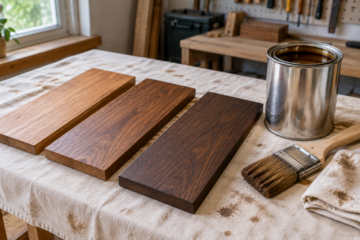
- Finish thickness. A thin finish, such as nitrocellulose lacquer or a thin polyurethane, lets the top vibrate. A thick finish is more protective but deadens the response.
- Species legality. Many rosewoods are in CITES listings, and instruments or raw wood may need paperwork to cross borders. Always check current rules before importing or exporting.
If you are buying tonewood to build or repair
Woodworkers who buy billets or sets rather than whole guitars can use a short checklist. Look at the end grain of a top set: rings should be close and even, and the surface should show no wavy grain or runout. Tap the board lightly while holding it near one edge; a clear, ringing note suggests stiff, resonant wood. Check the thickness for the intended use and ask whether the wood is air-dried or kiln-dried. For back and sides, quartersawn sets are more stable, and bookmatched halves should look consistent across the joint. For any rosewood, ask the seller for documentation and check the rules in your own country before you order.
How to choose: a short decision guide
| If you want | Consider | Why |
|---|---|---|
| Strumming and flatpicking power | Sitka spruce top, mahogany back and sides | Strong, balanced and forgiving |
| Fingerstyle response | Cedar or Engelmann top | Quick response at lighter touch |
| Rich, full sound | Spruce top, Indian rosewood back and sides | Dense back and sides add complexity |
| A guitar to travel with | Laminate, HPL or carbon fibre | Tolerates humidity and knocks |
| A lower cost with decent tone | Solid top, laminate back and sides | The top supplies most of the tonal benefit |
| Lightweight electric | Basswood, alder or swamp ash | Easy on the shoulder |
Frequently Asked Questions
What is the best wood for acoustic guitars overall?
There is no single best wood. The most common and dependable combination is a solid spruce top with mahogany or rosewood back and sides. Sitka spruce and mahogany are the safe all-rounders, and rosewood adds richness at a higher cost.
Is a solid top really better than laminate?
Makers and reviewers generally agree that a solid top gives a clearer response and a better sound, particularly as the guitar ages. Laminate tops are more resistant to cracking and humidity, which is useful for a beginner guitar.
Which wood is best for electric guitars?
Alder, ash, mahogany and maple are the traditional choices, with basswood common at lower prices. The pickups and amplifier shape the sound more than the body wood, so choose by weight, comfort and look.
Are carbon fibre guitars any good?
They are durable, hold tune through humidity swings and suit travel. Some players find the tone slightly different from wood, but many professionals use them on the road.
Why is rosewood so expensive?
Supply is restricted under international trade rules, and good quartersawn billets are limited. Dense, stable rosewood is also hard to work, which adds cost.
Does tonewood really change how a guitar sounds?
Yes, especially the top, because it radiates most of the sound. Differences between back and sides are smaller and are debated. A good setup, strings and the player matter just as much.
Sources
- The Wood Database, species profiles and Janka hardness data
- C. F. Martin and Company, wood and guitar construction guides
- Taylor Guitars, wood and sustainability guides
- CITES, listings for Dalbergia and related rosewood species
- Guild of American Luthiers and published luthier guidance on moisture and tops
Last updated: October 2026

0 Comments