What's inside
- Quick answer: which benchtop band saw fits which shop
- How we chose
- The five specs that matter
- Comparison table
- The best benchtop band saws
- When a benchtop saw is the wrong size
- Worked example: will your board fit, and what will you get?
- Setup tips that matter more than the model
- Decision matrix
- Frequently asked questions
As an Amazon Associate I earn from qualifying purchases. This post may contain affiliate links at no extra cost to you.
For most small shops the WEN BA3962 is the best benchtop band saw to start with because its 6-inch cut height is the tallest in the class, while the Rikon 10-3062S is the better pick if you want a stronger half-horsepower motor and a more refined table and guide setup. The SKIL BW9501 and Rikon 10-310 cover the entry-level and compact end, and the Shop Fox W1715 is a half-horsepower alternative. If you plan to resaw boards wider than about 6 inches, skip the benchtop class and look at a 14-inch floor model such as the JET JWBS-14SFX, Grizzly G0555XH or Powermatic PWBS-14CS.
A benchtop band saw does three jobs well in a small shop: cutting curves in 3/4-inch stock, ripping narrow parts and trimming joinery waste, and resawing narrow boards into thinner slices. It does those jobs in a footprint that fits on a bench or a rolling cart. What separates models is not the headline motor number alone but the combination of cut height, throat depth, motor power, blade tracking and the way the table tilts. This guide explains each criterion with a concrete threshold, then walks through eight saws.
As an Amazon Associate we earn from qualifying purchases at no extra cost to you.


Quick answer: which benchtop band saw fits which shop
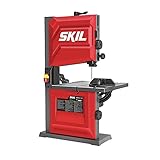
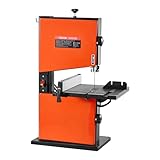
- Best overall value: WEN BA3962 (6 in. cut height, 9-3/4 in. throat, two speeds).
- Best step-up motor and table: Rikon 10-3062S Deluxe (1/2 HP, 5 in. cut height, two speeds, table tilt from -5 to 45 degrees).
- Best compact budget option for curves: Rikon 10-310 (1/3 HP, single speed, 4-5/8 in. cut height).
- Best entry-level saw for light hobby work: SKIL BW9501 (9 in. throat, 3.5 in. cut height, two speeds).
- Alternative half-horsepower saw: Shop Fox W1715 (1/2 HP, 9-1/2 in. throat, 4-1/2 in. cut height).
How we chose
This list is built from published manufacturer specifications and from how several independent buying guides rank the same machines, not from our own bench work. We kept only band saws that are sold as true benchtop or compact machines, then compared them on the five spec criteria that decide what a hobbyist can actually cut: cut height, throat depth, motor power, blade speed options and table tilt. Where two sources disagreed on a number, we used the lower figure or described the saw by spec class instead of quoting a doubtful value. Prices are shown only as tiers because retailer prices swing widely.
The five specs that matter
Cut height (resaw capacity)
Cut height is the distance from the table to the upper blade guide when it is raised all the way. It is the maximum thickness you can cut when a board lies flat, and the maximum board width you can resaw when it stands on edge. Benchtop saws land between about 3.5 and 6 inches. A practical threshold: for resawing 4/4 and 5/4 stock into thinner slices you want at least 4.5 inches; for resawing 6-inch-wide boards you want a 6-inch saw or a floor model.
Throat depth
Throat depth is the distance from the blade to the column. A 9-inch to 9-3/4-inch throat means the widest piece you can rotate while cutting a curve is roughly 18 to 19 inches across when you work from the center out, and a rip cut can run about 9 inches from the blade to the column. All the benchtop saws here fall in the 9 to 9-3/4-inch range, so throat depth is rarely the deciding factor. It matters when you compare against a 14-inch floor saw, which cuts roughly 13.5 to 14 inches deep.
Motor power
Motors on this class run from about 2.8 amps (SKIL) up to half horsepower (Rikon 10-3062S, Shop Fox W1715). More power matters when you cut dense hardwood or hold a tall cut, where a weak motor bogs and the blade wanders. For occasional curves in softwood and plywood, a 3-amp-class motor is enough. For regular hardwood work, aim for the half-horsepower class or a 3.5-amp saw paired with a sharp 1/4-inch blade.
Blade speed
Two-speed saws let you slow the blade for non-ferrous metals or plastics and run it faster for wood. The WEN BA3962 is listed at 1,520 and 2,620 feet per minute. A single-speed saw such as the Rikon 10-310 is simpler and fine if you cut only wood.
Blade tracking and guides
Benchtop saws use small wheels and a short blade loop, so they are sensitive to tracking and guide setup. Look for a front tracking knob you can reach, a clear upper-wheel window, and guide blocks or bearings that you can set within a hair of the blade. A saw with sloppy guides will drift on long rips no matter how strong its motor is.
Table size and tilt
Most benchtop tables tilt to 45 degrees. The Rikon 10-3062S and 10-310 are listed with a tilt range of -5 to 45 degrees, which helps when a blade cuts slightly crooked and you need to correct it, or when you want a small compound cut. Tables are small, so plan on a shop-made auxiliary table or sled for large panels.
Comparison table
| Model | Throat | Cut height | Motor | Speeds | Table tilt | Tier |
|---|---|---|---|---|---|---|
| WEN BA3962 | 9-3/4 in. | 6 in. | 3.5 A | 2 (1,520 / 2,620 ft/min) | Up to 45 deg. | Entry to mid-range |
| Rikon 10-3062S | 9-5/8 in. | 5 in. | 1/2 HP | 2 | -5 to 45 deg. | Mid-range |
| Rikon 10-310 | 9-5/8 in. | 4-5/8 in. | 1/3 HP | 1 | -5 to 45 deg. | Entry to mid-range |
| SKIL BW9501 | 9 in. | 3.5 in. | 2.8 A | 2 | Adjustable | Entry-level |
| Shop Fox W1715 | 9-1/2 in. | 4-1/2 in. | 1/2 HP | Variable pulley system | Adjustable | Mid-range |
The best benchtop band saws
1. WEN BA3962: best value and best cut height
Specs: 9-3/4 in. throat · 6 in. cut height · 3.5 A motor · 2 speeds (1,520 / 2,620 ft/min) · table tilts to 45 degrees · includes fence, miter gauge and work light
Best for: hobbyists who want to resaw boards up to about 5-1/2 inches wide without buying a floor saw, and shops that need maximum capacity per dollar.
Skip if: you regularly cut thick hardwood and want a half-horsepower motor, or you want a saw that needs very little guide tuning out of the box.
- Pros: the tallest cut height in the benchtop class; two blade speeds; a useful accessory kit; entry-to-mid-range pricing tier.
- Cons: an amp-rated motor that is weaker than the half-horsepower competitors under heavy tall cuts; guides and tracking usually reward some fine tuning; confirm current spec sheet details before buying because retailers list slightly different numbers.
2. Rikon 10-3062S Deluxe: best step-up motor and table
Specs: 9-5/8 in. throat · 5 in. cut height · 1/2 HP motor · 2 speeds · table tilt -5 to 45 degrees
Best for: woodworkers who cut hardwood curves and narrow resaw cuts every week and want a more capable motor and better table adjustment than the base class.
Skip if: you need to resaw anything wider than 5 inches, or you only cut a few curves a year. Some retailers also list a similar Deluxe model, the 10-3061, with specs that differ slightly between sources; verify cut height on the exact listing.
- Pros: half-horsepower motor; two speeds; negative table tilt for correcting drift; a long warranty on the Rikon line per several guides.
- Cons: costs noticeably more than the WEN and SKIL; less cut height than the WEN.
3. Rikon 10-310: best compact saw for curves and small parts
Specs: 9-5/8 in. throat · 4-5/8 in. cut height · 1/3 HP motor · single speed · table tilt -5 to 45 degrees · 61.75 in. blade
Best for: a tight garage or apartment shop where the saw sits on a bench and cuts scrollwork, toy parts, jewelry-box curves and small joinery waste.
Skip if: you plan to resaw 4/4 or 5/4 stock regularly or cut non-wood materials that need a slower blade.
- Pros: a compact footprint; simple single-speed operation; the same tilting table range as the deluxe model; a well-known brand with accessible parts.
- Cons: single speed; 1/3-horsepower motor limits tall hardwood cuts; cut height just under 5 inches.
4. SKIL BW9501: best entry-level saw for light hobby use
Specs: 9 in. throat · 3.5 in. cut height · 2.8 A motor · 2 speeds · 59-1/2 in. blade · adjustable table
Best for: beginners who want to learn blade setup and curve cutting on an entry-level machine before spending more.
Skip if: you need to cut 2x stock on edge, resaw, or cut thick hardwood. A 3.5-inch cut height will not clear a standard 2×4 lying on edge with margin.
- Pros: the lowest cost tier here; two speeds; light enough to move around.
- Cons: lowest cut height and weakest motor in this list; benchtop-grade guides that need patience.
5. Shop Fox W1715: alternative half-horsepower saw
Specs: 9-1/2 in. throat · 4-1/2 in. cut height · 1/2 HP motor · variable-speed pulley system · adjustable table
Best for: shops that want a half-horsepower motor and a wide speed range for cutting wood and thin non-ferrous or plastic stock.
Skip if: you need more than 4-1/2 inches of cut height. Our spec details for this model come from a single guide, so confirm numbers against the manufacturer sheet before you buy.
- Pros: half-horsepower motor; flexible speed changes.
- Cons: cut height trails the WEN and Rikon deluxe saw; fewer independent write-ups to cross-check.
When a benchtop saw is the wrong size
If your wish list includes resawing 8-inch or 10-inch boards into bookmatched panels, cutting 12-inch-tall blocks, or running a wide blade of 1/2 inch or more all day, a floor-standing 14-inch saw is the better tool. Three common options in that class are shown below.
6. JET JWBS-14SFX: floor-standing step-up
Specs: 14 in. throat · 13 in. cut height · 1-3/4 HP motor · 116 in. blade
Best for: serious resawing and any shop with floor space. Skip if: you cannot park a full-size saw.
7. Grizzly G0555XH: floor-standing step-up
Specs: 14 in. throat · 12 in. cut height · 1-3/4 HP motor
Best for: hobbyists who want large resaw capacity at a mid-range tier. Skip if: you only need small curve work.
8. Powermatic PWBS-14CS: premium floor-standing option
Specs: 13.5 in. throat · 6 in. standard cut height (taller with a riser block) · 1-1/2 HP motor
Best for: shops that value premium build and precise guides. Skip if: your budget is entry-level or you need maximum resaw height without adding a riser.
Worked example: will your board fit, and what will you get?
Suppose you want to resaw a 5-1/4-inch-wide piece of cherry into two bookmatched slices for a box lid. Use this logic.
- Check capacity with a margin. A saw needs about 1/4 inch of clearance under the upper guide so the guide post can ride on the stock. Add 1/4 to 5-1/4 and you need at least 5-1/2 inches of cut height. The WEN BA3962 (6 in.) clears it. The Rikon 10-3062S (5 in.) and Shop Fox W1715 (4-1/2 in.) do not.
- Estimate slice thickness. Start with a 1-inch-thick blank. A typical 1/4-inch resaw blade removes about 0.025 to 0.035 inch. Take 0.03 inch as the kerf: (1.00 – 0.03) / 2 = 0.485 inch per slice.
- Allow for flattening. Band saw faces are rough. Plan to remove about 1/16 inch from each face when you plane or sand. Each slice then finishes near 0.485 – 0.0625 – 0.0625 = 0.36 inch, close to a 3/8-inch panel.
- Match motor to the cut. A 5-inch-tall hardwood cut is the hardest job a benchtop saw does. Use a fresh 1/4-inch or 3/8-inch blade with a coarse tooth pattern, slow the feed, and expect to stop if the blade starts to burn or drift. On a 3.5-amp saw, take shallower first passes by flipping the board.
The conclusion: for a 5-1/4-inch resaw the WEN is the only benchtop saw in this list with clearance. For a 4-inch-wide board, the Rikon 10-3062S becomes the better choice because its stronger motor holds the cut more steadily.
Setup tips that matter more than the model
- Tension and tracking. Set the blade so it rides at the center of the upper wheel crown. Spin the wheel by hand before powering up.
- Guide clearance. Set the side guides about the thickness of a sheet of paper from the blade and the thrust bearing just behind the blade gullet. Set the upper guide just above the stock height.
- Blade choice. A 1/8-inch blade for tight scrolls, a 1/4-inch blade for general curves and light resaw, and a 3/8-inch blade for straighter work. Fewer teeth per inch cut thick stock faster; more teeth cut thin stock smoother.
- Safety. Keep fingers out of the blade path and at least 3 inches away from the blade when pushing stock. Use a push stick for narrow rips, lower the upper guide to within about 1/4 inch of the work, and unplug the saw before changing blades or adjusting guides. Wear eye and hearing protection and use dust collection.
Decision matrix
| If you mostly… | Choose | Why |
|---|---|---|
| Resaw boards up to 5-1/2 in. wide on a bench | WEN BA3962 | 6 in. cut height is the tallest here |
| Cut hardwood curves and narrow resaw weekly | Rikon 10-3062S | 1/2 HP motor, 5 in. cut height, negative tilt |
| Cut scrollwork and small parts in a tiny shop | Rikon 10-310 | Compact, single speed, simple |
| Want an entry-level saw for light curves | SKIL BW9501 | Lowest cost, two speeds |
| Want a half-horsepower saw with variable speed | Shop Fox W1715 | 1/2 HP and a pulley speed range |
| Need to resaw 8 in. or wider | JET JWBS-14SFX or Grizzly G0555XH | 12 to 13 in. cut height |
Frequently asked questions
What is the best benchtop band saw for a small woodworking shop?
The WEN BA3962 is the best all-round choice for most small shops because of its 6-inch cut height and low cost. Choose the Rikon 10-3062S if you want a stronger motor.
Both handle curves and light resawing. The WEN offers more height; the Rikon offers a half-horsepower motor and a table that tilts slightly past square in the other direction.
Can a benchtop band saw resaw hardwood?
Yes, within limits. A 6-inch benchtop saw can resaw boards up to roughly 5-1/2 inches wide, but it needs a sharp blade, a slow feed and careful guide setup.
Wide or dense boards, such as 8-inch-wide oak, are better cut on a 14-inch floor model.
How much resaw height do I need?
Plan for the widest board you will resaw plus about 1/4 inch. For 4/4 and 5/4 boards 4 to 5 inches wide, a 4.5-inch to 5-inch saw is enough.
If you want to resaw 6-inch-wide stock or taller, move to the 6-inch WEN or a floor saw.
Is a 1/2 HP motor necessary on a benchtop band saw?
Not for curves in softwood, but it helps on hardwood and tall cuts. A half-horsepower motor holds speed under load better than a small amp-rated motor.
If you cut hardwood weekly, favor the Rikon 10-3062S or Shop Fox W1715 class.
What blade width should I use on a benchtop saw?
A 1/4-inch blade is the best general-purpose width for a benchtop saw. Use 1/8 inch for tight scrolls and 3/8 inch for straighter or deeper cuts.
Check your manual for the maximum blade width the wheels and guides can handle, because small saws often top out at 3/8 inch or less.
Why does my band saw blade drift on a straight cut?
Blade drift usually comes from a dull blade, poor tracking, loose guides or an uneven feed. Re-set the guides, replace a worn blade and let the saw reach full speed before cutting.
If the cut still wanders, tilt or shift the fence to match the blade’s natural angle, which is where a table with a negative tilt range helps.
Should I buy a benchtop or a floor-standing band saw?
Buy a benchtop saw if space and budget are tight and you mostly cut curves and narrow stock. Buy a 14-inch floor saw if you resaw wide boards or cut thick lumber often.
A floor saw costs more and takes more room, but it removes the capacity limits that frustrate benchtop owners.
How do I use a benchtop band saw safely?
Keep the upper guide about 1/4 inch above the stock, keep your hands out of the blade line, and use a push stick on narrow work. Unplug the saw before changing blades.
Wear eye and hearing protection, never force a cut, and support long boards on a roller stand so they do not pull the blade off the wheel.

0 Comments