What's inside
- Quick picks by shop situation
- What makes a benchtop HVLP system suitable for a small shop?
- Head-to-head comparison
- Finish consistency: the factors that matter more than the brand
- A useful coverage calculation before you buy
- Noise, portability, and turbine storage
- Decision matrix for small-shop buyers
- Ownership realities: cleaning is the deciding factor
- Final recommendation
- Quick picks by shop situation
- What makes a benchtop HVLP system suitable for a small shop?
- Head-to-head comparison
- Finish consistency: the factors that matter more than the brand
- A useful coverage calculation before you buy
- Noise, portability, and turbine storage
- Decision matrix for small-shop buyers
- Ownership realities: cleaning is the deciding factor
- Final recommendation
As an Amazon Associate I earn from qualifying purchases. This post may contain affiliate links at no extra cost to you.
The best benchtop HVLP spray finishing system for most small shops is a compact two-stage turbine system with a 1.3–1.5 mm needle, a 1-quart cup, and a separate turbine box that can sit under a bench; among established options, the Earlex 5500 is the strongest value for furniture parts, while the Fuji Semi-PRO 2 is the better choice when you want a quieter, more refined system for regular cabinet work.
As an Amazon Associate we earn from qualifying purchases at no extra cost to you.
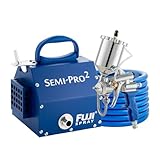


Quick picks by shop situation
| Shop situation | Best fit | Why | Main compromise |
|---|---|---|---|
| Lowest-cost entry for occasional projects | Wagner Control Spray Max HVLP | Compact integrated turbine, adjustable spray pattern, and broad availability | Less atomization headroom than a dedicated two-stage system |
| Small furniture and cabinet parts | Earlex 5500 | Two-stage turbine, 1-quart cup, 1.5 mm setup, and useful pattern control | More turbine noise and a less polished hose connection than premium systems |
| Frequent finishing and better overall refinement | Fuji Semi-PRO 2 | Two-stage turbine, metal spray gun, long hose, and consistent delivery | Heavier and more expensive than entry-level systems |
| Very small parts and minimal storage | Compact handheld HVLP turbine sprayer | Stores in a cabinet and sets up in seconds | Small cups, more frequent refilling, and less forgiving atomization |
What makes a benchtop HVLP system suitable for a small shop?
A benchtop HVLP system is not necessarily a spray gun that sits on the bench. In practice, it usually means a compact turbine unit that can be stored under or beside a workbench, connected to a lightweight hose and spray gun. The turbine supplies a high volume of air at relatively low pressure, so it can apply lacquer, waterborne finish, shellac, and thinned paint without requiring a large shop compressor.
For small furniture and cabinet components, the useful specification is not maximum advertised pressure. It is the combination of turbine stages, usable air volume, nozzle options, cup size, hose length, and how well the gun maintains atomization as the finish becomes thicker. One-stage systems are adequate for stain, clear coats, and well-thinned waterborne products. Two-stage systems provide more reserve for primer and heavier pigmented finishes.
Head-to-head comparison
| System | Approx. turbine footprint | Approx. weight | Stages | Typical cup | Typical nozzle | Best use |
|---|---|---|---|---|---|---|
| Wagner Control Spray Max HVLP | About 12 × 5 × 10 in | About 4 lb | 1 | 20 fl oz | 1.8–2.6 mm range, depending on setup | Small trim, craft work, occasional clear coats |
| Earlex 5500 | About 14 × 13 × 8 in | About 14 lb | 2 | 1 quart | 1.5 mm standard; optional sizes available | Furniture parts, doors, cabinet components |
| Fuji Semi-PRO 2 | About 13.5 × 7 × 10 in | About 16 lb | 2 | 1 quart | 1.3 mm standard; optional sizes available | Regular furniture and cabinet finishing |
| Compact handheld HVLP turbine sprayer | About 10–15 × 5–7 × 10–12 in | About 3–6 lb | 1 | 20–40 fl oz | Often 1.8–2.5 mm | Small batches and occasional projects |
Dimensions and weights vary slightly by package and production revision. Treat these figures as planning numbers rather than a substitute for the current manufacturer specification sheet.
Earlex 5500: the practical furniture choice
The Earlex 5500 occupies more shelf space than a handheld sprayer, but its two-stage turbine and one-quart cup make it much better suited to spraying multiple drawer fronts, cabinet doors, or furniture panels in one session. Its standard 1.5 mm needle is a useful middle ground: small enough for clear coats and large enough for many thinned waterborne finishes.
Its principal advantage is capacity. A quart cup contains 32 fluid ounces, so it can cover a useful batch of parts without repeated interruptions. The trade-off is weight and noise. A dedicated turbine is audible across a small shop, and the gun, hose, and cup occupy more storage space than an integrated handheld unit.
Fuji Semi-PRO 2: the better regular-use system
The Fuji Semi-PRO 2 is a strong candidate for the best benchtop HVLP spray finishing system when finishing is a recurring part of your work rather than an occasional weekend task. Its two-stage turbine provides useful air reserve, while the metal spray gun and long hose give it a more workshop-oriented feel than lightweight consumer sprayers.
The 1.3 mm setup is especially useful for clear finishes and thinner waterborne products. For heavier primer or pigmented coating, an optional larger setup may be more appropriate. The Fuji is not silent, and it is not the smallest system, but its airflow consistency makes it easier to maintain a wet edge across a cabinet door.
Wagner Control Spray Max: compact and inexpensive, with limits
The Wagner Control Spray Max HVLP is attractive when storage space and purchase cost matter more than maximum finish range. The separate hose and turbine arrangement is easier to control than a heavy all-in-one gun, and the system is suitable for stains, sealers, clear coats, and suitably thinned paint.
Its one-stage turbine has less reserve than the Earlex or Fuji. That matters when spraying thicker coatings, large panels, or several parts consecutively. It is a sensible choice for a small number of drawer fronts or occasional refinishing, but a two-stage unit becomes easier to justify if you spray every month.
Finish consistency: the factors that matter more than the brand
- Correct viscosity: Strain the finish, then thin only according to the coating manufacturer’s guidance. Excessive thinning causes runs and weak film build; insufficient thinning produces orange peel.
- Stable gun distance: Keep the nozzle about 6–8 inches from the work and move at a steady speed. Tilting the gun changes the fluid delivery and can create uneven bands.
- Overlap: Aim for roughly 50 percent overlap between passes. A narrow overlap produces striping, while extremely heavy overlap causes sags.
- Suitable nozzle: A 1.3–1.5 mm setup generally suits clear coats and many thin finishes. Heavier primer may need 1.8–2.0 mm or more, depending on the product.
- Clean filters and air passages: A restricted turbine filter or partially blocked air cap reduces atomization and makes the operator compensate by moving too slowly.
A useful coverage calculation before you buy
Suppose you are spraying eight cabinet doors measuring 24 × 18 inches on both sides. The total area is 8 × 2 × 3 square feet, or 48 square feet. If the finish is applied at an effective 350 square feet per gallon after transfer losses, one coat requires approximately:
48 ÷ 350 = 0.137 gallons, or about 17.5 fluid ounces.
A 20-ounce cup technically holds enough for that coat, but it leaves almost no margin for gun priming, test spray, overspray, and waste. A one-quart cup is more comfortable, especially when applying two or three coats. This is why small handheld systems can be adequate for individual parts but frustrating for a batch of cabinet doors.
Noise, portability, and turbine storage
All turbine systems produce a noticeable high-pitched motor sound. A compact one-stage unit is usually easier to move and store, while a two-stage system normally offers better atomization at the cost of additional weight and noise. If the spray area is close to the bench, place the turbine on a rubber mat or a stable shelf behind the operator. Do not place it in the spray cloud: finish mist can contaminate the motor intake and filters.
A 20–25 foot hose is useful when the turbine remains outside a temporary spray enclosure. It also reduces the chance that moving the gun will pull the turbine off a bench. For a small shop, a system with a hose that stores around or inside the turbine case is often more convenient than a slightly smaller unit with loose accessories.
Decision matrix for small-shop buyers
| Budget and frequency | Available space | Finish experience | Recommended direction |
|---|---|---|---|
| Under roughly $200; a few projects per year | Very limited | Beginner | Compact handheld or Wagner Control Spray Max; prioritize easy cleaning |
| Roughly $250–$450; monthly use | Room under a bench | Beginner to intermediate | Earlex 5500; the larger cup and two-stage turbine reduce interruptions |
| Roughly $400–$650; frequent use | Dedicated shelf or cabinet | Intermediate | Fuji Semi-PRO 2; better suited to repeatable furniture and cabinet work |
| Any budget; occasional small parts only | Must pack away after every use | Any level | Choose the smallest system that accepts the coating and nozzle size you need |
These are broad 2026 market ranges, not fixed prices. Bundles, nozzle kits, and regional availability can move a system into a different bracket.
Ownership realities: cleaning is the deciding factor
The parts that wear first are usually the needle tip, fluid nozzle, air-cap holes, cup gasket, and flexible hose seals. Dried finish on the needle or air cap changes the spray pattern long before the turbine itself fails. Keep replacement seals and at least one spare nozzle available if the system is used for paid or deadline-sensitive work.
Clean immediately after spraying. Empty the cup, wipe out remaining material, flush with the correct cleaning liquid, and remove the air cap and fluid nozzle for detailed cleaning. Do not leave the gun soaking as a complete assembly; liquid can reach seals or passages that are not designed for prolonged immersion. Follow the finish and sprayer manufacturer’s solvent instructions, particularly with lacquer products.
Common mistakes include spraying without a test panel, using an undersized nozzle for primer, turning fluid flow up to compensate for poor thinning, and storing the gun with finish in the cup. A five-minute test on cardboard or scrap wood often reveals an incorrect viscosity or fan setting before it ruins a cabinet door.
Final recommendation
Choose the Earlex 5500 if your priority is a capable, compact system for furniture parts and cabinet doors without moving into professional pricing. Choose the Fuji Semi-PRO 2 if you spray regularly and value smoother setup, a metal gun, and more consistent airflow. Choose the Wagner Control Spray Max or a similar handheld turbine sprayer when the work is occasional, the parts are small, and easy storage matters more than maximum coating capacity.
In every case, match the nozzle to the finish, allow enough cup capacity for the complete batch, and plan for ventilation and overspray control. Those decisions will affect the final surface more than a small difference in turbine specifications.
0 Comments