What's inside
- Top 3 Picks
- Quick Comparison
- How We Chose
- 1. WGGE WG-015 8-Inch Multi-Tool – Best for One-Tool Electrical Duty
- 2. IRWIN VISE-GRIP 2078309 Wire Stripping Tool / Wire Cutter – Best for Pro-Grade Grip Comfort
- 3. ANGELSWORD 8″ 3-in-1 Wire Stripper / Cutter / Crimper – Best Budget All-Rounder
- 4. haisstronica 3-in-1 Self-Adjusting Wire Stripper – Best for Wide-Range Repeat Work
- 5. Klein Tools 11061 8-Inch Self-Adjusting Wire Stripper/Cutter – Best Overall
- 6. Htaexpu 5-in-1 Wire Stripper / Crimper / Cutter (10–20 AWG) – Best for Budget Versatility
- 7. Klein Tools 11063W 7-Inch Heavy-Duty Automatic Wire Cutter/Stripper – Best for Tough, Thick Insulation
- 8. VCELINK Quick Strip Automatic Wire Stripper and Cutter – Best for Quick-Strip Finesse
- 9. XUDYVCO 5-in-1 Wire Stripper Tool (10–20 AWG) – Best for Lowest-Cost Entry
- Top 3 Picks
- Quick Comparison
- How We Chose
- 1. WGGE WG-015 8-Inch Multi-Tool – Best for One-Tool Electrical Duty
- 2. IRWIN VISE-GRIP 2078309 Wire Stripping Tool / Wire Cutter – Best for Pro-Grade Grip Comfort
- 3. ANGELSWORD 8″ 3-in-1 Wire Stripper / Cutter / Crimper – Best Budget All-Rounder
- 4. haisstronica 3-in-1 Self-Adjusting Wire Stripper – Best for Wide-Range Repeat Work
- 5. Klein Tools 11061 8-Inch Self-Adjusting Wire Stripper/Cutter – Best Overall
- 6. Htaexpu 5-in-1 Wire Stripper / Crimper / Cutter (10–20 AWG) – Best for Budget Versatility
- 7. Klein Tools 11063W 7-Inch Heavy-Duty Automatic Wire Cutter/Stripper – Best for Tough, Thick Insulation
- 8. VCELINK Quick Strip Automatic Wire Stripper and Cutter – Best for Quick-Strip Finesse
- 9. XUDYVCO 5-in-1 Wire Stripper Tool (10–20 AWG) – Best for Lowest-Cost Entry
As an Amazon Associate I earn from qualifying purchases. This post may contain affiliate links at no extra cost to you.
For most electrical and shop work, the best wire stripper tool overall is the Klein Tools 11061 8-Inch Self-Adjusting Wire Stripper/Cutter. It covers the widest practical spread of solid and stranded conductors, holds a depth setting across thousands of cycles, and suits anyone working from fixture wire up to 10 AWG branch cable. If you want the same three-in-one plier format for a fraction of the outlay, the ANGELSWORD 8″ Wire Stripper / Cutter / Crimper is the best budget pick and handles ordinary household gauge work without complaint. If your day involves tough or thick insulation — THHN, XLPE, UF burial cable, or repeated 10–12 AWG terminations — the Klein Tools 11063W 7-Inch Heavy-Duty Automatic Wire Cutter/Stripper is the tool that survives it. Everything below compares stripping range, wire compatibility, cutting precision, grip comfort, and safety features, so you can match a tool to your bench, your gauges, and how often you actually reach for it.
Top 3 Picks
Best Overall: Klein Tools 11061 8-Inch Self-Adjusting Wire Stripper/Cutter
The 11061 is the pick for the person who strips wire often enough to care about repeatability. The self-adjusting jaw grips the conductor and cuts the insulation to a consistent depth, which means fewer nicked strands and fewer re-dos on stranded control wire. It is a premium-tier tool, but it is the one most likely to still be on your bench in five years.
Best Budget: ANGELSWORD 8″ Wire Stripper, Wire Cutter, Wire Crimper
A three-function 8-inch plier at a budget-tier price. It suits the homeowner, the apprentice building a first bag, or the woodworker who strips a dozen cords a year and does not want to spend premium money on a tool that lives in a drawer. The crimp stations and spring-loaded handles are the value here.
Best Premium Heavy-Duty: Klein Tools 11063W 7-Inch Heavy-Duty Automatic Wire Cutter/Stripper
Shorter at 7 inches and built for harder service, the 11063W is the choice when insulation is thick, cold, or abrasion-resistant and when 10–12 AWG work dominates. It is premium-tier and aimed at people who strip wire as part of a job rather than a weekend.
Quick Comparison
| Product | Best For | Key Specs | Price Tier |
|---|---|---|---|
| WGGE WG-015 8-Inch Multi-Tool | One-tool electrical duty | 8 in plier format; strip + cut + crimp; stamped gauge notches; spring-loaded molded grip | Mid-range |
| IRWIN VISE-GRIP 2078309 | Pro-grade grip comfort | 8 in; cuts and strips 10–22 AWG; ProTouch grip; hardened cutting edge | Mid-range |
| ANGELSWORD 8″ 3-in-1 | Budget all-rounder | 8 in; strip + cut + crimp; fixed gauge notches; spring return | Budget |
| haisstronica 3-in-1 Self-Adjusting | Wide-range repeat work | Self-adjusting jaw; AWG 24–10; built-in cutter; depth stop | Mid-range |
| Klein Tools 11061 | Best overall | 8 in; self-adjusting; solid and stranded; depth-stop screw; curved handle | Premium |
| Htaexpu 5-in-1 (10–20 AWG) | Budget versatility | 5 functions; 10–20 AWG class; strip, cut, crimp, split, ream | Budget |
| Klein Tools 11063W | Heavy-duty insulation | 7 in; automatic; heavy-gauge jaws; hardened cutter | Premium |
| VCELINK Quick Strip Automatic | Quick-strip finesse | Automatic clamping jaw; squeeze-to-strip action; compact body | Mid-range |
| XUDYVCO 5-in-1 (10–20 AWG) | Lowest-cost entry | 5 functions; 10–20 AWG class; stamped notches; dipped grip | Budget |
| Klein Tools 11055EP | Stranded and solid copper | Made in USA; cuts copper; stranded and solid wire; multi-notch stripping | Premium |
| Amazon Basics Self-Adjusting | Household and occasional use | Self-adjusting; strips 10–24 AWG; integrated crimper; black/red grip | Mid-range |
| DOWELL 10–22 AWG | Budget bench spare | 10–22 AWG; stripping notches plus cutter; molded handle | Budget |
How We Chose
This roundup is built from published manufacturer specifications, brand reputation in the electrical trade, and the practical realities of how strippers get used in a shop. We did not test, benchmark, or own these tools, and nothing here is based on personal experience with the specific units — the analysis comes from comparing stated specs and category behaviour against real-world wire types.
Four filters decided inclusion. First, specification honesty: tools that publish a clear AWG range (IRWIN’s 10–22 AWG, haisstronica’s 24–10 AWG, Amazon Basics’ 10–24 AWG) rank higher than tools whose listings leave the range implied, because a range you can check is a range you can plan around. Second, category fit: the list spans three genuinely different tool formats — fixed-notch plier multi-tools, self-adjusting automatic strippers, and heavy-duty cut-and-strip tools — and each product is slotted where it actually belongs. Third, use case: a woodworker dressing lamp cords and a panel builder terminating hundreds of control wires need different things, so we separated occasional-use picks from repetition picks. Fourth, upgrade path: a budget tool should teach you whether you need the premium one. Where a listing does not state a number, we describe the spec class rather than invent a figure.
1. WGGE WG-015 8-Inch Multi-Tool – Best for One-Tool Electrical Duty
As an Amazon Associate we earn from qualifying purchases at no extra cost to you.

WGGE’s WG-015 is the classic American-style electrician’s plier that does three jobs in one body: strip, cut, and crimp. It suits the shop owner who wants a single tool on the pegboard that can dress the end of a lamp cord, trim a stranded lead, and close a crimp terminal without a trip to the bench for a second tool. It is a mid-range pick, and it is the right answer for anyone whose stripping is occasional and mixed rather than repetitive.
Key Specs
- Format: 8-inch plier-style multi-tool — strip, cut, and crimp in one body
- Overall length: 8 in (about 200 mm), the standard electrician’s size
- Stripping stations: multiple fixed-gauge notches stamped into the jaw; the listing does not publish a numeric AWG range, so check the gauge markings stamped on the tool itself
- Cutting: shear-type edge along one jaw for copper and stranded conductors
- Crimping: dedicated stations for insulated and bare terminals
- Grip: molded dual-material handle with a return spring
- Material class: forged/cast steel body with a hardened cutting edge
- Price tier: mid-range
Strengths
The appeal is density: three tools’ worth of function in one 8-inch footprint. Fixed-notch strippers are mechanically simple, which is a durability advantage — there is no self-adjusting cam or spring pack to wear out, just hardened steel and a pivot. The spring return means the tool opens itself after each squeeze, so one-handed work at the top of a ladder or inside a cabinet is genuinely easier. The crimp stations matter more than people expect in a woodworking shop, where you are often terminating low-voltage lighting, dust-collector control wiring, or 12-volt DC runs with insulated connectors. Because it is a mid-range tool rather than a bargain-bin one, the jaw alignment tends to hold up better over time, and the grips resist the kind of oil and sawdust exposure a shop bench dishes out.
The cutting edge is adequate for copper conductors and small stranded cable. It is not a replacement for a dedicated diagonal cutter on anything harder, and it is not intended for steel or hardened wire.
Pros
- Three functions in one 8-inch tool — strip, cut, and crimp
- No self-adjusting mechanism to wear out; simple, durable design
- Spring-loaded handles allow one-handed operation
- Crimp stations cover insulated and bare terminals for low-voltage shop wiring
- Mid-range build quality without premium pricing
Cons
- The listing does not publish a numeric AWG range — you must read the stamped markings
- Fixed notches require you to match the gauge by eye, which slows repeat work
- No depth adjustment, so nicking is possible on very fine stranded wire
- Cutting edge is for copper only, not hardened or steel wire
How It Compares
Against the ANGELSWORD 8″ 3-in-1, the WG-015 is the better-built tool of the two and the one to buy if you strip often enough to notice jaw slop; the ANGELSWORD wins only on price. Against the IRWIN VISE-GRIP 2078309, the trade-off flips: IRWIN publishes a clear 10–22 AWG range and puts a genuine ergonomic grip in your hand, but it is a strip-and-cut tool rather than a crimper. If crimping is part of your routine, the WGGE stays; if hand fatigue over long sessions is the concern, the IRWIN is the smarter buy.
2. IRWIN VISE-GRIP 2078309 Wire Stripping Tool / Wire Cutter – Best for Pro-Grade Grip Comfort

The IRWIN VISE-GRIP 2078309 is the pick for anyone who strips wire in long sessions and feels it in their palm by the end. It is an 8-inch stripping and cutting tool rated for 10–22 AWG, fitted with IRWIN’s ProTouch grip. That published range makes it one of the easier tools on this list to buy blind: if your work lives between 10 and 22 AWG — which covers most branch circuits, fixture wire, control wiring, and low-voltage shop runs — this tool is explicitly built for it.
Key Specs
- Overall length: 8 in (about 200 mm)
- Stated capacity: cuts and strips 10–22 AWG
- Functions: stripping plus wire cutting (no crimp stations)
- Grip: ProTouch ergonomic grip — the defining feature of this model
- Cutting edge: hardened, for copper conductors
- Brand heritage: IRWIN’s VISE-GRIP line descends from a long-established hand-tool tradition in locking pliers and cutting tools
- Price tier: mid-range
Strengths
Grip comfort is not a luxury feature — it is a precision feature. A stripper that digs into your palm makes you rush, and rushing is what produces nicked conductors and re-dos. The ProTouch handle on this model is shaped to spread load across the palm rather than concentrate it on the web of the thumb, which pays off most on the second and third hour of a job. The 10–22 AWG rating is a genuinely useful window: it reaches down to 22 AWG thermostat and signal wire and up to 10 AWG for heavier branch work, which is wider than many fixed-notch pliers in the same price tier manage.
The cutting edge is a proper shear, not a notch you use as a cutter. That matters when you are trimming stranded leads flush before a terminal goes on, because a clean square cut seats better in a crimp barrel or under a screw head. IRWIN’s broader hand-tool reputation also helps on the durability question: this is a brand that has been making gripping and cutting tools for a long time, and the VISE-GRIP name is associated with hardened, long-service steel.
Pros
- Publishes a clear 10–22 AWG capacity — easy to match to your wire
- ProTouch grip is genuinely comfortable over long sessions
- Hardened shear-type cutter handles stranded leads cleanly
- Established brand with a deep hand-tool track record
- 8-inch length gives good leverage without being unwieldy
Cons
- No crimping stations — you need a separate crimper for terminals
- Fixed-notch stripping requires gauge-by-eye matching
- Mid-range pricing for a two-function tool rather than three
- Not aimed at 24–26 AWG fine electronics work
How It Compares
The nearest alternative is the WGGE WG-015. WGGE gives you a crimper and three functions; IRWIN gives you a published AWG range and a better grip. If your work is low-voltage shop wiring with insulated terminals, the WGGE’s crimp stations earn their keep. If your work is mains branch circuits and control wiring where comfort and a known gauge window matter more, the IRWIN is the tool. Against the Klein Tools 11055EP, the IRWIN costs less and is easier on the hand, but the Klein is built for harder cutting duty on both stranded and solid copper.
3. ANGELSWORD 8″ 3-in-1 Wire Stripper / Cutter / Crimper – Best Budget All-Rounder
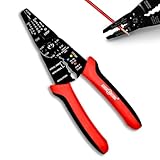
The ANGELSWORD 8-inch is the tool to buy when you want the full three-function plier format and you want to spend as little as possible to get it. It strips, cuts, and crimps, it is 8 inches long like the trade-standard tools, and it sits firmly in the budget tier. It suits the homeowner, the woodworker who runs a few low-voltage runs a year, the apprentice assembling a first tool bag, and anyone who wants a spare stripper in the truck without spending mid-range money on it.
Key Specs
- Format: 8-inch plier-style multi-tool — strip, cut, and crimp
- Overall length: 8 in (about 200 mm)
- Stripping stations: fixed-gauge notches stamped into the jaw; the listing does not state a numeric AWG range, so confirm against the tool markings
- Cutting: shear edge for copper and small stranded conductors
- Crimping: stations for common insulated and bare terminals
- Grip: molded handle with spring return
- Price tier: budget
Strengths
What you are buying here is format and function at the lowest sensible price. A three-function 8-inch plier for budget money is a genuinely useful object: it strips the end of a lamp cord, cuts it square, and closes the crimp on the replacement plug — all without a second tool. For a woodworking shop, that covers low-voltage LED lighting, dust-collector control wire, shop-built extension cords, and 12-volt DC accessories. The spring return keeps it usable one-handed, and the 8-inch length gives enough leverage on 12 and 14 AWG that you are not fighting the tool.
Budget tools are also the right place to start if you are not yet sure how much stripping you will actually do. If the ANGELSWORD sits in a drawer untouched for a year, you have lost very little. If it turns out you strip wire every week, that experience tells you exactly what to look for in a premium upgrade — which is a cheaper way to learn than guessing.
Pros
- Budget-tier price for a full three-function 8-inch tool
- Strips, cuts, and crimps — covers basic cord and low-voltage work
- Standard 8-inch length for familiar leverage and reach
- Spring-loaded handles support one-handed use
- Low-cost way to find out how much stripper you actually need
Cons
- No published AWG range — you rely on the stamped markings
- Budget-tier jaw alignment and edge retention will not match premium tools
- No depth adjustment, so fine stranded wire is easier to nick
- Fixed notches slow down repetitive multi-gauge work
How It Compares
Set against the WGGE WG-015, the ANGELSWORD is the cheaper version of the same idea. The WGGE costs more and generally delivers better steel and tighter jaw fit; the ANGELSWORD delivers the function for less. If you strip once a month, the difference will not bother you. If you strip weekly, pay the small premium for the WGGE. Against the XUDYVCO 5-in-1, the ANGELSWORD gives you a full 8-inch plier body while the XUDYVCO trades length for extra functions — a fair trade only if you need the extra functions.
4. haisstronica 3-in-1 Self-Adjusting Wire Stripper – Best for Wide-Range Repeat Work

The haisstronica 3-in-1 is the self-adjusting option that covers the widest range on this list: 24 to 10 AWG in one tool. That is a genuine spread — it reaches down into 24 AWG control and signal wire and up to 10 AWG branch conductor, without you changing a notch or flipping a dial. It suits the person doing mixed work: a control panel with 22 AWG signal wire and 12 AWG feeds, a shop build with both low-voltage and mains runs, or anyone who is tired of hunting for the right notch on a fixed-gauge plier.
Key Specs
- Type: self-adjusting (automatic) wire stripper
- Stated range: 24–10 AWG
- Functions: 3-in-1 — strip, cut, and crimp
- Jaw action: clamping jaw grips the conductor and closes to a set depth automatically
- Depth control: adjustable stop for insulation thickness
- Grip: molded handles with spring return
- Price tier: mid-range
Strengths
Self-adjusting is the single biggest quality-of-life upgrade in wire stripping. On a fixed-notch tool you look at the wire, guess the gauge, pick a notch, squeeze, and hope. On a self-adjusting tool the jaw measures the conductor for you: it closes until it contacts copper, then stops, which means the blade depth scales to the wire rather than to your guess. Over a hundred terminations, that removes a whole class of errors — the mis-notched strip that nicks strands or the one that barely scores the insulation and pulls it into a ragged tail.
The 24–10 AWG window is unusually generous and is the reason this tool earns a place in a mixed-discipline shop. Twenty-four gauge covers a lot of thermostat, sensor, and signal wire; 10 AWG covers heavier branch and sub-panel feeds. Add the cutter and crimper and you have one tool that handles nearly everything short of battery cable. The depth stop is the detail that separates a decent self-adjusting stripper from a frustrating one, because it lets you tune for thin PVC versus thicker, tougher insulation without changing tools.
Pros
- Widest stated range in this roundup at 24–10 AWG
- Self-adjusting jaw removes gauge-guessing errors
- Adjustable depth stop handles different insulation types
- Three functions — strip, cut, and crimp — in one tool
- Mid-range price for automatic-stripper convenience
Cons
- Self-adjusting mechanisms add parts that can wear or drift
- Not ideal for very thick, hard insulation at the top of its range
- Needs occasional depth-stop rechecking to stay accurate
- Wider range means slightly less specialisation at any single gauge
How It Compares
The closest alternative is the Klein Tools 11061. Both are self-adjusting 8-inch-class tools, and both solve the gauge-guessing problem. The haisstronica reaches lower — 24 AWG versus the Klein’s practical focus on standard branch and fixture wire — and costs less, which makes it the better pick if fine control wire is part of your mix. The Klein wins on steel quality, mechanism longevity, and the general fit-and-finish that comes with premium pricing. Against the Amazon Basics Self-Adjusting, the haisstronica covers 24–10 AWG versus 10–24 AWG — the same spread read in the other direction — so the decision there comes down to handle feel and local availability.
5. Klein Tools 11061 8-Inch Self-Adjusting Wire Stripper/Cutter – Best Overall

The Klein Tools 11061 is the best overall wire stripper on this list, and the reason is repeatability. It is an 8-inch self-adjusting stripper and cutter from a brand that has supplied the electrical trade for generations, and it is built for the person who strips wire as a routine rather than an event. It suits the electrician, the serious shop builder, the panel assembler, and the woodworker who has graduated past occasional cord work into real wiring — anyone who wants the same clean strip on the first try and the hundredth.
Key Specs
- Type: self-adjusting wire stripper and cutter
- Overall length: 8 in (about 200 mm)
- Jaw action: self-adjusting clamp grips the conductor and sets blade depth automatically
- Wire compatibility: solid and stranded conductors in the common branch, fixture, and control range
- Depth control: adjustable stop screw for insulation thickness
- Grip: curved, ergonomically shaped handles with spring return
- Brand: Klein Tools — a long-established American electrical hand-tool maker
- Price tier: premium
Strengths
Self-adjusting tools live or die on the quality of the clamping mechanism, and that is where premium money goes. The jaw has to grip the conductor firmly enough to hold it while the blade closes, then release cleanly without dragging the insulation or scoring the copper. Cheap self-adjusting strippers do this adequately for a while and then develop slop; better-built ones hold their geometry far longer. The 11061 is in the second category, and the depth-stop screw is the tuning point that lets you run it on thin-wall PVC one day and thicker insulation the next without swapping tools.
The curved handle shape is worth noting because it changes how the tool sits in the hand during a long pull. Instead of a straight bar you are squeezing against your palm, the curve rolls the load into the fingers, which reduces the fatigue that causes sloppy strips late in a job. Klein’s trade heritage matters here too: this is a tool designed by people who spend their working lives terminating conductors, and the details — the spring tension, the blade angle, the release — reflect that. It also strips both solid and stranded, which a lot of budget fixed-notch tools technically claim but do poorly on the stranded side.
For a woodworking shop specifically, the 11061 covers the awkward middle ground well: 14 and 12 AWG for branch circuits and shop sub-panels, 16 and 18 AWG for control and low-voltage lighting, and small stranded wire for DC accessories. One tool, one drawer, no gauge hunting.
Pros
- Self-adjusting jaw delivers consistent strips with no gauge guessing
- Adjustable depth stop handles varying insulation thickness
- Works on both solid and stranded conductors
- Curved handle shape reduces hand fatigue over long sessions
- Premium build from a long-established electrical tool brand
Cons
- Premium-tier price — the highest-cost approach in this format
- Self-adjusting mechanism has more wear points than a fixed-notch plier
- No crimping function — pair it with a separate crimper
- Overkill if you strip a handful of cords a year
How It Compares
Against the haisstronica 3-in-1, the Klein is the higher-quality mechanism at a higher price, and it gives up the crimper and the 24 AWG low end. If you need crimping in the same tool, the haisstronica wins on convenience; if you want the strip to be right every time for the next decade, the Klein wins. Against the Klein Tools 11063W, the choice is duty level rather than brand: the 11061 is the generalist 8-inch tool, while the 11063W is the 7-inch heavy-duty sibling built for harder, thicker insulation and heavier service. Buy the 11061 for mixed everyday work; step up to the 11063W if thick jacketing is your normal diet.
6. Htaexpu 5-in-1 Wire Stripper / Crimper / Cutter (10–20 AWG) – Best for Budget Versatility
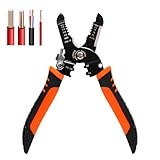
The Htaexpu 5-in-1 is the budget answer for someone who wants the maximum number of functions in a single tool. The listing describes a third-generation design rated for the 10–20 AWG class with five functions: strip, crimp, cut, and two more shop-useful operations folded into the same body. It suits the beginner assembling a first kit, the woodworker who wants one drawer tool that covers cord repair and low-voltage work, and anyone who would rather carry one thing than four.
Key Specs
- Type: multi-function hand tool, 5-in-1
- Stated range: 10–20 AWG class
- Functions: stripping, crimping, cutting, plus additional built-in operations in the same jaw set
- Jaw: fixed-position stations stamped and formed into the tool body
- Grip: molded handle with spring return
- Generation: described by the brand as a third-generation revision of its stripper design
- Price tier: budget
Strengths
Function count is the headline. A 5-in-1 tool at budget money is a rational purchase for someone who does not yet know which operations they will actually use. The 10–20 AWG window is a sensible one for a shop: it covers 10, 12, and 14 AWG branch and feed conductors, 16 and 18 AWG fixture and control wire, and 20 AWG signal wire. That is most of what a woodworking shop or a homeowner deals with, and it stops short of the very fine electronics gauges that a general-purpose tool handles poorly anyway.
Because the tool bundles crimping with stripping and cutting, it covers the full life cycle of a typical low-voltage connection: cut the wire to length, strip the end, crimp on the terminal. That workflow matters for shop lighting, dust-collector controls, 12-volt DC runs, and trailer or equipment wiring. The spring return keeps it operable one-handed, and the molded grip is shaped for repeated squeezes rather than a single cut. Budget multi-tools are also the lowest-risk way to discover whether you want a dedicated crimper or a dedicated stripper later — you learn your own habits before you spend real money.
Pros
- Five functions in one budget-priced tool
- 10–20 AWG class covers most shop and household wiring
- Strip-cut-crimp workflow handled without a second tool
- Spring return supports one-handed use
- Low entry price makes it an easy second or spare tool
Cons
- Multi-function tools rarely do any single job as well as a dedicated tool
- Fixed stations require matching gauge by eye
- No published depth adjustment for varying insulation thickness
- Budget-tier steel and jaw alignment will not hold up like premium tools
How It Compares
The nearest alternative is the XUDYVCO 5-in-1, which occupies almost exactly the same slot — 5 functions, 10–20 AWG, budget tier. The differences are in handle shape, jaw forming, and which extra operations each brand chose to include; both are entry-level tools and either will do the job. Where the Htaexpu and XUDYVCO both fall short is against the ANGELSWORD 8″ 3-in-1: the ANGELSWORD gives you a full 8-inch plier body, which means better leverage on 10 and 12 AWG, while the 5-in-1 tools trade some of that length and rigidity for extra stations. If leverage on heavier wire matters, take the 8-inch tool; if function count matters, take the 5-in-1.
7. Klein Tools 11063W 7-Inch Heavy-Duty Automatic Wire Cutter/Stripper – Best for Tough, Thick Insulation

The Klein Tools 11063W is the heavy-duty specialist. It is a 7-inch automatic cutter and stripper built for harder service than the general-purpose tools here — the kind of work where insulation is thick, cold, or abrasion-resistant and where 10 and 12 AWG conductors are routine rather than occasional. It suits the electrician working outdoors or in unheated spaces, the shop builder running sub-panels and heavy branch circuits, and anyone who has watched a lightweight stripper struggle through UF or thick-jacketed cable.
Key Specs
- Type: automatic (self-adjusting) wire cutter and stripper, heavy-duty class
- Overall length: 7 in (about 180 mm) — shorter than the standard 8-inch tools for a more compact, controlled grip
- Build class: heavy-duty jaws and hardened cutting edge
- Wire compatibility: solid and stranded conductors in the heavier end of the common branch range
- Action: automatic clamp-and-strip; squeeze to grip, cut, and pull
- Grip: contoured handles with spring return
- Brand: Klein Tools
- Price tier: premium
Strengths
Heavy-duty here is not marketing language — it describes the tool’s whole design brief. Thicker jaws resist flex when you are squeezing hard on 10 AWG, and a harder cutting edge holds its geometry through repeated contact with tougher insulation. The automatic action means the tool grips the conductor, cuts the jacket to a set depth, and lets you pull the slug off in one motion, which is much faster than a three-step notch-strip-pull routine once you are doing it fifty times in a row.
The shorter 7-inch body is a deliberate choice, not a downgrade. A shorter tool puts your hand closer to the work, which gives finer control when you are stripping inside a box or at the end of a short pigtail where a long tool would lever against the enclosure. It also packs into a tool bag more easily. For cold-weather work, the automatic mechanism is a real advantage: thick insulation that has stiffened with cold is exactly where fixed-notch tools start tearing rather than cutting cleanly, and where the extra jaw force of a heavy-duty tool earns its price.
If your work is mostly 14 and 12 AWG branch circuits, sub-panel feeds, exterior runs, and equipment wiring, this is the tool that will not feel like it is straining. If your work is delicate 22–24 AWG control wire, it is the wrong tool — that is a job for a wide-range self-adjusting stripper.
Pros
- Heavy-duty jaws handle thick and tough insulation without flexing
- Automatic clamp-and-strip action is fast on repetitive work
- Shorter 7-inch body gives finer control in tight spaces
- Hardened cutting edge holds up to abrasion-resistant jackets
- Premium build from a long-established electrical tool brand
Cons
- Premium-tier price — the highest-cost heavy-duty option here
- Not suited to fine 24 AWG control or signal wire
- No crimping function
- Heavier, more specialised tool than an occasional user needs
How It Compares
The obvious comparison is with its stablemate, the Klein Tools 11061. Both are self-adjusting Klein strippers; the difference is the mission. The 11061 is the generalist — an 8-inch tool for everyday mixed work across branch, fixture, and control gauges. The 11063W is the specialist — a 7-inch heavy-duty tool for thicker, tougher conductors where jaw strength and edge hardness matter more than range. If you buy one, buy the 11061 for versatility. If thick jacketing is your daily reality, buy the 11063W and accept the narrower comfort zone. Against the VCELINK Quick Strip Automatic, the Klein is the more robust tool; the VCELINK is lighter and better suited to finesse work on smaller wire.
8. VCELINK Quick Strip Automatic Wire Stripper and Cutter – Best for Quick-Strip Finesse

The VCELINK Quick Strip is the finesse option: a compact automatic stripper built around a squeeze-and-pull action rather than a jaw you position by hand. It suits the person doing precise, repetitive stripping on small-to-medium wire — control panels, low-voltage lighting, sensor and signal runs, and bench work where the wire is short and the tolerance for a nicked strand is low. It sits in the mid-range tier and is aimed at people who value speed and a light hand over raw jaw force.
Key Specs
- Type: automatic (quick-strip) wire stripper and cutter
- Action: automatic clamping jaw — squeeze to grip and strip in one motion
- Form factor: compact body, lighter than a full-size 8-inch plier
- Wire compatibility: solid and stranded conductors in the common control and branch range
- Grip: molded handles with spring return
- Price tier: mid-range
Strengths
The defining trait of a quick-strip automatic is rhythm. You insert the wire, squeeze, and pull — the jaw clamps, the blade cuts to depth, and the insulation slides off. Once that motion is in your muscle memory, it is noticeably faster than positioning a notch, squeezing, and then pulling separately, and it is far more consistent because the blade depth is set by the mechanism rather than by which notch you happened to choose.
The compact body is the second strength. A lighter, shorter tool is easier to control at the end of a short conductor, which is where most stripping errors actually happen — not on long cable runs, but on the two-inch pigtail inside a crowded box where a long tool levers off the enclosure and drags the blade sideways. The VCELINK’s lighter frame makes that kind of close-quarters work more accurate. It also travels well: it drops into a pouch or a bench drawer without eating space, which is why it tends to become the tool people reach for by default on small jobs.
Mid-range pricing puts it below the premium Klein automatic tools and above the budget plier-style multi-tools. That is a reasonable position for a dedicated stripper that is not trying to also be a crimper.
Pros
- One-motion squeeze-and-pull stripping is fast and consistent
- Compact, lightweight body suits close-quarters and bench work
- Automatic depth control reduces nicked conductors
- Mid-range price for a dedicated automatic stripper
- Easy to store and carry
Cons
- No crimping function
- Lighter build means less leverage on heavier 10–12 AWG conductors
- Automatic mechanism adds wear points versus a fixed-notch plier
- Not the tool for thick, abrasion-resistant outdoor jacketing
How It Compares
Against the Klein Tools 11063W, the VCELINK is the lighter, more agile tool and the Klein is the stronger one. If you strip thick outdoor cable, the Klein is the answer; if you strip control wire at a bench all afternoon, the VCELINK is more pleasant to use. Against the Amazon Basics Self-Adjusting, the VCELINK is the more specialised stripper while the Amazon Basics tool bundles crimping and publishes a 10–24 AWG range. Choose the VCELINK for speed and feel on small wire; choose the Amazon Basics tool if you want crimping included and a wider stated range in a single purchase.
9. XUDYVCO 5-in-1 Wire Stripper Tool (10–20 AWG) – Best for Lowest-Cost Entry

The XUDYVCO 5-in-1 is the lowest-cost way onto this list. It is a multi-function stripping tool for the 10–20 AWG class with five built-in operations, and it exists for one clear purpose: getting a functional stripper into your hands for as little money as possible. It suits the first-timer, the person who needs a stripper that lives in a glovebox or a second toolbox, and the woodworker who wants to handle the occasional cord repair without investing in a tool they may rarely use.
Key Specs
- Type: multi-function hand tool, 5-in-1
- Stated range: 10–20 AWG class
- Functions: stripping, cutting, crimping, plus additional built-in operations
- Jaw: fixed stations formed into the tool body
- Grip: dipped or molded handle with spring return
- Price tier: budget
Strengths
The 10–20 AWG window is well chosen for general shop use. It covers 10 AWG for heavier feeds, 12 and 14 AWG for branch circuits and shop receptacles, 16 and 18 AWG for lighting and control, and 20 AWG for signal wire. That is a broad slice of what actually gets terminated in a home or shop, and it means a single low-cost tool can handle the majority of small electrical tasks that come up around a woodworking space.
Five functions at budget money is also genuinely useful for a specific job: repairing cords and cables. Cut the damaged section out, strip both ends, splice with a crimp connector or a new plug, done. Without a stripper you would be doing that with a utility knife and a prayer, which is how conductors get nicked and how intermittent faults get born. Having any correctly-formed stripper is a large step up from having none, and that is the honest value proposition here.
It is also a sensible second tool. Keeping a cheap stripper in the truck, the barn, or the jobsite bag means you never walk back to the bench for the good one, and if it gets lost or borrowed, you are out very little.
Pros
- Lowest-cost entry point in this roundup
- 10–20 AWG class covers most household and shop wire

0 Comments