What's inside
- Quick picks by beginner situation
- What a beginner bowl gouge must do
- Head-to-head: flute shapes and grinds
- Steel: carbon, M2, and powdered metal
- Individual gouges versus starter sets
- How much sharpening should you expect?
- Matching tool size to bowl size
- Ownership details that affect value
- Final recommendation
- Related Guides
- Quick picks by beginner situation
- What a beginner bowl gouge must do
- Head-to-head: flute shapes and grinds
- Steel: carbon, M2, and powdered metal
- Individual gouges versus starter sets
- How much sharpening should you expect?
- Matching tool size to bowl size
- Ownership details that affect value
- Final recommendation
- Related Guides
As an Amazon Associate I earn from qualifying purchases. This post may contain affiliate links at no extra cost to you.
The best bowl turning tools for beginners are usually a 1/2-inch bowl gouge with a swept-back or “fingernail” grind, a second 1/2-inch gouge with a more conventional grind, and a sharpening method you can repeat consistently; a carefully chosen individual gouge is often better value than a large starter set.
As an Amazon Associate we earn from qualifying purchases at no extra cost to you.

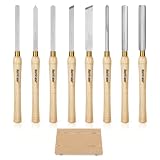
Quick picks by beginner situation
| Situation | Best starting choice | Why it fits | Expected sharpening |
|---|---|---|---|
| Lowest sensible budget | One high-speed-steel 1/2-inch bowl gouge, 12–16 mm flute width | Handles small and medium bowls without paying for unused tools | Frequent light honing or grinding; full reshaping is occasional |
| Learning from a class or tutor | Gouge matching the instructor’s profile, usually a swept-back 1/2-inch model | The grind and bevel angles will match the demonstrations | Moderate, provided the profile is maintained |
| Turning bowls every week | Two gouges: swept-back 1/2-inch plus heavier 5/8-inch or 3/4-inch model | One tool removes stock quickly; the other handles shaping and finishing | More total sharpening, but less wear per tool |
| Limited workshop space | Compact starter set with two gouges and a parting tool | Useful coverage without a large rack of specialist tools | Set quality varies; expect to refine factory grinds |
| Mostly large, heavy bowls | 5/8-inch or 3/4-inch bowl gouge with a long handle | More steel and leverage for deeper cuts and larger blanks | Grinding takes longer, but the edge lasts longer in heavy cuts |
What a beginner bowl gouge must do
A bowl gouge is not simply a deep version of a spindle gouge. Its flute, wall thickness, bevel, and grind work together to make cuts inside a curved bowl possible without the heel of the bevel catching the wood.
For a first tool, look for a flute width around 1/2 inch, commonly described by manufacturers as 1/2 inch even when the actual bar diameter is larger. A 12–16 mm flute is versatile for bowls from roughly 150 to 350 mm in diameter. It is large enough to remove wood efficiently but not so cumbersome that a new turner struggles to control it.
A long handle is useful because bowl turning involves leverage and interrupted cuts. An overall tool length of approximately 550–700 mm is comfortable for many benchtop and mid-sized lathes. Very long handles can be helpful on large bowls, but they also need more clearance around the lathe and may feel unwieldy on small work.
Head-to-head: flute shapes and grinds
Swept-back or fingernail grind
The swept-back grind curves the wings well behind the nose. It is the most useful all-round profile for bowl interiors because the wing can cut along the sides of the bowl while the nose remains supported by the bevel. It also works well for pull cuts on the outside.
The trade-off is sharpening. A swept-back profile requires you to move the tool or sharpening jig through an arc rather than simply holding it still against the wheel. A sharpening jig makes the result more repeatable, but the wings can easily become uneven if you remove too much steel.
Conventional or standard grind
A conventional grind leaves the wings closer to the nose. It is easier to understand and often easier to sharpen freehand. It can be a good first profile for basic outside shaping and simple open bowls.
Its limitation is that the wings are less effective inside a deep or sharply curved bowl. The bevel may rub or the wing may present an awkward cutting angle. Beginners who start with this profile often add a swept-back gouge later rather than replacing it.
Irish, Ellsworth-style, and other long-wing profiles
Long-wing profiles are variations of the swept-back idea rather than a separate class of tool. They can produce clean shear cuts and reach around bowl curves, but they demand more accurate sharpening and careful presentation. They are excellent once you can identify the bevel and flute position, but they are not automatically the easiest first gouge.
Steel: carbon, M2, and powdered metal
Most useful beginner bowl gouges are made from high-speed steel (HSS). HSS tolerates heat better than ordinary carbon steel, so the edge is less likely to lose hardness when a new turner pauses too long at the grinder. M2 HSS is a common, proven choice and offers a good balance of price, edge life, and ease of sharpening.
Powdered-metal steels, including products marketed as M42 or other proprietary particle steels, can hold an edge longer. That matters when turning abrasive woods, dry wood, or bark-covered blanks. However, they cost more and do not eliminate sharpening. A dull powdered-metal gouge still cuts poorly, and sharpening it may remove steel more slowly.
Carbide-tipped bowl tools are another beginner-friendly option. They use replaceable cutters and do not require shaping a traditional flute grind. They are convenient for roughing and learning basic tool presentation, but traditional gouges generally offer more control for bevel-supported curves, cleaner shear cuts, and fine interior surfaces.
Individual gouges versus starter sets
A starter set is attractive because it may include a bowl gouge, spindle gouge, parting tool, scraper, and sometimes a sharpening accessory. Typical beginner sets cost roughly $100–$300, while a premium set can exceed that range. A single dependable bowl gouge commonly costs about $60–$180 depending on steel, size, handle, and manufacturing quality.
The problem is that sets often divide the budget across tools you will not immediately need. A thin spindle gouge is not a substitute for a bowl gouge, and a small scraper does not replace a properly ground bowl gouge for finishing an interior. If your budget is limited, buy one quality 1/2-inch HSS bowl gouge and reserve money for a grinder, sharpening wheel, or jig.
Recognised choices include the Robert Sorby 842H bowl gouge range, Crown bowl gouges including their Pro-PM offerings, and bowl gouges from Hamlet and Henry Taylor. These brands offer established turning-tool ranges, but the exact grind and handle length can differ by model. Check the actual flute width, steel designation, and supplied profile rather than choosing by brand name alone.
How much sharpening should you expect?
Plan on a brief sharpening touch-up every few bowls, and more often when roughing green wood, bark, or dirty reclaimed timber. The exact interval depends on wood species, interrupted cuts, bevel pressure, and how aggressively you remove stock.
A practical sharpening routine is:
- Inspect the edge whenever the cut becomes noisy, starts leaving torn fibers, or requires noticeably more force.
- Use a fine or medium sharpening wheel appropriate for turning tools and avoid pressing hard enough to heat the edge.
- Restore the existing profile with several light passes rather than grinding until a large new burr appears.
- Use a honing slip or leather wheel only if it helps remove the burr; honing should not replace a correct grind.
- After sharpening, make a test cut on scrap wood before returning to the bowl.
For a swept-back gouge, mark the sharpening jig settings or record the wheel position. Repeating the same setup is more important than chasing a particular angle. Many bowl gouges work well with a bevel angle around 45–60 degrees, but the ideal angle depends on the profile and whether you prioritise outside shaping or deep-bowl access.
Matching tool size to bowl size
| Typical bowl diameter | Useful gouge size | Handle guidance | Best role |
|---|---|---|---|
| 100–180 mm | 3/8-inch or small 1/2-inch | 450–600 mm overall | Small bowls, cups, and detail work |
| 180–350 mm | 1/2-inch | 550–700 mm overall | Best general-purpose beginner range |
| 300–450 mm | 5/8-inch | 650–800 mm overall | Faster stock removal and more leverage |
| 400 mm and above | 3/4-inch or heavy bowl gouge | 700 mm or longer | Large blanks and deeper cuts |
These are starting ranges, not strict limits. A 1/2-inch gouge can turn a large bowl if the cuts are light and the lathe is suitable, while a large gouge can be awkward and unsafe on a small blank. The lathe’s swing, motor power, tool rest position, and blank security matter as much as the gouge size.
Ownership details that affect value
The cutting edge usually wears first, but the handle, ferrule, and tool-rest surface also deserve attention. Keep the steel dry after use, remove resin from the flute, and store gouges so their edges cannot strike one another. A nicked edge takes substantially more grinding to restore than a merely dull edge.
Inspect the ferrule for looseness and the handle for cracks, especially on inexpensive sets. A comfortable handle encourages a relaxed grip; excessive squeezing increases fatigue and makes bevel control harder. Replace a damaged handle rather than continuing to use a loose tool.
Do not judge a gouge by its factory sharpening alone. Many new tools arrive with a usable but generic profile. Refining the grind to match your bowl shapes may take several sharpening sessions, and that initial steel removal is part of the ownership cost.
Final recommendation
For most beginners, choose a 1/2-inch M2 HSS bowl gouge with a swept-back grind, a handle around 550–700 mm long, and a sharpening jig that can reproduce its profile. Add a conventional-grind gouge if you turn mostly open bowls, or move to a 5/8-inch tool if your blanks are routinely over 300 mm. Choose a starter set only when every included tool matches your immediate projects and the set leaves enough budget for safe sharpening equipment.
0 Comments