What's inside
As an Amazon Associate I earn from qualifying purchases. This post may contain affiliate links at no extra cost to you.
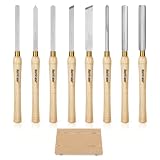
The best lathe turning tools for beginners are usually a compact high-speed steel (HSS) set with 3/8-inch and 1/2-inch tools, medium-length handles, and a sharpening system you can use consistently; a six-piece set is a better starting point than a large, inexpensive kit full of rarely used profiles.
As an Amazon Associate we earn from qualifying purchases at no extra cost to you.



Quick picks by beginner situation
| Situation | Best starting choice | Why it fits | Typical 2026 budget |
|---|---|---|---|
| Lowest sensible cost | 4- to 6-piece HSS set | Covers spindle work and basic bowls without paying for duplicate profiles | $90–$180 |
| Mostly chair spindles, pens, and handles | HSS spindle set with roughing gouge, spindle gouge, skew, and parting tool | These profiles remove waste, make beads and coves, and cut tenons efficiently | $120–$250 |
| Mostly bowls | HSS bowl gouge set with a 1/2-inch bowl gouge and sharpening jig | A suitable bowl gouge matters more than owning several small specialty tools | $150–$350 |
| Frequent use or long-term upgrade path | Individually selected M42 or premium HSS tools | Better edge life can justify the higher initial price when sharpening and turning are regular habits | $250–$600+ |
What a useful beginner set should contain
A practical starter set normally includes a 3/4-inch roughing gouge, 3/8-inch spindle gouge, 1/2-inch or 5/8-inch bowl gouge, 1/2-inch skew chisel, 1/8-inch or 3/16-inch parting tool, and a scraper. Exact sizes vary by manufacturer, but these profiles teach the fundamental cuts rather than merely adding pieces to a box.
- Roughing gouge: turns square stock into a cylinder. Do not use a spindle roughing gouge on a bowl blank or other interrupted bowl work.
- Spindle gouge: handles beads, coves, tapers, and detail cuts on work mounted between centers.
- Bowl gouge: removes material from the outside and inside of bowls. A 1/2-inch bowl gouge is a versatile first size for many small and medium lathes.
- Skew chisel: makes clean planing cuts and fine details, but demands more practice than the other tools.
- Parting tool: separates work and cuts grooves or tenons. A narrow tool wastes less material, while a wider tool is more resistant to flex.
- Scraper: useful for refining transitions and some bowl interiors, although it should not become a substitute for learning a clean bevel-supported cut.
HSS, M42 HSS, and carbon steel compared
For most beginners, conventional HSS is the sensible baseline. It tolerates heat better than carbon steel, stays serviceable through repeated sharpening, and is widely available in replacement sizes. It does not need to be sharpened as frequently as carbon steel during ordinary turning.
M42 HSS contains more cobalt than standard HSS and is commonly sold as a premium upgrade. It can retain an edge longer in demanding use, but it is not immune to dulling, catches, or poor grinding technique. The benefit is most noticeable for someone who turns often enough to value fewer sharpening interruptions. A premium steel tool with a poor grind is still a poor tool.
Carbon-steel turning tools are inexpensive and can be pleasant to sharpen, but their edge loses hardness more quickly when overheated. They can work well for occasional light turning if maintained carefully, yet HSS is usually the better ownership choice for a first set.
| Steel type | Typical edge behavior | Sharpening demand | Best match |
|---|---|---|---|
| Carbon steel | Sharp quickly but loses hardness if overheated | Frequent; use light grinding pressure | Very low-cost or occasional turning |
| Standard HSS | Good balance of edge life, toughness, and price | Moderate; the most forgiving general choice | Most beginners and mixed projects |
| M42 or other premium HSS | Longer edge life in regular use, with a higher purchase cost | Moderate, but fewer interruptions between sharpening sessions | Frequent turners and demanding hardwood work |
Handle length is a safety and control decision
Look for handles roughly 10 to 14 inches long on spindle tools and around 12 to 16 inches on larger bowl tools. A longer handle gives leverage when the tool is presented against the rest, particularly with a bowl gouge, but it also needs more clearance around the lathe.
Short handles, often about 6 to 9 inches, can suit pen work and small benchtop lathes. They are easier to maneuver in tight spaces but provide less leverage and can encourage an unstable grip on larger work. The tool should rest comfortably against your body and remain supported by the tool rest; do not choose an extra-long handle merely because it sounds more powerful.
Check the handle-to-shank fit before buying. A handle that rotates, splits, or allows the metal to loosen is a maintenance problem regardless of steel quality. Tang-style tools should have a properly fitted ferrule, while socket-style tools need a clean, secure seating surface.
Set styles worth considering
Compact standard-HSS sets
These offer the best value when you are learning both spindle and bowl work. Sets from established makers such as Robert Sorby, Crown, and Hamlet are available in different configurations, so compare the actual profiles rather than relying on the piece count. A six-tool set containing two similar scrapers may be less useful than a five-tool set containing a bowl gouge and parting tool.
Dedicated spindle sets
A spindle-focused set is the strongest choice for table legs, dowels, tool handles, rolling pins, and other work held between centers. Prioritize a 3/4-inch roughing gouge, 3/8-inch spindle gouge, skew, and parting tool. A beginner who mainly makes spindles may get more value from these four tools than from a general-purpose set with a large bowl scraper.
Dedicated bowl sets
Bowl turning rewards a correctly ground bowl gouge more than a crowded assortment. Choose a 1/2-inch bowl gouge with enough flute depth for the intended blank, plus a scraper or shear-scraping option for finishing. If the set includes a sharpening guide or a documented grind angle, that can be more useful than an extra small gouge.
Premium individual tools
Buying individually avoids paying for profiles you will not use. A good progression is a roughing gouge, spindle gouge, bowl gouge, and parting tool first; add a skew and scraper after you know which projects you make. This approach costs more per tool but often reduces duplication and makes future upgrades easier.
Sharpening requirements beginners should budget for
Every steel option requires sharpening. A typical beginner setup uses a 6- or 8-inch bench grinder with a 1,750-rpm motor, a friable aluminum-oxide wheel around 60 or 80 grit, and a coarse diamond truing tool. A slow-speed grinder is also suitable and reduces the risk of overheating an edge, although it is not a substitute for light, controlled contact.
Expect to sharpen after roughly 10 to 30 minutes of active cutting, depending on wood species, bark, abrasive contamination, and how much material you remove. The number is not a rule: sharpen when the tool stops producing clean shavings or requires force. Dipping the tool in water can help cool carbon steel, but do not quench a red-hot tool or grind heavily enough to discolor HSS.
For a bowl gouge, a swept-back or traditional grind changes how the bevel contacts the wood. A sharpening jig can make the first grind repeatable, but it will not prevent a catch caused by presenting the cutting edge incorrectly. Practice the basic bevel-supported cut before chasing highly specialized grinds.
Ownership costs and common mistakes
Suppose a $150 HSS set is used twice a month for three years. That is 72 sessions, or about $2.08 per session before electricity and sharpening-wheel wear. A $300 premium set used only ten times costs $30 per session. The cheaper purchase is not automatically better value; frequency and the projects you actually make determine the result.
- Store tools dry and wipe sap and moisture from the steel after use. Surface rust often begins at the ferrule or in a damp tool rack.
- Do not let tools strike the lathe bed, chuck jaws, or concrete floor. Small nicks create extra grinding work.
- Do not judge a set by its case or piece count. Confirm the tool widths, flute shapes, handle lengths, and steel specification.
- Do not use a spindle roughing gouge on bowls. The interrupted cut and unsupported geometry can cause a dangerous catch.
- Keep the tool rest close to the work, typically with a small working gap, and adjust it as the diameter changes.
Bottom line
For most first-time turners in 2026, choose a five- or six-piece standard-HSS set with a 3/4-inch roughing gouge, 3/8-inch spindle gouge, 1/2-inch bowl gouge, parting tool, and scraper or skew. Choose a dedicated spindle set if your projects are long and narrow, a bowl-focused set if you primarily hollow vessels, and premium M42 tools only when regular use makes longer edge life worth the added cost. The best lathe turning tools for beginners are the profiles you can sharpen, control, and use safely—not the set with the most pieces.
0 Comments