What's inside
As an Amazon Associate I earn from qualifying purchases. This post may contain affiliate links at no extra cost to you.
Best wood carving tools for beginners: choose by the kind of carving you’ll do
The best wood carving tools for beginners are a small, sharp set matched to your project: a few pocket-friendly knives for whittling, a palm-tool set for relief carving, or a compact selection of gouges and a V-tool for detail work. Before buying, compare blade profiles, steel, handle shape, and whether sharpening equipment is included—an impressive piece count matters less than tools you can keep sharp and control safely.
Starter sets at a glance
The figures below are useful comparison points, not claims about one fixed bundle: manufacturers and retailers may change set contents. Check the current listing for exact dimensions and included accessories.
As an Amazon Associate we earn from qualifying purchases at no extra cost to you.


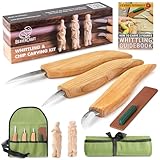

| Starter option | Typical contents | Blade steel and size | Sharpening gear | Best suited to |
|---|---|---|---|---|
| Flexcut KN700 Deluxe Palm & Knife Set | Four carving knives and four palm tools | High-carbon steel; knife blades roughly 1–1½ in., palm-tool sweeps vary | Leather strop and polishing compound commonly included | Learning both whittling and basic relief carving |
| Flexcut SK1 Whittlin’ Jack | Two folding blades: detail knife and roughing knife | High-carbon steel; blades roughly 1½–2 in. | Strop not built in; buy one separately | Portable whittling and small figures |
| BeaverCraft S15 Whittling Knife Set | Three knives: detail, roughing, and chip-carving profiles | High-carbon steel; blades generally around 1–1½ in. | Strop and compound are commonly supplied | Low-cost entry into several knife-based tasks |
| Two Cherries 6-piece carving set | Six full-size carving tools, usually a mix of straight, skew, gouge, and V profiles | High-carbon tool steel; cutting edges commonly about 6–12 mm wide | Usually no complete sharpening kit; verify bundle contents | Bench-based relief carving and longer-term tool ownership |
Blade length and set contents can vary by version. For gouges, width is measured across the cutting edge; the sweep describes how curved the edge is. A smaller sweep number is flatter, while a deeper sweep removes material from a tighter curve.
Which set fits your situation?
| Your situation | Good starting choice | Why it fits | Trade-off |
|---|---|---|---|
| New to carving, working outdoors or on a small table | Two- or three-knife whittling set | Few profiles to learn; easy to store and carry | Does not include the curved gouges needed for relief carving |
| Want to carve patterns into a flat board | Four- to eight-piece palm-tool set | Gouges and V-tools can define lines and remove background wood | Small handles limit reach and leverage on larger work |
| Unsure whether you prefer knives or gouges | Combination knife-and-palm-tool set | Lets you explore both without assembling a collection one tool at a time | Some profiles may see little use; compare the actual tool list |
| Carve regularly and want tools for larger panels | Full-size bench carving set | Long handles provide reach and control for work held on a bench | Costs more and needs a secure work surface and more storage |
Head-to-head: three practical beginner routes
For whittling: Flexcut SK1 or a comparable two-knife set
A folding whittling knife keeps the kit simple: a broader blade takes off waste, while a narrower detail blade cuts eyes, grooves, and small curves. The Flexcut SK1 pairs those two roles in one pocketable tool. Its high-carbon steel is straightforward to maintain with a strop, but it can discolor if left damp. A folding knife is convenient for travel, though its joint needs to stay clear of wood dust and should be checked for secure lockup before use.
Choose this route for small figures, simple animals, and practice cuts in basswood. It is not a substitute for a set of gouges when you want to carve a broad recessed background or repeat a curved relief pattern.
For mixed projects: Flexcut KN700 or a similar combo set
A combination set is a sensible choice if you have room for both knife carving and shallow relief work. Knives handle outside contours; palm gouges and a V-tool open up curved hollows and crisp lines. The KN700’s commonly supplied strop and compound are useful because sharpening is part of ownership, not an occasional extra. Confirm the current package contents before purchase.
Its main advantage is coverage, not that every included profile is essential on day one. Start with one knife, one medium gouge, and the V-tool; add the remaining tools as a project calls for them. Short palm handles are comfortable for controlled cuts but are less suitable for deep work in a large panel.
For relief and fine detail: a small fixed-tool set
A set such as the six-piece Two Cherries carving set offers longer handles and more varied edge shapes than a knife-only kit. A straight chisel cleans edges, a skew can reach corners, gouges shape hollows, and a V-tool draws narrow lines. This makes a small, well-chosen set more useful for relief carving than a large assortment of near-duplicate knives.
These tools work best with the carving held securely on a bench or in a vise. Longer handles offer reach, but they also make it easier to apply too much force. If the set does not include a strop, compound, or sharpening stones, budget for maintenance supplies rather than assuming the factory edge will remain keen indefinitely.
What to inspect before buying
- Profiles: For whittling, look for a roughing knife and a smaller detail knife. For relief, prioritize at least two different gouge curves and a V-tool. A dozen tools with nearly identical edges may offer less range than four complementary profiles.
- Steel: High-carbon steel is common in carving tools and can take a keen edge, but it needs drying and occasional oiling to resist rust. Stainless steel is less prone to corrosion, though sharpening behavior varies by alloy. “Harder” alone does not mean “better”: geometry and edge quality matter too.
- Handles: Check that the handle is long and wide enough to sit securely in your palm without forcing a tight grip. Rounded or oval handles can help with orientation; very small handles may tire larger hands. For fixed tools, consider whether the handle suits palm pressure or a mallet—many beginner carving sets are intended for hand pressure, not hammering.
- Sharpening supplies: A strop and compound help maintain a knife edge, while gouges require shaped slips or stones that fit the curve. A flat stone alone cannot properly reach the inside bevel of a curved gouge.
Keep the edge useful: a simple maintenance routine
- Strop before a session. Pull the edge away from the cutting direction across leather with compound. This realigns and polishes a lightly dulled edge; it will not repair a chipped or rounded bevel.
- Use the right sharpening surface. Match a slipstone or shaped abrasive to the gouge’s curve. Keep the original bevel angle consistent rather than grinding a new shape into the tool.
- Clean and dry after carving. Brush away wood dust, wipe the steel, and apply a thin rust-preventive oil if the tool will be stored for a while. Store edges so they cannot knock together.
- Stop when the edge drags. A dull tool takes more force and is harder to steer. Don’t compensate by pushing harder; resharpen, and keep your free hand behind the cutting path.
For a rough ownership-cost check, divide the price of a set and its sharpening supplies by the number of sessions you expect to use it. For example, a $60 set plus $20 in maintenance gear used across 40 sessions comes to $2 per session. The sharper tools are easier to control, and a small maintenance kit can extend their useful life far more than extra blades you rarely reach for.
Bottom line
Choose a compact knife set if you mainly want to whittle, a palm-tool set if relief carving is the goal, or a combination set if you are still exploring. Prioritize a useful mix of profiles, a handle you can control, and a realistic sharpening plan. Beginners usually learn more from a few suitable tools kept sharp than from a large set that is difficult to maintain.
0 Comments