What's inside
As an Amazon Associate I earn from qualifying purchases. This post may contain affiliate links at no extra cost to you.
Our Top Picks
 BeaverCraft Wood Carving Knife C4 3.14" Whittling Sloyd3.1"7.9 x 1.2 x 0.4 inches0.1 poundsCheck on Amazon
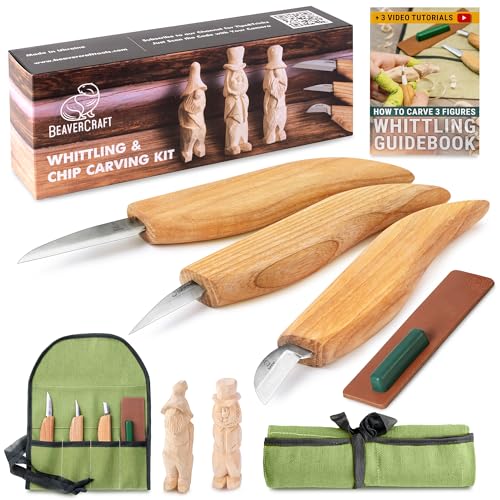


Best Wood Carving Knives: Choose by Cut, Steel, and Handle
The best wood carving knife is the one whose blade profile matches your usual cuts and whose handle you can control without straining; for most beginners, a 1¼–1½-inch detail knife with a comfortable palm-sized handle is a more useful first purchase than a large multi-knife set.
Before comparing options, decide what you want to carve. A general carving knife handles shaping and broad details. A short, pointed detail knife reaches tight corners. A hook knife scoops concave areas such as bowls. These shapes are not interchangeable: buying several blades that all perform the same cuts adds cost without adding much capability.
As an Amazon Associate we earn from qualifying purchases at no extra cost to you.


Compare Knife Types by the Work They Do
| Knife type | Typical blade dimensions | Best for | Trade-off |
|---|---|---|---|
| General carving knife | 1¼–1½ in. cutting edge; 3–4 in. handle | Shaping, slicing, trimming and medium details | Too long for the tightest corners; too short for fast stock removal |
| Detail knife | ¾–1¼ in. cutting edge; 3–4 in. handle | Eyes, small notches, narrow grooves and precise cuts | Short edge removes material slowly over broad areas |
| Roughing knife | 1½–2 in. cutting edge; 4–5 in. handle | Quickly reducing a blank and establishing large forms | Less nimble around small features |
| Hook knife | Curved edge about 1–2 in. long | Hollowing spoons, bowls and other concave forms | Curve requires shape-specific sharpening and technique |
| Chip-carving knife | ¾–1¼ in. cutting edge; pointed or angled tip | Controlled geometric chips and shallow decorative facets | Not the most comfortable profile for general three-dimensional carving |
Dimensions are common working ranges, not universal standards. Makers measure blades differently, so check whether a stated length means the cutting edge or the entire blade. The handle’s usable grip length matters too: a long blade attached to a tiny handle may still feel cramped.
Choose by Your Project and Experience
| Your situation | A practical choice | Why |
|---|---|---|
| First project; uncertain how often you’ll carve | One general knife, about 1¼–1½ in. edge | Versatile enough to learn shaping and slicing without paying for unused profiles |
| Small figures or fine facial details | General knife plus a shorter detail knife | The second blade reaches tight areas with less risk of the tip wandering |
| Spoons or shallow bowls | General knife plus a hook knife sized to the hollow | A curved edge removes material inside a concavity that a straight blade cannot follow efficiently |
| Repeated production or frequent carving | Two or three task-specific knives with consistent handle dimensions | Purpose-matched edges reduce awkward blade angles and interruptions to change grip |
| Limited storage or tight budget | One quality general knife; add profiles when a project demands them | Fewer tools mean less sharpening, protection and storage to manage |
For a set, look at what each knife adds—not the number of pieces. A useful starter set combines distinct jobs, such as a general knife, a detail knife and a hook knife. If the blades are nearly identical in length and profile, a set may offer less practical range than its piece count suggests.
Steel, Edge Retention, and Sharpening
Most carving knives use either carbon steel or stainless steel. Carbon steel is often straightforward to sharpen and can take a keen edge, but moisture can cause rust; wipe it dry after use and apply a light protective oil for storage. Stainless steel generally needs less rust prevention, though sharpening feel and edge retention depend on the specific alloy and heat treatment. “Stainless” does not mean maintenance-free.
Do not choose on hardness or alloy name alone. A hard blade may hold an edge longer but take more work to restore; a softer one may sharpen quickly but need more frequent touch-ups. For a beginner, a maker that gives clear sharpening guidance and sells or recommends compatible abrasives is often a safer bet than an unfamiliar steel specification.
Most straight carving edges can be maintained with a fine stone or suitable abrasive, followed by stropping on leather. Keep the bevel angle consistent with the knife’s existing grind rather than forcing a new angle. Hook knives need shaped stones or other abrasives that contact the curved edge; a flat stone may sharpen only part of the curve. Stropping helps maintain an edge but does not replace sharpening once the blade is dull or damaged.
Handle Fit Is a Control Feature
A knife handle should let you guide the edge while keeping your wrist relaxed. As a rough reference, many general carving knives have handles around 3–4 inches long and roughly ¾–1¼ inches across at their thickest point, though shape and personal hand size matter more than the number. A slim handle can suit delicate fingertip control; a fuller handle may be more comfortable for sustained carving. Neither is universally better.
Look for a grip that does not force your fingers against the blade or require a tight squeeze. Check that the handle is secure, smoothly finished and free of sharp edges. Wood handles can be comfortable and repairable, but benefit from being kept clean and dry. Synthetic handles are often easier to wipe down. With either material, avoid soaking the knife or leaving it wet in a closed sheath.
What You’ll Spend—and What Ownership Adds
As a broad market guide in 2026, a basic single carving knife may cost about $15–$35, a better-finished specialist knife roughly $30–$70, and a small quality set approximately $50–$150 or more. Prices vary by maker, steel, handle material and country of manufacture. A low purchase price can be less attractive if the edge needs substantial correction before it is useful; a premium knife is not automatically the right profile for your work.
Budget for maintenance as well as the blade. A stone or suitable abrasive and a leather strop are common ongoing tools, while protective storage prevents edge damage. The edge is usually the first part to lose performance, especially when it meets dirt, knots, staples or other hard inclusions. Chips and rolled edges often indicate an impact or a cut that exceeded the blade’s intended use, rather than ordinary dulling.
A Simple Buying Check Before You Order
- Match the edge to the cut: straight for shaping and slicing, short and pointed for confined details, curved for hollowing.
- Confirm the measurement: distinguish cutting-edge length from overall blade length, and check handle length separately.
- Consider your maintenance tolerance: carbon steel needs rust prevention; any steel needs sharpening.
- Check the handle in context: choose a shape and thickness you can control, not simply the largest or smallest option.
- Buy a set only for useful variety: one general knife plus a genuinely different profile usually beats several near-duplicates.
If you are unsure, start with one well-made general carving knife and a sharpening plan. Add a detail or hook knife after a project reveals a specific limitation. That approach keeps the first purchase versatile while making each later tool solve a real problem.

0 Comments