What's inside
As an Amazon Associate I earn from qualifying purchases. This post may contain affiliate links at no extra cost to you.
The Suizan 9.5-inch ryoba is the best Japanese pull saw to buy first because one blade rips and crosscuts, and a Gyokucho 372 or Z-Saw 9.5-inch dozuki is the best second saw for dovetails and fine joinery. The Suizan 10.5-inch kataba suits deep rip cuts and tenon cheeks, the Gyokucho 650 is the step-up ryoba, and a 5-inch Suizan flush-cut saw trims dowels and plugs. All of them cut on the pull stroke, all use replaceable blades, and all cost far less than a premium Western backsaw.
A Japanese saw cuts in tension: you pull the blade toward you, so the blade stays straight and can be much thinner than a push saw blade. Thinner steel means a narrower kerf, less effort and cleaner starts. The tradeoff is that the blade is fragile, so you learn a light touch. This guide explains the three main saw types, the tooth geometry that controls speed and finish, and eight specific saws, with a worked example of how kerf and tooth count affect a dovetail joint.
As an Amazon Associate we earn from qualifying purchases at no extra cost to you.
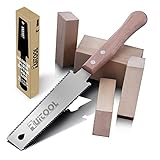


Quick picks
- Best first saw: Suizan 9.5-inch ryoba (9 and 15 TPI, replaceable blade).
- Best dozuki for dovetails: Gyokucho 372 dozuki (9.5 in., 20 TPI, about 0.012 in. thick).
- Best budget dozuki: Suizan 6-inch dozuki (25 TPI).
- Best premium-feeling dozuki: Z-Saw 9.5-inch dozuki (26 TPI, bamboo-wrapped handle).
- Best kataba for deep rips: Suizan 10.5-inch kataba (14 TPI).
- Best step-up ryoba: Gyokucho 650 ryoba (9.4 in., 8 and 15 TPI).
- Best compact ryoba: Gyokucho 770-3600 (7 in., 9 and 19 TPI, rotatable handle).
- Best flush-cut saw: Suizan 5-inch flush-cut saw.
How we chose
This list is built from published specifications and from how several independent 2026 buying guides rank the same saws, not from our own shop work. We looked for saws that are widely sold in the United States, come from established Japanese makers, use replaceable blades and cover the three main saw patterns. We compared blade length, teeth per inch, blade thickness and handle style. Where a source did not publish a spec, we describe the saw by class instead of quoting a number. Several of the guides we read are affiliate-style review sites, so we cross-checked the numbers across them. Prices appear only as tiers.
Ryoba vs dozuki vs kataba
Ryoba: the all-rounder
A ryoba has teeth on both edges of a single blade. One edge has rip teeth for cutting with the grain and the other has crosscut teeth for cutting across it. It is the best first Japanese saw because it handles breaking down boards, cutting tenon shoulders and trimming parts. The tradeoff is that the wide blade has no spine, so it is more flexible than a dozuki and takes practice to keep straight.
Dozuki: the joinery saw
A dozuki has a thin blade stiffened by a metal spine along the back, much like a Western backsaw. The spine keeps the blade straight and gives a very narrow kerf, typically around 0.012 inch on the saws here. The spine limits depth of cut, so a dozuki is for joinery: dovetails, tenon shoulders, small boxes and precise crosscuts. Choose a dozuki if your main goal is fine joinery.
Kataba: the single-edge rip and deep-cut saw
A kataba has teeth on one edge only and no spine. A kataba leaves a cleaner rip cut than a ryoba and cuts deeper than a dozuki, and it can be gently bent to make a flush cut. It is the saw for tenon cheeks, trimming large stock and general cutting where depth matters more than a spine’s stiffness.
Tooth geometry: what the numbers mean
- Teeth per inch (TPI): a lower TPI (8 to 14) cuts faster and leaves a rougher surface, so it suits ripping and rough work. A higher TPI (20 to 26) cuts slower and leaves a smoother surface, so it suits fine crosscuts and joinery.
- Rip vs crosscut teeth: rip teeth have a flat, chisel-like edge for slicing along fibers; crosscut teeth are sharpened with bevels like knives to sever fibers cleanly. Ryoba saws have both on one blade.
- Kerf and blade thickness: a thinner blade removes less wood. The dozuki saws listed here are about 0.012 inch thick, ryoba blades about 0.020 inch and the kataba about 0.024 inch.
- Replaceable blades: the saws listed here use replaceable blades, because the hardened teeth cannot be resharpened by hand in a normal shop. When the saw dulls, you swap the blade instead of buying a whole saw.
- Handle: long rattan-wrapped or bamboo-wrapped handles let you use two hands and change your grip for control. A rotatable handle helps for left- and right-handed use or for flush cuts.
Comparison table
| Saw | Type | Blade length | TPI | Blade thickness | Replaceable blade | Tier |
|---|---|---|---|---|---|---|
| Suizan ryoba | Ryoba | 9.5 in. | 9 and 15 | 0.020 in. | Yes | Entry-level |
| Gyokucho 650 | Ryoba | 9.4 in. | 8 and 15 | 0.020 in. | Yes | Mid-range |
| Gyokucho 770-3600 | Ryoba | 7.0 in. | 9 and 19 | 0.020 in. | Yes | Mid-range |
| Gyokucho 372 | Dozuki | 9.5 in. | 20 | 0.012 in. | Yes | Mid-range |
| Suizan dozuki | Dozuki | 6.0 in. | 25 | 0.012 in. | Yes | Entry-level |
| Z-Saw dozuki | Dozuki | 9.5 in. | 26 | 0.012 in. | Yes | Mid-range |
| Suizan kataba | Kataba | 10.5 in. | 14 | 0.024 in. | Yes | Entry-level |
| Suizan flush-cut | Flush-cut | 5 in. | See spec sheet | See spec sheet | Check listing | Entry-level |
The best Japanese pull saws
1. Suizan 9.5-inch ryoba: best first saw
Specs: 9.5 in. blade · 9 TPI rip edge / 15 TPI crosscut edge · about 0.020 in. thick · replaceable blade · rattan-wrapped handle
Best for: beginners and anyone who wants one saw for ripping, crosscutting and rough joinery.
Skip if: your only goal is fine dovetails. A ryoba has no spine, so it is harder to hold on a marked line than a dozuki.
- Pros: the most frequently recommended saw in the guides we reviewed; entry-level tier; two cutting edges in one tool; replaceable blade.
- Cons: thin, flexible blade that kinks if forced; a 15 TPI edge is fine but not as smooth as a 25 TPI dozuki.
2. Gyokucho 650 ryoba: step-up ryoba
Specs: 9.4 in. blade · 8 TPI rip edge / 15 TPI crosscut edge · about 0.020 in. thick · replaceable blade · rattan-wrapped handle
Best for: woodworkers who have learned the technique on an entry saw and want a Gyokucho blade with distinctive tooth design.
Skip if: you are not yet sure you like pull saws. One review site found the Suizan a better learning saw for roughly half the price.
- Pros: a coarse 8 TPI rip edge that clears chips quickly; respected maker.
- Cons: a higher cost than the Suizan with similar blade size.
3. Gyokucho 770-3600 ryoba: compact with a rotatable handle
Specs: 7.0 in. blade · 9 TPI rip / 19 TPI crosscut · about 0.020 in. thick · replaceable blade · tilting, rotatable handle
Best for: small parts, tight spaces, and users who want to angle the handle for flush or awkward cuts.
Skip if: you need long strokes for ripping wide boards.
- Pros: short blade is easier to control; finer 19 TPI crosscut edge; adjustable handle angle.
- Cons: shorter blade limits rip speed and cut length; moving handle adds a part that can loosen.
4. Gyokucho 372 dozuki: best dozuki for dovetails
Specs: 9.5 in. blade · 20 TPI · about 0.012 in. thick · replaceable blade · rattan-covered handle · spined
Best for: dovetails in hardwood, tenon shoulders and fine crosscuts, with a blade long enough to stroke smoothly.
Skip if: you are on a tight budget, since a 6-inch dozuki gives similar thickness for less.
- Pros: very thin kerf; spine keeps the cut straight; 20 TPI balances speed and finish.
- Cons: spine limits depth of cut; fragile if dropped or bent.
5. Suizan 6-inch dozuki: best budget dozuki
Specs: 6.0 in. blade · 25 TPI · about 0.012 in. thick · replaceable blade · rattan-wrapped handle · spined
Best for: small dovetails and box joinery at an entry-level tier. One test called it the best-value dovetail saw.
Skip if: you cut deep tenons or wide stock, where the short blade and shallow spine limit capacity.
- Pros: fine 25 TPI cut; low cost; short blade is easy to guide on a marked line.
- Cons: short stroke; slower in thick material.
6. Z-Saw 9.5-inch dozuki: finest tooth count
Specs: 9.5 in. blade · 26 TPI · about 0.012 in. thick · replaceable blade · bamboo-wrapped handle · spined
Best for: the smoothest cut straight off the saw in hardwoods and for users who want a polished, ready-for-glue joint.
Skip if: you cut thick stock regularly; the fine teeth cut slowly and can clog in resinous wood.
- Pros: highest TPI here; thin kerf; a widely sold brand with replacement blades readily available.
- Cons: slower cutting; mid-range tier.
7. Suizan 10.5-inch kataba: best for deep rips
Specs: 10.5 in. blade · 14 TPI · about 0.024 in. thick · replaceable blade · rattan-wrapped handle · single edge, no spine
Best for: tenon cheeks, rip cuts in thick stock and trimming boards where a ryoba’s two edges are not needed.
Skip if: you want the stiffness of a spine for tight joinery lines.
- Pros: cuts deeper than a dozuki; cleaner rip than a ryoba; can be gently flexed for flush cuts.
- Cons: thicker kerf than a dozuki; no spine to guide the cut.
8. Suizan 5-inch flush-cut saw: best for plugs and dowels
Specs: 5 in. flexible blade · fine teeth (confirm exact TPI on the listing) · designed to cut flush to a surface
Best for: trimming dowels, plugs and tenon ends flush to the surface without marring it.
Skip if: you want a general cutting saw. A flush-cut saw is a specialty tool, and we could not confirm its exact tooth count.
- Pros: flexible blade lies flat on the surface; entry-level tier.
- Cons: single-purpose; not for rough work.
Match the saw to the cut
| Task | Best saw type | Suggested TPI |
|---|---|---|
| Ripping a board with the grain | Ryoba rip edge or kataba | 8 to 14 |
| Crosscutting boards to length | Ryoba crosscut edge | 15 to 19 |
| Hardwood dovetails | Dozuki | 20 to 26 |
| Tenon cheeks and shoulders | Kataba and dozuki | 14 and 20+ |
| Trimming dowels and plugs flush | Flush-cut saw | Fine |
Worked example: tooth count and kerf in a dovetail
Use this logic to choose between a ryoba and a dozuki for a drawer corner.
- Check teeth in the cut. A good rule is to keep at least three teeth in the wood at any time. For a 3/4-inch board, a 20 TPI blade has 0.75 x 20 = 15 teeth in the work, which is comfortable. A coarse 9 TPI edge has 0.75 x 9 = about 7 teeth, fine for a rip but rough on the surface. For a 1/4-inch drawer side, 20 TPI gives 5 teeth and 9 TPI gives only 2, which is below the rule. That explains why fine joinery calls for a high-TPI dozuki.
- Count the kerf you will lose. A dovetail tail board with 4 tails has about 8 saw cuts (two per tail). With a 0.012-inch dozuki, that removes 8 x 0.012 = 0.096 inch of wood across the joint. With a 0.020-inch ryoba, it removes 8 x 0.020 = 0.160 inch, about 0.064 inch more.
- Interpret the difference. If you saw on the waste side of the line, kerf width decides how much you must pare. A wider kerf means a looser joint or a bigger error if you wander. The thinner dozuki kerf closes more easily with a light paring cut.
- Choose. If you cut a few dovetails a year, a ryoba you already own can do them with care. If you cut them often, buy a dozuki with 20 TPI or higher.
Technique and care
- Pull lightly. Let the teeth do the work. Pressing down bends the blade and wanders the cut.
- Start with a nick. Use your thumb or a knuckle as a guide at the far edge of the line, and start with a short backward pull.
- Saw on the waste side. Leave the knife line and pare to it.
- Protect the teeth. Use the blade guard, store the saw hanging or in a sleeve and never drop it on the bench edge.
- Replace instead of resharpen. Replacement blades are inexpensive, and the teeth are hardened and not meant for hand sharpening.
- Safety. The teeth are extremely sharp. Clamp the work, keep your guide hand behind the blade path, and wear eye protection when trimming brittle material.
Frequently asked questions
What is the best Japanese pull saw for beginners?
The Suizan 9.5-inch ryoba is the best beginner saw because one blade rips and crosscuts. It has a replaceable blade and sits at an entry-level tier.
If you already know you want dovetails, start with a dozuki such as the Suizan 6-inch or Gyokucho 372.
What is the difference between a ryoba, dozuki and kataba?
A ryoba has teeth on both edges, a dozuki has a stiffening spine and thin blade, and a kataba has one toothed edge with no spine.
Use a ryoba for general work, a dozuki for joinery and a kataba for deeper rips and tenon cheeks.
Are Japanese saws better than Western saws?
They are different, not better in every case. A pull saw cuts with a thinner kerf and less effort, but the thin blade is more fragile than a Western saw plate.
Many woodworkers keep both: a pull saw for fine cuts and a Western saw for heavy sawing.
What TPI should I look for in a dovetail saw?
Look for 20 to 26 TPI. That range gives a smooth cut in hardwood without being painfully slow.
The Gyokucho 372 is 20 TPI, the Suizan 6-inch dozuki is 25 and the Z-Saw 9.5-inch dozuki is 26.
Can I sharpen a Japanese pull saw?
Generally no. The teeth are hardened and cut in complex shapes, so replacement is the normal fix. All the saws in this guide use replaceable blades.
Swap the blade when the saw starts to burn the wood or needs more force to cut.
Why does my pull saw wander off the line?
Usually from pushing down too hard, an unclear start, or a ryoba blade flexing without a spine. Lighten your grip, start with a short nick and use a dozuki for tight joinery lines.
A dull blade also wanders, so replace it when it stops cutting freely.
What is a flush-cut saw used for?
A flush-cut saw trims dowels, plugs and tenon ends flush to a surface without scratching it. Its flexible blade lies flat on the work.
You can also bend a kataba gently to make a flush cut, but a dedicated flush-cut saw is easier to control.
How do I store a Japanese saw?
Store it with the blade guard on, hung from the handle or laid flat in a drawer, and keep it dry. Wipe the blade with a light oil to prevent rust.
Keep the teeth away from other tools, because contact can chip or bend them.

0 Comments