What's inside
- Best sawhorses by working situation
- Head-to-head comparison
- What capacity do you actually need?
- Height, width, and sheet-goods support
- Stability matters more than the headline load rating
- Decision matrix for shoppers
- Setup method for safer, steadier work
- Durability and ownership realities
- Final buying recommendation
- Best sawhorses by working situation
- Head-to-head comparison
- What capacity do you actually need?
- Height, width, and sheet-goods support
- Stability matters more than the headline load rating
- Decision matrix for shoppers
- Setup method for safer, steadier work
- Durability and ownership realities
- Final buying recommendation
As an Amazon Associate I earn from qualifying purchases. This post may contain affiliate links at no extra cost to you.
The best sawhorses for most woodworkers are adjustable, folding steel or reinforced-polymer models rated for at least 1,000 lb per pair, with a work height near 30 inches and a top that accepts sacrificial 2x4s.
As an Amazon Associate we earn from qualifying purchases at no extra cost to you.

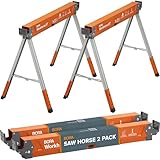


Best sawhorses by working situation
- Best all-around job-site choice: ToughBuilt C700 sawhorses, with adjustable legs, integrated support features, and a 1,300-lb-per-pair rated capacity.
- Best for frequent transport: DEWALT DWX725B folding sawhorses. They are compact, relatively light, and rated for 1,000 lb per pair.
- Best for sheet goods and large assemblies: a pair of wide, adjustable sawhorses with 2×4 support slots, such as the ToughBuilt C700 or a similar heavy-duty model.
- Best for a tight home workshop: folding polymer sawhorses with built-in carry handles and quick-deploy legs.
- Best budget solution: basic folding steel sawhorses rated around 500 to 1,000 lb per pair, provided the hinges lock positively and the feet do not rock.
Capacity is only one part of the decision. A sawhorse that supports 1,500 lb but flexes, slides, or folds awkwardly can be less useful than a 1,000-lb model with wider feet and better locking hardware.
Head-to-head comparison
| Model or type | Rated capacity | Working height | Material | Approx. folded size or storage profile | Best use |
|---|---|---|---|---|---|
| ToughBuilt C700 | 1,300 lb per pair | Adjustable, approximately 28–32 in | Steel frame with reinforced polymer components | Folds flat; roughly 6–8 in deep per horse | Heavy sheet goods, remodeling, general shop work |
| DEWALT DWX725B | 1,000 lb per pair | Approximately 29.5 in | Steel | Folds to about 36 in long and 6–7 in deep | Portable job-site support and track-saw work |
| Heavy-duty folding steel type | 1,000–1,500 lb per pair | 28–32 in | Painted or powder-coated steel | Usually 30–36 in long and 5–8 in deep | Frequent construction and rough handling |
| Folding polymer type | 500–1,000 lb per pair | 24–32 in, sometimes fixed | High-impact plastic with steel legs | Often under 5 in deep when folded | Home shops, light work, easy carrying |
| Traditional fixed wooden type | Variable; commonly 500–1,000 lb per pair | Usually 28–30 in | Wood | Does not fold unless specially built | Low-cost shop fixtures and custom workbenches |
Dimensions and capacities can vary by production version, so check the label or current manufacturer specification before buying. The figures above are useful comparison targets rather than a reason to exceed a model’s published rating.
What capacity do you actually need?
Estimate the load on the pair, then add a safety margin. A 4-by-8 sheet of 3/4-inch plywood weighs roughly 60–70 lb, while a solid hardwood countertop or assembled cabinet can weigh several hundred pounds. Cutting forces, shifting material, and uneven loading make a generous margin worthwhile.
For example, if a cabinet carcass weighs 220 lb, tools and clamps add 40 lb, and you allow 50 percent headroom, the target is:
(220 + 40) × 1.5 = 390 lb.
Even a 500-lb-per-pair model clears that calculation, but a 1,000-lb pair gives more useful stiffness and leaves room for future projects. Do not assume the capacity of one horse is the capacity of the pair: some manufacturers rate the set, while others state a per-unit figure.
Height, width, and sheet-goods support
A work height between 28 and 32 inches suits many standing woodworking tasks and keeps a sheet of plywood at a manageable level for breaking down. Taller users may prefer adjustable horses that reach 34 inches, while shorter users often gain control from a 24–28-inch setup.
For a 4-by-8 sheet, two horses alone are not always enough. The sheet can sag between supports, especially when cutting near the center. Add a third horse, a pair of longitudinal 2×4 rails, or a sacrificial cutting grid. Support the panel at multiple points without placing a hidden obstacle directly beneath the cut line.
Integrated 2×4 slots are valuable because they let you create a temporary work surface above the metal frame. A pair of 8-foot 2x4s gives a stable base, while a sacrificial sheet or narrow strips across them distribute pressure. Replace the sacrificial wood when kerfs become deep or the surface twists.
Stability matters more than the headline load rating
Look for feet that spread outward rather than narrow tripod-like legs. Wide feet resist tipping when a board is pushed sideways. Non-skid rubber pads help on concrete and finished floors, but they do not compensate for a sloped surface or a partially opened leg.
The best folding designs have positive leg locks that can be confirmed visually and by touch. Avoid relying on friction alone. Adjustable-height pins should pass fully through the hole, and telescoping legs should not wobble excessively at their maximum extension.
For long boards, place the horses far enough apart that the overhang is modest. As a practical starting point, position supports about one-quarter of the board length in from each end, then add a center support for flexible stock. A 96-inch panel might therefore use supports around 24 inches from each end plus a middle support when cutting or assembling.
Decision matrix for shoppers
| Your situation | Recommended specification | Why |
|---|---|---|
| Occasional homeowner, limited storage | Folding polymer or light steel; 500–1,000 lb per pair | Low storage burden and adequate capacity for trim, plywood, and repairs |
| Beginner building furniture | Adjustable height, 2×4 slots, rubber feet, at least 1,000 lb per pair | More forgiving for varied projects and temporary work surfaces |
| Frequent job-site use | Powder-coated steel, folding design, replaceable feet, 1,000–1,500 lb per pair | Better resistance to impacts, dirt, and repeated setup |
| Small workshop with permanent assembly space | Wide fixed or folding horses with a flat sacrificial top | Prioritizes stiffness over minimum folded size |
| Heavy cabinets or countertops | At least 1,300 lb per pair, three-point support, locking height adjustment | Reduces deflection and provides useful capacity margin |
Setup method for safer, steadier work
- Inspect before opening: Check hinges, pins, welds, feet, and 2×4 support slots for damage.
- Use a level surface: Sweep away chips and place both horses on the same plane. If the floor is uneven, use the adjustment mechanism rather than loose shims.
- Open every leg completely: Confirm each latch or brace is locked. A leg that is only partly deployed is a tipping hazard.
- Align the pair: Set the tops parallel and at the same height. Misalignment twists sheet goods and makes assembly inaccurate.
- Add sacrificial supports: Use straight 2x4s or a temporary top when the workpiece is flexible or the finished surface must be protected.
- Test before cutting: Push lightly from several directions. If the horse slides or rocks, correct the floor contact before placing the workpiece.
Durability and ownership realities
On most folding sawhorses, the first wear points are hinge pivots, locking pins, rubber feet, and plastic 2×4 pockets. Fine sawdust can prevent pins from seating, while outdoor moisture can rust untreated hardware and hinge areas. Brush debris away before folding; do not force a dirty hinge.
Keep the horses dry, lubricate metal pivots sparingly with a product suitable for the manufacturer’s hardware, and replace damaged feet rather than compensating with unstable scraps. Do not stand on a sawhorse, use it as a ladder, or drag a loaded pair across the floor. Repeated side loads are harder on the frame than a centered static load.
For a home woodworker who uses sawhorses twice per month, a $50–$90 pair used for five years costs roughly $0.10–$0.17 per use before replacement parts. A heavier $100–$180 pair becomes economical when it is deployed weekly, transported often, or used to support large sheet goods.
Final buying recommendation
Choose the DEWALT DWX725B when compact transport and a predictable fixed height matter most. Choose the ToughBuilt C700 when adjustable height, 2×4 integration, and higher rated capacity are more valuable than minimum folded size. For occasional indoor work, a lighter polymer or steel folding pair is sufficient if its locks are positive and its feet sit firmly.
Whichever style you buy, prioritize stable geometry, usable height, replacement-friendly wear parts, and a capacity margin over the largest project you expect to build. Those details determine whether a sawhorse remains a dependable woodworking tool or becomes a wobbly obstacle in the shop.
0 Comments