RP Woodworks

  • Home
  • Reviews
  • Projects
  • Tools
  • Woodworking Techniques
  • About

Sanding & Surface Prep

Sanding schedules, abrasives, grit choice and surface prep that decide how good a finish can look.

Sanding & Surface Prep

How to Remove Gray Oxidation From Deck Wood Before Refinishing

The best way to remove oxidation from decking wood is to clean it off chemically rather than blast it off: wet the boards, apply a sodium percarbonate (oxygen bleach) deck cleaner, scrub along the grain, rinse at low pressure, and follow immediately with an oxalic acid brightener. Save sanding for Read more

By admin, 1 dayOctober 4, 2026 ago
Sanding & Surface Prep

How to Strip Finish From Turned Spindles and Detailed Wood Parts

To strip varnish or another finish from turned spindles, brush on a thick coat of gel stripper and wrap the spindle in plastic so the stripper stays wet. Then pull the softened finish out of the coves and beads with jute twine, a brass-bristle brush, and small profile scrapers. A Read more

By admin, 1 dayOctober 4, 2026 ago
Sanding & Surface Prep

What Grit Sandpaper to Use After Stripping Varnish From Furniture

After stripping varnish off furniture, start sanding at 150 grit if the wood came out clean, or at 120 grit if there’s leftover residue or the stripper raised the grain. Stop at 180 grit for most stains, or 180–220 for water-based stain, dye, and clear finishes. You don’t need 60 Read more

By admin, 1 dayOctober 4, 2026 ago
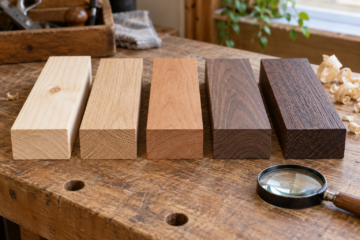
AI-generated editorial illustration: five wooden board samples showing different grain textures and colors.
Sanding & Surface Prep

How to Remove Mill Glaze from Hardwood

Mill glaze is the hard, burnished surface left on most kiln-dried hardwood straight from the mill. High-speed steel knives and planer rollers compress and polish the wood fibers, often with heat, leaving a shiny, slick skin that resists glue and stain. On softwoods it’s less of an issue, but on Read more

By , 1 weekSeptember 25, 2026 ago
AI-generated editorial illustration: five wooden board samples showing different grain textures and colors.
Sanding & Surface Prep

How to Prepare Torn-Out Grain After Planing

Understanding What Torn Grain Actually Is Torn grain isn’t a scratch and it isn’t chatter. It happens when a planer knife lifts fibers instead of cutting them, usually where grain changes direction around knots, figured maple, or wherever boards have interlocked or reversing grain. The surface looks pitted or fuzzy, Read more

By , 1 weekSeptember 25, 2026 ago
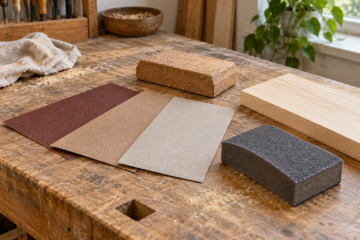
AI-generated editorial illustration of sandpaper
Sanding & Surface Prep

How to Sand Inside Corners on Cabinet Boxes

Sanding the inside corners of cabinet boxes is where factory-flat panels meet hand work. You can’t hit that 90-degree joint with a random orbit sander, and if you skip it, stain will show every mill mark and glue spot. If you over-sand it, you’ll round over the joint or blow Read more

By , 1 weekSeptember 25, 2026 ago
AI-generated editorial illustration of sandpaper
Sanding & Surface Prep

How to Choose Sandpaper for Removing an Old Clear Coat

Why Clear Coat Is Different to Sand An old clear coat – whether it’s polyurethane, lacquer, or conversion varnish – is harder and more brittle than bare wood. It doesn’t sand like wood does. Instead of producing fluffy dust, it clogs paper quickly, melts if you generate too much heat, Read more

By , 1 weekSeptember 25, 2026 ago
AI-generated editorial illustration of sandpaper
Sanding & Surface Prep

How to Prevent Sanding Swirl Marks on Bare Wood

Why Swirl Marks Happen on Bare Wood Swirl marks on bare wood are not scratches from the grit you are using. They are pigtails – tight, curling scratches left when a single abrasive particle gets trapped and dragged in a circular path. On a random-orbit sander, the pad spins and Read more

By , 1 weekSeptember 25, 2026 ago
Editorial illustration: random orbital sander beside circular sanding discs.
Sanding & Surface Prep

How to Use a Random-Orbit Sander on Veneer

Veneer gives you the look of expensive wood for a fraction of the cost, but it leaves almost no margin for sanding mistakes. Most raw wood veneer is 0.5mm to 0.6mm thick, shop-sawn veneer might be 1/32″ (0.8mm), and even thick commercial veneer rarely exceeds 1/42″ (0.6mm) after factory sanding. Read more

By , 1 weekSeptember 25, 2026 ago
AI-generated editorial illustration of sandpaper
Sanding & Surface Prep

How to Sand a Large Wood Panel by Hand

Why Hand Sanding a Large Panel Is Different Sanding a cutting board is forgiving. Sanding a dining table top, conference table, or large cabinet side panel is not. On a small piece you can get away with finger pressure and random motion. On a panel wider than 18 inches and Read more

By , 1 weekSeptember 25, 2026 ago

Posts pagination

1 2 … 12 Next
Recent Posts
  • Best Woodworking Clamps: Which Types to Buy and How Many You Need
  • Best Pocket Hole Jigs in 2026: Kreg, Massca and Milescraft Compared
  • Best Dovetail Jigs: Fixed, Multi-Template and Variable-Spacing Options Explained
  • Best Compact Wood Routers: Corded vs Cordless Picks for Edge Work and Trimming
  • How to Repair a Wood Split Caused by a Screw (Even in Thin Teak)
Recent Comments
No comments to show.
Archives
  • October 2026
  • September 2026
Categories
  • Clear Coats & Topcoats
  • Finish Problems & Fixes
  • Gift Guides
  • Grain Filling & Sealing
  • Guides
  • Oils & Waxes
  • Painting & Priming
  • Sanding & Surface Prep
  • Shop Setup & Safety
  • Staining & Dyes
  • Tool Troubleshooting
  • Tools
  • Wood Finishing
  • Wood Species & Lumber
  • Woodworking Techniques
Hestia | Developed by ThemeIsle