What's inside
As an Amazon Associate I earn from qualifying purchases. This post may contain affiliate links at no extra cost to you.
Best Wood Lathe Tool Sets for Beginners and Experienced Turners
The best wood lathe tool set for most buyers is a compact set of high-speed steel (HSS) tools with useful profiles, sturdy handles, and enough blade length to allow repeated sharpening—not the bundle with the most pieces. Choose a five- or six-tool HSS set for learning spindle and faceplate work, a smaller premium set if you already know which profiles you use, or a carbide set if you want easier edge maintenance and accept a different cutting style.
Compare the options by how you’ll turn
| Set type | Typical useful contents | Steel or cutter | Handle and sharpening | Best fit |
|---|---|---|---|---|
| Entry-level HSS bundle | 5–8 tools, commonly 10–25 mm (3/8–1 in) wide | HSS; steel grade and heat treatment may be unspecified | Often 250–400 mm (10–16 in) handles; requires a grinder and learning to hone profiles | Beginners who want several traditional cuts at a lower general market price, often about $40–$100 |
| Premium HSS set | 3–6 selected tools, often 10–25 mm (3/8–1 in) wide | Named HSS grade, such as M2 or powdered-metal steel, when specified | Usually replaceable or extended handles; sharpening still matters, but better steel can retain an edge longer | Frequent turners who value edge life and know which profiles they need; roughly $150–$400 or more |
| Carbide set | Typically 3–4 bars with round, square, or diamond cutters | Replaceable carbide tips; shape and tip quality vary | Long handles are common; rotate or replace a dull cutter rather than grind a traditional profile | New turners prioritizing simple maintenance, or shops that want quick edge changes; roughly $60–$200 |
These are broad market ranges and typical configurations, not specifications for every brand or model. Compare the actual tool list, dimensions, and steel description before buying; bundle contents change, and a large piece count can include duplicates or small tools that are less useful for your work.
As an Amazon Associate we earn from qualifying purchases at no extra cost to you.


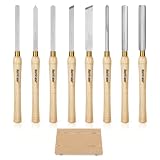

Which set makes sense for your situation?
- First lathe, occasional projects: Start with a modest HSS set containing a spindle roughing gouge, spindle gouge, parting tool, and a suitable scraper or skew. If sharpening feels like a barrier, consider a carbide set, but still learn safe tool-rest positioning and cutting technique.
- Small shop or limited sharpening space: A carbide set avoids the need to grind several different profiles. Check that replacement cutters are easy to obtain and reasonably priced. The cutter is a consumable, and a proprietary shape can make future ownership more expensive.
- Regular spindle turning: Favor a good spindle roughing gouge, spindle gouge, and parting tool over a large assortment of bowl tools. A roughing gouge is for spindle stock, not for turning bowl blanks.
- Bowls and faceplate work: Choose tools designed and sized for bowl turning, such as a bowl gouge and scraper. A short, light starter bundle may not provide enough reach or mass for larger work.
- Experienced turner replacing favorite tools: Buy individual tools or a focused premium set. Paying for several profiles you already own rarely improves the shop.
What separates useful tools from filler
Tool selection and dimensions
Read the tool names, not just the piece count. A six-piece set with clearly identified, distinct profiles is generally more useful than a twelve-piece set padded with duplicate sizes, tiny detail tools, or accessories unrelated to turning. Common starter profiles support different jobs: a spindle roughing gouge removes material on spindle work; a spindle gouge shapes coves and beads; a parting tool separates or sizes work; and a skew can produce clean spindle cuts when used with practice. Bowl turning calls for bowl-specific tools.
Check whether stated widths refer to the cutting edge, bar, or shank. Also look for the overall length and usable blade length. A tool that feels substantial in the listing may have a short blade that offers little room for future sharpening.
Steel quality and what the label tells you
“HSS” is a useful starting point, but it does not tell you the grade, heat treatment, or edge life. If the maker identifies a recognized grade such as M2 or powdered-metal steel, that adds information; it still does not replace sound manufacturing. Vague labels such as “premium steel” are hard to compare. For a low-cost set, expect to sharpen more often and inspect the cutting edge for chips or uneven grinding when it arrives.
Carbide is not automatically better or worse than HSS. It trades traditional sharpening and profile flexibility for easy cutter rotation or replacement. HSS can be reground into a different shape, while carbide tips are usually replaced when damaged or worn beyond useful rotation.
Handle construction and balance
A handle should give you control without forcing you to grip tightly. Look for a secure tang-to-handle fit, a ferrule that resists splitting, and enough length to keep your hands away from the tool rest and rotating work. Wooden handles can be comfortable and are often replaceable; hollow or modular handles can make storage and tool changes convenient. Check whether handles are included, since some premium tools are sold as unhandled blades.
Longer does not always mean better. A long handle can help control a larger bowl tool, but it can be awkward on a small lathe or crowded bench. If possible, match tool length and weight to the swing and work you expect to turn.
Budget for sharpening, not just the set
Traditional HSS tools need a sharpening plan. A bench grinder with a suitable wheel or a dedicated sharpening system, a safe tool-rest setup, and a honing option are common approaches. The right setup depends on the tool and the user; a jig can help repeat a profile, but it does not make an unsafe grinder setup safe. Follow the grinder and tool makers’ instructions, use eye protection, and keep the tool supported while sharpening.
As a simple ownership comparison, suppose a $70 HSS set is used for 30 sessions. Its purchase cost is about $2.33 per session before sharpening equipment, time, or replacement tools. If you need to buy a grinder specifically for it, that equipment can outweigh the set price. A $100 carbide set may be more economical for a beginner who already has no sharpening setup—but only if replacement cutters are affordable and the set suits the work. The calculation changes with frequency and what equipment you already own.
Keeping a set useful over time
- Sharpen before an edge is badly damaged. Touching up a dull edge usually removes less steel than repairing a chipped or overheated one.
- Keep profiles consistent. Record a useful bevel angle or jig setting for each tool. Repeatedly changing the profile can waste blade length and make cuts less predictable.
- Clean and store tools dry. Wipe off dust and moisture, and keep edges from knocking against one another. Surface rust and damaged cutting edges are avoidable sources of extra work.
- Buy replacements with ownership in mind. Check the availability and cost of carbide tips, handles, and compatible sharpening accessories before choosing a proprietary system.
For a first traditional set, prioritize a handful of distinct HSS tools with disclosed dimensions and enough blade to sharpen repeatedly. Choose carbide when convenient edge maintenance is more important than reshaping the cutting edge. For experienced turners, the strongest value is usually the few high-quality profiles that match the work—not the largest bundle.
0 Comments