Key takeaways
- A plain-language guide to router bit shanks, carbide grades and profiles, plus the small starter set that covers most real woodworking jobs.
What's inside
As an Amazon Associate I earn from qualifying purchases. This post may contain affiliate links at no extra cost to you.
Walk into a home center and you meet a wall of router bits, from a five dollar straight bit in a blister pack to a 40-piece boxed set. The packaging talks about piece count and coating color, not about the two things that decide how a bit cuts: how it is held, and how the edge meets the wood. Here are router bits explained from the shank up.
Hold this picture the whole way through. A router bit is a small milling cutter spinning at 10,000 to 24,000 rpm, gripped at one end only. Good cuts come from keeping it rigid, keeping it sharp, and giving chips somewhere to go. Piece count has nothing to do with any of that.
As an Amazon Associate we earn from qualifying purchases at no extra cost to you.


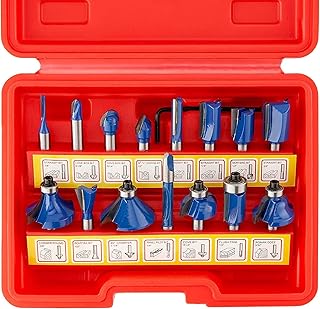


| Bit type | What it does | In your first set? |
|---|---|---|
| Straight, 1/4 in and 1/2 in | Flat-bottomed grooves, dados, hinge mortises | Yes, both |
| Flush trim, bearing at the tip | Copies an edge exactly, trims overhang and edge banding | Yes |
| Roundover, 1/4 in radius | Softens corners so finish holds and edges stop chipping | Yes |
| Chamfer, 45 degrees | Clean bevel, fast way to break a sharp edge | Yes |
| Rabbeting bit with bearing set | Shoulders for cabinet backs and glass | Buy second |
| Spiral, solid carbide | Slices fibers instead of chopping them, glassy walls | Best upgrade |
| Cove, ogee, beading | Decoration only, project specific | As needed |
Router Bits Explained: The Shank Is Structure, Not a Handle
The shank is the smooth rod that goes into the router, and most people treat it as a mounting peg. It is really the beam holding your cutting edge steady. Push sideways on the tip of a pencil, then on a broom handle. Stiffness climbs far faster than diameter, so moving from a 1/4 inch shank to a 1/2 inch shank does not double rigidity, it multiplies it, and it adds steel to carry heat away from the carbide.
The misconception worth correcting: a 1/2 inch shank does not cut faster or remove more wood. The edge does that. The bigger shank simply refuses to flex while the edge works, which is why the same profile chatters in hard maple on a 1/4 inch shank and behaves on a 1/2 inch one.
Your router holds the bit in a collet, not a drill chuck. A collet is a slotted sleeve that squeezes the whole circumference at once, so contact area matters. Insert most of the shank, leave a small gap rather than bottoming the bit out, and tighten with the wrench. Reducer sleeves work in a pinch, but a matching collet holds truer.
Bits for a 1/2-Inch Collet
If your router takes a 1/2 inch collet, buy that shank size by default and skip the 1/4 inch version of the same profile. Less chatter, cooler running, and the bits stay useful when the router eventually goes into a table.
Profiles: What the Cutting Edge Is Actually Doing
Straight and spiral bits
A straight bit has flutes parallel to the shank, so it chops fibers straight across, the way a chisel hits end grain. That is fine inside a groove nobody sees. A spiral twists the edge so it slices progressively, and the twist also works like a pump. Upcut clears chips out of deep mortises but lifts fibers on the top face. Downcut presses top fibers down for a crisp surface and packs chips into the slot, so take shallower passes.
Bearing-guided edge bits
Roundover, chamfer, cove, ogee, rabbet and flush trim bits all ride a bearing against the work, which is a fence you cannot forget to set. Change the bearing diameter and you change the depth of cut, which is why a rabbeting bit ships with a stack of them. A flush trim bit carries its bearing at the tip and follows the part underneath; a pattern bit carries it near the shank and follows a template on top. Owning both lets you flip the work and always cut with the grain.
Joinery bits
Rail and stile sets, lock miter, drawer lock and dovetail bits are matched geometry that only works at one exact height. They earn their keep on the twentieth repetition, not the first, so they do not belong in a starter kit.
Carbide, Coatings and Why Cheap Bits Feel Dull Fast
Nearly every woodworking bit is carbide, but that word covers a range. Tungsten carbide grains are cemented in a metal binder, and finer grain takes a keener edge while coarser grain shrugs off abuse. Carbide-tipped bits have a slab of carbide brazed to a steel body, and the quality of that braze and the final grind matter far more than the color of the coating. Solid carbide is one piece, used for small spirals where a brazed tip is not practical.
Second misconception: burn marks do not automatically mean a dull bit. Feeding too slowly, running a big diameter at full rpm, or letting pitch cake onto the flutes will scorch cherry and maple with a perfectly sharp edge. Clean the bit, keep moving, and slow the router down for large profiles.
Solid Carbide Spiral Bits
The upgrade most people notice immediately. A spiral leaves walls in plywood and figured hardwood that need almost no cleanup, so get one upcut for mortises and one downcut for dados in veneered sheet goods.
Which Router Bits to Buy First
Five bits cover most real work: a 1/2 inch straight, a 1/4 inch straight, a flush trim, a 1/4 inch roundover and a 45 degree chamfer. That kit cuts dados and grooves, copies parts from a template, trims edge banding, and breaks every sharp edge so the finish does not wear through at the corners. Add a rabbeting bit with a bearing set for your first cabinet, then buy decorative profiles one project at a time.
Flush Trim and Pattern Bit Pair
One accurate template plus these two bits turns into ten identical parts. Buy them in matching diameter and check that replacement bearings are a standard size you can actually find later.
- ✔ Cheap way to learn which profiles you actually reach for
- ✔ Case keeps carbide edges from banging together
- ✔ Fine for one-off decoration in softwood
- ✘ Carbide grade and grind quality are the usual place cost gets cut
- ✘ Most of the profiles never get mounted
- ✘ Often 1/4 inch shank only, so there is no upgrade path
- ✘ Rarely worth paying to have resharpened
Speed, Passes and Feed Direction
Rim speed is the part people skip. The outer edge of a 3 inch panel bit travels several times farther per revolution than the edge of a 1/2 inch straight bit, so at the same rpm it moves much faster and runs much hotter. Large diameter bits belong at the low end of the speed dial and in a router table. Small bits want the high end so each bite stays thin.
Depth is simpler. Reach the full profile in two or three passes instead of one. Feed so the bit’s rotation pushes back against you rather than dragging the tool along, which means counterclockwise around the outside of a workpiece handheld, clockwise inside a cutout, and right to left across a router table.
Router Bit FAQ
Can I use 1/4 inch bits in a router with a 1/2 inch collet? Yes, by swapping in the matching 1/4 inch collet that came with the router. Never force a small shank into a large collet, and prefer a true collet over a reducer sleeve when you have the choice.
Are router bits worth sharpening? Good ones are. Carbide is honed on the flat inside face only, with a fine diamond card and a few light strokes. Never touch the beveled outer face, since that changes the profile and the cutting diameter. Bargain bits are usually cheaper to replace.
Why does my profile have a small step or ridge in it? Almost always setup rather than the bit. Look for a bearing that shifted between passes, a base that rocked over the edge, stock lifting off the table, or a second pass taken at a slightly different height.
Buy fewer bits than you think you need, in the largest shank your router accepts, and judge them by grind quality instead of piece count. A short shelf of sharp, rigid bits will outwork a big case of soft ones every time.
Check prices on Amazon →
0 Comments