What's inside
As an Amazon Associate I earn from qualifying purchases. This post may contain affiliate links at no extra cost to you.
The best woodworking clamps for most shops are parallel-jaw clamps such as the Bessey K Body REVO or Jet parallel clamps for glue-ups, F-style clamps like the Bessey GearKlamp or Jorgensen bar clamps for general work, Irwin Quick-Grip one-handed clamps for holding parts, and Pony or Jorgensen pipe clamps for long, inexpensive reach. No single clamp style covers everything, so the smartest buy is a small mix sized to your projects rather than a pile of one type.
As an Amazon Associate we earn from qualifying purchases at no extra cost to you.

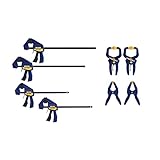


Our Top Picks
 IRWIN QUICK-GRIP Bar Clamps for Woodworking2 count (Pack of 1)8.2 x 3.5 x 0.9 inches0.1 poundsCheck on Amazon

Clamp types and what each is for
| Clamp type | Typical clamping force | Common lengths | Best use | Typical price each |
|---|---|---|---|---|
| Parallel-jaw (K-body style) | Up to about 1,500 lb | 12 in. – 98 in. | Panel glue-ups, case assembly, keeping work square | Roughly $40–$90 |
| F-style bar clamp | About 600 – 1,100 lb | 6 in. – 36 in. | General holding, edge gluing short parts, jig work | Roughly $15–$40 |
| Pipe clamp fixture | About 1,000 lb+ | Any length of 3/4 in. or 1/2 in. pipe | Wide tabletops, long glue-ups on a budget | Roughly $15–$30 plus pipe |
| One-handed bar clamp | About 100 – 600 lb | 6 in. – 36 in. | Holding parts while drilling, positioning, light gluing | Roughly $15–$35 |
| Spring clamp | Under 50 lb | 1 in. – 3 in. openings | Edge banding, veneer, small trim | Roughly $2–$8 |
| Hand screw | About 500 lb | 4 in. – 12 in. openings | Odd angles, holding small parts at the drill press | Roughly $25–$50 |
Clamping force figures are manufacturer ratings for the larger sizes in each class; real pressure delivered at the joint is lower and depends on how hard you turn the handle.
Specific clamps worth knowing
Bessey K Body REVO: the parallel-clamp benchmark
The REVO’s large jaw faces stay parallel under pressure, so a cabinet carcass or panel stays flat and square instead of bowing. The rail is stiff steel, the jaws are wide enough to spread load, and the clamps stand upright on their own during a glue-up. They are heavy and expensive, so buy them in the lengths you will use most, often 24 in. and 40 in.
Jet parallel clamps: a close alternative
Jet’s parallel clamps follow the same concept with a slightly different handle and jaw design. They are a common choice for shops that want parallel jaws at a modest discount to Bessey.
Bessey GearKlamp: F-style power in tight spaces
The GearKlamp moves its handle behind the bar through a gear drive, so you can tighten it where a normal F-clamp handle would hit the bench or another clamp. It is an excellent specialty clamp for jig work and inside cabinets.
Jorgensen and Bessey F-clamps: the everyday workhorses
Steel F-style clamps with a sliding jaw are the clamp you will reach for most often. Jorgensen and Bessey both make heavy-duty versions with hardened bars and cast jaws that resist flexing.
Irwin Quick-Grip: one hand free
Irwin’s trigger clamps let you position and tighten with one hand while the other holds the part. Pressure is moderate, so they are best for holding rather than for structural glue joints. The jaws can also reverse to spread parts apart.
Pony and Jorgensen pipe clamps: cheap length
Pipe clamp fixtures thread onto black iron pipe, so a 6 ft clamp costs a fraction of a parallel clamp of the same length. Their weakness is that the pipe flexes and the jaws are small, so use cauls to spread pressure and alternate them above and below a panel to prevent cupping.
How many clamps a glue-up actually needs
A practical rule for edge-gluing boards into a panel is one clamp about every 6 to 8 in. along the length, alternating top and bottom, with each end clamp about 2 to 3 in. from the end.
| Project | Panel or part size | Clamps needed | Suggested length |
|---|---|---|---|
| Cutting board | 12 in. x 18 in. | 3 – 4 | 18 in. – 24 in. |
| End table top | 20 in. x 24 in. | 4 – 5 | 24 in. – 30 in. |
| Bookcase carcass | 12 in. deep x 36 in. wide | 6 – 8 | 40 in. – 50 in. |
| Dining tabletop | 36 in. x 72 in. | 10 – 12 | 48 in. pipe or parallel clamps |
That last row is why many woodworkers buy pipe clamps for wide panels and reserve parallel clamps for carcass work where squareness matters most.
A sensible starter set
| Budget | What to buy |
|---|---|
| About $150 | 4 one-handed clamps (12 in.), 4 F-clamps (12 in. – 24 in.), a handful of spring clamps |
| About $350 | Above, plus 4 pipe clamp fixtures with 36 in. – 48 in. pipe |
| About $700+ | Above, plus 4 parallel-jaw clamps (two 24 in., two 40 in.) |
Add clamps as projects demand them. Buying a full set of 48 in. clamps before you know your projects often leaves expensive clamps sitting unused.
Glue-up technique that matters more than the clamp
- Dry-fit first. Set every clamp to the right opening before glue goes on; open time for standard yellow glue is only a few minutes.
- Use cauls (straight strips of wood, waxed or taped) across panels to keep boards flush and spread pressure.
- Aim for moderate pressure. A thin, even squeeze-out bead means enough pressure. Over-tightening can starve the joint and bow the panel.
- Check for square on carcasses by measuring diagonals; adjust clamp angle until they match.
- Protect the jaws. Clamp pads or scrap blocks prevent dents in softwoods and keep glue off the clamp.
What wears out
- Jaw pads crack or fall off; replacement pads are inexpensive for most major brands.
- Dried glue on bars causes sliding jaws to stick. Wax the bars and scrape glue off before it cures.
- Trigger clamp mechanisms can slip after years of heavy use; they are the first type to need replacement.
- Pipe threads rust; a light coat of paste wax on the pipe also prevents black marks on glue-ups.
Bottom line
Start with F-style and one-handed clamps for daily work, add pipe clamps for wide panels, and invest in parallel-jaw clamps when you begin building cabinets and casework where flat, square assemblies matter.

0 Comments