What's inside
- DeWalt Paint Sprayer Review: Power, Finish Quality & Value Compared
- First, an important lineup distinction
- What matters for unthinned latex
- DeWalt and Wagner: practical comparison
- Which sprayer makes sense for you?
- Is the premium worth it? A cost-per-use check
- Finish quality and ownership realities
- Verdict
- Related Guides
- DeWalt Paint Sprayer Review: Power, Finish Quality & Value Compared
- First, an important lineup distinction
- What matters for unthinned latex
- DeWalt and Wagner: practical comparison
- Which sprayer makes sense for you?
- Is the premium worth it? A cost-per-use check
- Finish quality and ownership realities
- Verdict
- Related Guides
As an Amazon Associate I earn from qualifying purchases. This post may contain affiliate links at no extra cost to you.
Our Top Picks


DeWalt Paint Sprayer Review: Power, Finish Quality & Value Compared
Short answer: A DeWalt airless sprayer is worth considering if you already own compatible DeWalt 20V MAX batteries and regularly paint fences, sheds, or other outdoor projects—but for spraying unthinned latex or finishing indoor trim, a corded Wagner airless or HVLP model is usually the more practical buy. DeWalt’s cordless advantage is real; a verified edge in finish quality, tip selection, or thick-paint capability over comparable Wagner equipment is harder to establish.
First, an important lineup distinction
“DeWalt paint sprayer” can mean a cordless airless sprayer, a corded airless machine, or a turbine HVLP gun. These technologies behave differently, so a single brand-versus-brand verdict can mislead. DeWalt’s best-known homeowner-focused option is the 20V MAX cordless airless sprayer. Wagner’s broad lineup includes corded airless equipment and HVLP sprayers such as the Control Spray and FLEXiO families. Check the exact model’s manual before choosing paint or tips: specifications from one type do not transfer to another.
As an Amazon Associate we earn from qualifying purchases at no extra cost to you.


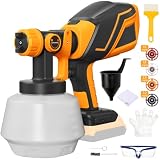

The cordless airless format is primarily about mobility and speed, not fine furniture finishing. HVLP typically offers more control and less overspray for smaller detail work, while airless systems cover broad surfaces quickly. If your must-have is spraying unthinned latex, confirm that the specific model and tip combination is rated for it; “airless” alone is not a guarantee.
What matters for unthinned latex
Paint viscosity is not a universal number you can compare across brands without knowing the test method, temperature, and measurement cup. A product’s maximum viscosity claim is useful only when the manufacturer states how it was measured and which materials are allowed. Latex formulations vary, and cold paint can flow quite differently from paint at room temperature.
DeWalt’s cordless airless sprayer is intended for compatible architectural coatings, but maximum material capability depends on the exact model, tip, and coating. Don’t assume every unthinned latex can pass through it. Consult the manual’s approved-material list and tip guidance; if the paint is outside those limits, follow its label and the sprayer maker’s thinning instructions. Straining paint can catch dried particles, but it does not make an unsuitable coating compatible.
For a fair test on a scrap board, bring the paint to the recommended temperature, strain it if the manufacturer recommends doing so, and use the specified tip. Start at a moderate pressure and make overlapping passes. Tails at the edges of the spray pattern can indicate insufficient pressure, a worn or unsuitable tip, or paint that is too thick. Fix the cause rather than immediately thinning the whole can.
DeWalt and Wagner: practical comparison
The table compares categories rather than claiming every model has identical specs. DeWalt model packages and Wagner configurations vary by market, so verify the current manual and included accessories before buying.
| Factor | DeWalt 20V MAX cordless airless | Comparable Wagner options | What it means for your project |
|---|---|---|---|
| Power source | 20V MAX battery platform; runtime depends on battery capacity, coating, pressure, and trigger time | Common homeowner airless and HVLP models are corded | DeWalt avoids a power cord; Wagner avoids battery-runtime limits. |
| Typical use | Mobile outdoor and maintenance work | Airless for broad coverage; HVLP for smaller, more controlled jobs | Choose the spray technology before comparing brand names. |
| Latex compatibility | Model- and coating-dependent; check approved materials and tip limits | Also model-dependent; some HVLP systems require thinning for latex | “Unthinned latex” must be confirmed in the specific manual. |
| Tip options | Use only tips approved for the exact sprayer; confirm compatible sizes and fan patterns | Airless models use model-specific tips; HVLP systems may use different nozzles and material settings | Do not assume tips interchange between brands or technologies. |
| Cleanup | Flush promptly using the coating maker’s recommended cleaner and the sprayer’s procedure | Same basic need; HVLP also requires cleaning the gun’s fluid passages and air cap | Cleaning time and discipline can matter more than the purchase price. |
| Price positioning | Often a higher-cost choice when the battery and charger are not already owned | Wide range from entry-level HVLP to more capable airless machines | Compare complete kits, not bare-tool prices against a full corded package. |
There is no defensible universal tip-size list for “DeWalt versus Wagner”: the approved sizes depend on the exact sprayer, coating, and application. Before purchasing, look for the manual’s supported tip range and the intended fan width. A wider fan can speed up siding or fencing, while a narrower pattern gives better control on rails and trim. The wrong tip can mean poor atomization, excessive overspray, or rapid wear.
Which sprayer makes sense for you?
- Occasional fence or shed work, DeWalt batteries already owned: The cordless DeWalt may justify its higher kit price if avoiding an extension cord is valuable. Expect to manage battery swaps on longer jobs.
- Large, stationary exterior project and no battery-platform preference: Compare corded airless Wagner models with the DeWalt package on included tips, hose or pickup arrangement, cleanup process, and warranty. A corded unit can keep working without a runtime break.
- Cabinets, furniture, or careful indoor trim: Consider an HVLP system rather than choosing an airless tool by brand. HVLP can be easier to control on smaller surfaces, though thick latex may need an approved adjustment or a different coating.
- First-time user with one small room: A sprayer may not save time after masking and cleanup. A roller and brush can be more economical unless the project has many doors, cabinets, or large surfaces.
- Frequent professional use: Compare duty expectations, serviceability, parts availability, and the cost of tips and filters. A cordless convenience premium pays off only if mobility improves enough jobs to offset it.
Is the premium worth it? A cost-per-use check
Use total kit cost, not just the sprayer’s headline price. As a rough market comparison, homeowner sprayers span about $100–$300 for many entry and mid-level options, while more capable airless packages can run roughly $300–$700 or more. Cordless kits may cost more than a bare tool, especially if you need batteries and a charger. These are broad ranges, not quotes; prices and package contents change.
For example, suppose a cordless kit costs $200 more than a suitable corded alternative. If you use it on five projects, that premium works out to $40 per project; across 20 jobs, it is $10 per project. That calculation does not include the value of avoiding cords—or the cost of spare batteries. If you already own compatible batteries, the cordless option can look much better. If not, include the battery investment before deciding.
Finish quality and ownership realities
A smooth finish depends on the coating, surface preparation, tip condition, pressure, distance, and technique—not just the motor. Hold the gun perpendicular to the surface, keep it moving before pulling the trigger, overlap passes consistently, and test the pattern on scrap. Masking remains essential: airless spraying can carry overspray well beyond the workpiece.
Tips and filters are wear items. Abrasive coatings and frequent use can wear a tip until the pattern grows wider and coverage becomes less consistent; a partially blocked tip can produce uneven edges. Clean the system immediately after use, following the manual for water-based or solvent-based materials. Never leave paint to dry in the gun, hose, or passages. For storage, use only the manufacturer-approved procedure and fluid.
Also budget for strainers, suitable cleaners, protective equipment, masking materials, and replacement tips when needed. Those costs apply to both brands. Avoid forcing paint through an incompatible setup: excessive pressure or improvised thinning can compromise the finish and may damage equipment.
Verdict
DeWalt’s cordless airless sprayer is a sensible choice when portability and an existing 20V MAX battery collection matter more than uninterrupted runtime or the lowest initial cost. Wagner is often the stronger value comparison for buyers who want a corded airless setup, or an HVLP tool for smaller finishing work. Neither brand wins every category, and claims about unthinned latex or tip compatibility should be checked against the exact model’s manual. For the best purchase, match the sprayer technology to the project, verify the coating and tip limits, and compare complete kits with cleanup and consumables included.


0 Comments