What's inside
As an Amazon Associate I earn from qualifying purchases. This post may contain affiliate links at no extra cost to you.
Quick answer: the Milwaukee paint sprayer lineup splits cleanly by job size — the M12 compact sprayer is the right pick for trim, cabinets, furniture, and touch-ups where finish control matters more than speed, while the M18 paint sprayer covers walls, ceilings, fences, and full rooms in a fraction of the time. If you spray paint more than a few times a year, the M18 pays for the difference in cleanup and reload frustration alone.
As an Amazon Associate we earn from qualifying purchases at no extra cost to you.


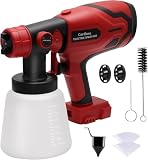
M12 vs M18 at a Glance
Milwaukee positions its sprayers inside two battery platforms, and the distinction is physical, not just marketing. The M12 compact sprayer is built around a small cup, a fine-finish setup, and a light body you can hold at shoulder height all afternoon. The M18 sprayer is a bigger tool with a larger hopper, more flow, and the grunt to move thicker material. Exact specs vary by kit, so verify the current model sheet, but the real-world differences look like this:
| Factor | M12 Compact Sprayer | M18 Paint Sprayer |
|---|---|---|
| Tool weight (bare) | Roughly 2.5–3.5 lb | Roughly 4.5–6 lb |
| Cup / hopper capacity | ~600–800 mL class | ~1 L class or larger |
| Typical coverage per fill | Small sections: a door, a chair, 30–50 ft of trim | A wall, a ceiling bay, or several fence panels |
| Spray pattern options | Fine-finish oriented, narrower fan | Wider fan plus detail settings |
| Best material | Thinned latex, enamel, stains, lacquers | Unthinned or lightly thinned latex, stains, primers |
| Battery drain | A 4.0–6.0 Ah pack covers a small room’s trim on one charge | Plan on 1–2 high-output packs (5.0 Ah+) for a full room |
| Cleanup time per session | 10–15 minutes | 15–25 minutes |
| Street price range (tool only) | Lower — compact tool category pricing | Mid-range cordless sprayer pricing; kits with batteries cost more |
Coverage per Battery: What a Charge Actually Buys You
Coverage is where the platforms genuinely diverge, and it depends on two variables: how much material the tool moves per minute and how often you stop to refill.
On the M12, a mid-size battery realistically delivers enough spray time to shoot a five-panel door on both sides plus a run of baseboard — call it 20–35 minutes of actual trigger time. The limitation isn’t the battery; it’s the cup. You’ll refill two or three times on a single bedroom’s worth of trim, and each refill is a stop, a wipe-down of the threads, and a re-prime.
The M18 flips that ratio. With a 5.0 Ah or larger high-output pack, you can spray roughly a gallon of material — enough for one coat on the walls of a typical 12×12 room — before the pack needs swapping. If you already own two M18 packs, continuous work is easy: charge one while you spray the other.
Finish Quality: Trim vs Walls
Finish quality is less about the platform and more about matching the tool’s sweet spot to the surface.
Trim, doors, and cabinetry
This is the M12’s home turf. Its narrower fan and finer atomization suit enamel and lacquer, and the light weight means you can hold a consistent 8–10 inch distance on vertical cabinet faces without arm fatigue destroying your overlap. Vertical spraying is where heavier sprayers lose amateurs: a drooping wrist at minute twenty produces sags at minute twenty-one.
Walls and ceilings
The M18 wins here, with a caveat. Its wider fan lays down a wall coat fast, but fine-atomization control is coarser than dedicated fine-finish units, so expect to backroll high-visibility walls if you want a dead-flat finish. On ceilings, textured surfaces, and exterior siding, nobody will notice — speed dominates. For the walls of a living room under raking light, thin the paint per the manual, spray, and backroll.
Cleanup Time: The Real Cost Per Job
Cleanup is the hidden variable in any sprayer decision. Budget it honestly:
- M12: 10–15 minutes. Fewer wetted parts, a smaller cup, and quick access to the needle/nozzle assembly. Water-based paint flushes fast.
- M18: 15–25 minutes. Bigger fluid path, more residual material in the hopper, and a bit more disassembly. Skipping a thorough flush shows up next job as spitting.
Run the math on a per-job basis and a pattern emerges. If your typical project is a single door or a set of shelves, an M18 job costs you 25 minutes of cleanup for 10 minutes of spraying — a bad trade. If your typical project is a full room, the M12 costs you three refills and 40 extra minutes of masking-and-starting-over. Match the tool to your median job, not your dream job.
Decision Matrix: Which Milwaukee Paint Sprayer Fits You
| Your situation | Recommended | Why |
|---|---|---|
| Mostly trim, furniture, cabinets, occasional door | M12 | Fine control, light weight, fast cleanup on small jobs |
| Rooms, ceilings, fences, regular repaint work | M18 | Coverage per fill and per battery dominates |
| Already on M12 batteries only | M12 | Platform investment beats marginal capability |
| Already on M18 batteries (trades, homeowner with M18 kit) | M18 | Batteries you own subsidize the bigger tool |
| Budget-sensitive, first sprayer | M12 | Lower entry cost; easier to learn on smaller projects |
| Spraying more than ~10 times a year | M18 | Cleanup and refill time compounds per job |
Ownership Realities Listings Don’t Mention
- What wears first: tips/nozzles and seals. A worn tip widens your fan and burns material. Plan a tip as an annual consumable under moderate use; keep spare seals and a filter on hand.
- Filters clog before anything breaks. A clogged filter mimics a dead tool — weak spray, surging. Clean it every session, not every season.
- Strain your paint. The single most common sprayer mistake is spraying paint straight from the can. A cheap mesh strainer eliminates most spitting and most “this tool is junk” moments.
- Oil-based and solvent materials change the cleanup math. Factor in mineral spirits flushing and slower drying on the wetted parts; add 5–10 minutes to either tool.
- Lubricate the needle packings per the manual. A dry packing drags the needle and produces pulsing fans.
FAQ
Can the M12 handle unthinned latex?
It’s happier with thinned material. For thick wall paint, thin per the manual’s guidance or step up to the M18, which is designed to move heavier coatings.
Is one sprayer enough for a whole house repaint?
Owners doing whole-house work commonly run both: M18 for walls and ceilings, M12 for trim and doors. If you can only buy one for that job, buy the M18 and accept slightly slower detail work.
Do I need a high-output battery?
For the M18, a 5.0 Ah pack is the practical minimum for room-scale work. The M12 runs fine on standard compact packs for its intended job size.
Bottom line: buy the Milwaukee paint sprayer that matches your most frequent job size, not your biggest one. Trim-and-furniture owners get a better experience from the M12; room-and-exterior owners should go straight to the M18 — and if you’re spraying regularly, the pair makes more sense than either alone.

0 Comments