What's inside
As an Amazon Associate I earn from qualifying purchases. This post may contain affiliate links at no extra cost to you.
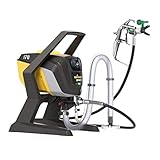
The right Wagner airless paint sprayer for most homeowners is the Control Pro 170 — it balances power, hose reach, and duty rating for whole-house exterior work — while the Control Pro 130 or 150 makes more sense if you’re spraying a few rooms a year. Below is how the four Control Pro HEA models actually differ and which situations each one fits.
As an Amazon Associate we earn from qualifying purchases at no extra cost to you.



Our Top Picks
 Wagner Spraytech Control Pro 150 HEA Airless PaintControl Pro 15013.5 x 16 x 18.2 inchesCheck on Amazon
 Wagner Spraytech FLEXiO 595 Handheld HVLP Paint andFLEXiO 59518 x 7 x 13.75 inches0 PoundsCheck on Amazon

What HEA Actually Means (and Why It Matters)
Every model in this comparison uses Wagner’s HEA (High Efficiency Airless) system. Instead of spraying at conventional airless pressures, HEA pumps run at roughly 1,000–1,500 PSI through a reversible tip with a pre-orifice that softens the stream. Wagner claims up to 55% less overspray than standard airless sprayers, and in practical terms that means less masking, less back-rolling, and a forgiving fan pattern for DIY users. The trade-off: HEA models move less paint per minute than contractor-grade airless units, so they’re sized by annual gallonage, not daily production.
Control Pro Lineup at a Glance
| Spec | Control Pro 130 | Control Pro 150 | Control Pro 170 | Control Pro 190 |
|---|---|---|---|---|
| Max tip size | 0.013″ | 0.015″ | 0.017″ | 0.019″ |
| Max flow | ~0.24 GPM | ~0.29 GPM | ~0.33 GPM | ~0.40 GPM |
| Hose included | 25 ft | 25 ft | 30 ft | 50 ft |
| Recommended annual use | ~125 gal | ~150 gal | ~300 gal | ~500 gal |
| Paint source | Suction tube, 1–2 gal | Suction tube, 1–2 gal | Suction tube, up to 5 gal | Suction tube, up to 5 gal |
| Form factor | Compact, carry handle | Compact, carry handle | High-boy cart | High-boy cart |
| Typical price range | Budget tier | Low-mid tier | Mid tier | Upper-DIY tier |
The spec that quietly decides most purchases is max tip size, because it caps what you can spray. Latex wall paint flows fine through a 0.013″–0.015″ tip. Unthinned exterior acrylic and elastomeric coatings want 0.017″ or larger — which rules the 130 and 150 out for heavy exterior work done at speed.
Head-to-Head: Which Model for Which Job
Single rooms and interior repaints: Control Pro 130 or 150
A 12×12 room is roughly 350–400 square feet of wall — one to two gallons of paint, maybe 30 minutes of spraying. The 130’s 125-gallon annual rating covers that scale of use for years. Its compact body stores in a closet, and cleanup is faster because there’s less hose to flush. The 150 earns its premium mainly through the larger 0.015″ tip allowance, which handles thicker paint without thinning, and a slightly stronger pump that holds pressure more consistently across a long wall. If you’ll only ever spray interiors a few times a year, spending beyond the 150 is hard to justify.
Exterior siding, fences, and decks: Control Pro 170
Exterior work is where the 170 separates itself. The 0.017″ tip sprays most exterior acrylics unthinned, the cart rolls around the house instead of needing to be carried, and the suction tube sits directly in a 5-gallon bucket — no decanting. A 1,500-square-foot single-story home’s siding typically takes 8–12 gallons, which the 170’s ~300-gallon annual rating absorbs easily alongside fences and outbuildings. The 30-foot hose reaches across a typical wall section without repositioning, though two-story work means moving the unit more often than the 190’s 50-foot hose would.
Two-story exteriors and frequent large projects: Control Pro 190
The 190 is the pick when the limiting factor is reach and throughput, not budget. The 50-foot hose lets you park the unit on the ground and spray a full two-story gable from a ladder or extension wand without relocating. The 0.019″ tip and ~0.40 GPM flow keep pace on big open surfaces like barn walls or long fence runs. Its ~500-gallon annual rating suits semi-pro use — landlords, flippers, anyone spraying multiple properties per season. For a homeowner doing one house every ten years, it’s more machine than the job needs.
Decision Matrix
| Your situation | Pick | Why |
|---|---|---|
| A few interior rooms per year, tight storage | Control Pro 130 | Cheapest entry, fastest cleanup, enough duty rating |
| Interiors plus the occasional fence or shed | Control Pro 150 | Bigger tip handles thicker coatings |
| Full exterior repaint, single-story home | Control Pro 170 | Cart + bucket suction + 0.017″ tip hits the sweet spot |
| Two-story exterior or 500+ gal/season | Control Pro 190 | 50-ft hose and highest flow for sustained large work |
| Primarily cabinets and furniture | None — look at HVLP instead | HEA airless fans are tuned for walls, not fine finish |
Worked Example: What a Siding Job Actually Costs in Runtime
Take 1,800 square feet of lap siding at roughly 300 square feet per gallon — that’s about 6 gallons of paint. With the 170 spraying near 0.33 GPM with realistic pauses, figure roughly 30–45 minutes of actual trigger time split over two coats’ worth of passes. Compare that to a roller-and-brush weekend. The catch is prep and cleanup: masking windows and flushing the system adds an hour on each end. On jobs under ~400 square feet, a roller is often faster end-to-end; the sprayer pays off when surface area climbs past that threshold or the surface is heavily textured (rough sawn siding, stucco, brick), where spraying reaches crevices a roller can’t.
Ownership Realities a Listing Won’t Tell You
- Tips are consumables. HEA tips wear with abrasive paint; a tip that started at 0.015″ gradually fans wider and droopier. Plan on a replacement every 50–100 gallons — cheap insurance against a ruined finish.
- Cleaning is the real chore. Flushing the pump, hose, gun, and tip takes 20–30 minutes with water (latex) or the correct solvent. Dried latex inside the suction tube is the most common cause of “the sprayer broke” complaints — it’s almost always a cleaning failure, not a pump failure.
- Storage matters. Run pump armor or the manufacturer’s storage fluid through the system between seasons; a pump left wet with plain water can corrode internally over winter.
- Common mistake: thinning paint out of habit. HEA systems are designed for unthinned latex; over-thinning causes runs and weak coverage.
- Overspray is reduced, not eliminated. You’ll still need drop cloths, masking, and calm days outdoors — just less of them than with conventional airless.
FAQ
Can the Control Pro spray elastomeric or very thick coatings?
The 190 handles heavier elastomeric products better thanks to the 0.019″ tip ceiling; the smaller models will struggle or refuse to prime. Check the coating’s label for a required tip size and match it against the model’s max.
Is the hose upgradeable?
Yes — airless hoses are a standard fitting, so a 130 or 150 can accept a longer hose. The limiting factor is the pump’s ability to maintain pressure over distance, so past ~50 feet, gains diminish on the smaller pumps.
Do I need an extension wand?
For second stories and tall ceilings, a 20–30 inch tip extension is one of the most useful accessories for any of these models — it keeps you off ladders longer and reduces fatigue.
Bottom line: match the model to your annual gallons and tip needs, not to the biggest number on the shelf. The Control Pro 170 covers the most ground for the most people; the 130 wins on simplicity, and the 190 wins when reach and volume are the job.


0 Comments