What's inside
As an Amazon Associate I earn from qualifying purchases. This post may contain affiliate links at no extra cost to you.
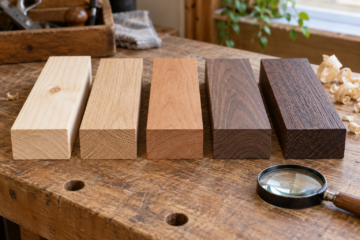
Mahogany is prized for its even texture, warm red-brown color, and generally straight, workable grain. It is also a broad trade name: genuine Honduras mahogany (Swietenia macrophylla), African mahogany (Khaya spp.), sapele (Entandrophragma), and several unrelated reddish woods may all be sold as “mahogany” or “mahogany substitute.” Grain pattern is one of the quickest ways to separate them, especially when the board is unfinished.
Why grain pattern matters
Color alone is unreliable. A stain, clear coat, age, and even the lighting in a lumberyard can make different species look nearly identical. Grain remains more useful because it reflects the way the wood was cut and the structure of the species.
Start by examining a freshly planed or sanded surface. Scratched, oxidized, or heavily stained boards hide important details. Use bright light held at a low angle, and inspect both the face and end grain. A small amount of mineral spirits can temporarily darken the surface and reveal figure, but test it on an offcut first.
Look for three things: the direction of the pores, the contrast between earlywood and latewood, and whether the grain stays straight or changes direction in repeating bands. Do not rely on one feature. A plain-sawn board can look dramatically different from a quarter-sawn board of the same species.
What genuine mahogany usually looks like
Honduras mahogany commonly has a straight to interlocked grain, medium-to-coarse texture, and open but not dramatically ring-porous pores. The surface often shows subtle ribboning, flame, or chatoyance when the grain interlocks. Quarter-sawn boards may display narrow stripes, while plain-sawn boards can show broad, quiet cathedral shapes.
Its pores are usually visible without being harshly contrasted. The grain tends to look calm rather than sharply striped. On a freshly cut board, the color may range from salmon or pinkish tan to orange-brown. Exposure gradually deepens it to a richer red-brown.
A key practical clue is workability. Genuine mahogany generally planes and sands cleanly, though interlocked areas can tear out. It accepts oil, varnish, and film finishes evenly. If a board has extremely strong alternating light-and-dark stripes or a very coarse, splintery surface, it may be something else.
Common substitutes and their grain signatures
| Wood | Typical grain pattern | Surface and finishing clues |
|---|---|---|
| African mahogany | Usually straight or interlocked, with more visible contrast and occasional ribbon figure | Can be coarser and more variable than genuine mahogany; some boards have brittle or fuzzy areas |
| Sapele | Distinctive interlocked grain, often producing regular stripes, ribbons, or shimmering figure | Can tear out while planing; pores and alternating bands often remain visible under clear finish |
| Khaya-type substitutes | Moderate to strong grain movement, sometimes with wavy or rope-like lines | Color varies widely; may need careful sanding to avoid uneven stain absorption |
| Meranti or Philippine mahogany | Ranges from straight and plain to coarse, irregular, or interlocked | Often less consistent in color and texture; soft pieces can dent and fuzz during sanding |
| Genuine mahogany | Mostly straight to gently interlocked, with restrained ribbon or cathedral figure | Even workability, moderate open pores, and a relatively uniform appearance |
Recognizing sapele by its grain
Sapele is one of the most convincing mahogany substitutes, but its interlocked grain is usually more obvious. Look along the board while tilting it under a light. The surface may flash from light to dark in alternating bands, often called ribbon stripe on quarter-sawn stock. Plain-sawn sapele can show dramatic waves or a mottled, broken stripe.
Those stripes are not just cosmetic. Interlocked grain changes direction from one short section to the next, so a hand plane or powered planer can lift fibers and create tear-out. On figured sapele, use a sharp cutter, light passes, and a low cutting angle when possible. For final preparation, start with 120-grit paper and progress through 150 and 180. Going much finer before staining can close the surface and cause a pale, uneven result.
African mahogany and meranti clues
African mahogany is not one uniform-looking material. Some boards are close to genuine mahogany, while others have stronger interlocking, darker streaks, or a coarser texture. If the seller labels it only “African mahogany,” ask for the botanical name or at least the species group. Grain inspection can suggest a match, but it cannot reliably identify every Khaya species.
Meranti, often marketed under the old name Philippine mahogany, is even more variable. Plain boards can be perfectly serviceable for painted furniture, interior trim, shelves, and utility work. However, low-grade pieces may have soft zones, fuzzy fibers, resin pockets, or uneven density. These defects become obvious after staining, especially with dark red-brown colors.
For a clear-finished project where grain consistency matters, pay for better stock rather than trying to correct a poor board with stain. For painted work, the cheaper substitute is often fine after sealing and filling.
Use end grain as a secondary check
End grain can confirm what you see on the face, but it is not a perfect field test. Mahogany-type woods generally show diffuse-porous structure: pores are spread relatively evenly rather than forming the strong earlywood bands seen in many oak species. Use a sharp knife or fresh sanding on the end, then inspect with a 10x loupe.
Do not confuse large open pores with a ring-porous pattern. The pores should not form a distinct row at the start of every growth ring. Also check for a very fine, uniform texture that might indicate a different reddish wood or a painted and filled surface.
Test the finish before committing
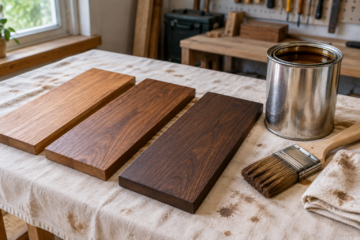
Sand an offcut through 180 grit, remove dust, and apply the intended finish. A clear water-based finish will preserve a lighter, pinker appearance; oil-based finishes usually add amber warmth and make the grain look deeper. Test both if color is important.
For open-pored boards, a wood grain filler can produce a smoother tabletop or door. Apply it only after confirming the color. Tinted filler may collect in pores and create dark freckles if the board has uneven absorption. A thin washcoat of dewaxed shellac can reduce blotching before stain, but it can also reduce color depth if applied too heavily.
Buying and preparing the board
Buy from a supplier that identifies species and lets you inspect the board. Reject pieces with unexplained paint, thick oxidation, or only one visible face. Compare boards side by side, view them at an angle, and check whether the grain pattern continues through the edge.
For general furniture, a straight-grained substitute that costs 30 to 50 percent less can be a sensible choice. For a highly visible clear finish, consistent grain and stable moisture content matter more than the name on the bundle. Store boards flat with spacers and allow them to acclimate for at least several days before final milling.
If the surface is rough, use a sharp hand plane or take shallow machine cuts. Finish sanding with fresh 120-, 150-, and 180-grit abrasives, sanding with the grain. Stop when the scratch pattern is uniform; sanding longer will not fix tear-out, crushed fibers, or a mismatched grain pattern.
0 Comments