What's inside
As an Amazon Associate I earn from qualifying purchases. This post may contain affiliate links at no extra cost to you.
Mahogany and walnut can both produce a dark, attractive table under clear finish, but they get there in different ways. Walnut is usually the easier choice if you want a naturally brown surface with visible grain. Mahogany is worth considering when you want a redder, more uniform look or need a less expensive alternative—but “mahogany” covers several species, and not all are the same color or quality.
The clear coat matters as much as the wood. It protects the surface, but it also deepens color and adds sheen. Judge samples with the finish you plan to use, not from bare-wood photos.
As an Amazon Associate we earn from qualifying purchases at no extra cost to you.

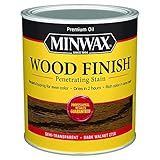


Our Top Picks
 Varathane Total Control Dark Walnut Gel StainQuart (Pack of 1)4.25 x 4.25 x 4.9 inches2.07 poundsCheck on Amazon
 Varathane Water-Based Ultimate Satin PolyurethaneHalf Pint (Pack of 1)3 x 3 x 3 inches0.64 poundsCheck on Amazon


Color and grain under clear finish
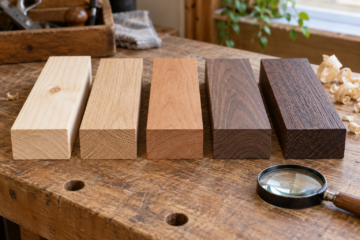
Black walnut heartwood ranges from light brown to chocolate brown, sometimes with gray, purple, or nearly black streaks. Its color can vary across one board. A clear oil or oil-based finish usually warms and darkens it; a water-based finish tends to change the color less. Walnut also lightens with prolonged exposure to sunlight, so a freshly finished sample may not match the table after years in a bright room.
Genuine mahogany, usually Khaya or Swietenia sold under that name, is often pinkish or reddish brown. Clear finish brings out the red and can make it look darker and richer. Grain is often straighter and more even than walnut’s, though interlocked grain can produce ribbon-like figure. Be wary of assuming every board labeled “mahogany” will match a familiar reddish sample: the name is used loosely in the market.
For a dark table, walnut normally needs no stain. Staining walnut can obscure its natural variation and make scratches or repairs more obvious. Mahogany may also look good unstained; test it first before reaching for a dark stain.
Practical comparison
| Factor | Walnut | Mahogany |
|---|---|---|
| Typical clear-finished color | Brown to chocolate, with varied tones | Reddish or pinkish brown, often more even |
| Grain character | Often lively, with figure and color changes | Often straighter, sometimes ribbon-striped |
| Hardness | About 1,010 lbf on the Janka scale | Varies by species; genuine mahogany is around 800 lbf |
| Tabletop wear | Good for normal use; dents remain possible | Also suitable, but some varieties dent more easily |
| Cost and availability | Often costly, especially in wide, clear boards | Can be cheaper, but species and supply vary |
| Best fit | Natural brown color and pronounced variation | Red-brown color and a more uniform look |
Janka numbers are useful for comparing dent resistance, not for predicting whether a finish will scratch. Both woods are softer than hard maple or white oak. A sharp impact can dent either one, and a thin clear coat will not prevent that damage.
What to inspect before buying
Choose boards in person when possible. Lay them side by side and look at the full length in neutral light. For a dark, restrained tabletop, avoid boards with abrupt pale sapwood unless you like the contrast. Walnut often has a pronounced light sapwood band; mahogany can also vary in tone between boards.
Check for twist, cup, cracks, knots, and end checks. Ask whether the stock is kiln-dried and acclimate it in the room where it will be used. For indoor furniture, a moisture content around 6–8% is a practical target in many heated homes, though local climate matters. Buy enough extra length and width to remove defects and trim ends.
If comparing prices, calculate the cost of usable material, not just the price per board foot. A cheap board with wide sapwood, severe cup, or short clear sections may yield less than a pricier one. For a painted base or an unseen part of the table, walnut’s extra cost is hard to justify; use a stable, less expensive wood there.
Preparing the surface
Mill the top flat, then sand progressively. A typical sequence is 80 or 100 grit to remove milling marks, followed by 120, 150, and 180. Stop at 180 or 220 for most clear finishes. Sanding much finer can reduce finish adhesion or make stain absorb unevenly. Use a random-orbit sander with light pressure, then hand-sand with the grain to remove swirl marks.
Mahogany’s open pores may remain visible beneath clear finish. That is normal. If you want a glass-smooth surface, use a compatible grain filler; expect additional work and a less natural texture. Walnut pores are also visible, though the effect depends on the board and finish. Before coating, vacuum the surface and wipe it with a clean, dry cloth. Avoid oily tack cloths that can leave residue.
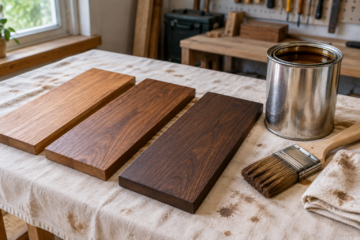
Make a test board from offcuts, sanded and finished exactly like the tabletop. Include the same edge treatment and number of coats. This reveals color shifts, blotching, and sheen before they become expensive surprises.
Choosing and applying a clear coat
For a table used every day, a film finish such as polyurethane offers better resistance to water and household spills than a simple oil finish. Water-based polyurethane generally preserves a lighter, less amber color. Oil-based polyurethane adds warmth and deepens both woods, especially mahogany. Compare water-based polyurethane and oil-based polyurethane on scrap before choosing.
Follow the can’s spread rate and recoat times; many products call for three or more coats on a tabletop. Sand lightly between coats only as directed, commonly with 220–320 grit, and remove the dust. Keep each coat thin enough to avoid runs and ridges. A thick coat can look impressive at first but may cure slowly and show scratches plainly.
Oil finishes are easier to refresh and keep a low-build, natural feel, but they offer less protection against standing water, alcohol, and heat. Neither polyurethane nor oil makes a table damage-proof. Use coasters, wipe spills promptly, and do not set hot cookware directly on the surface.
Which one makes sense?
Choose walnut if its natural brown color and varied grain are the point of the table, and the price fits the budget. Choose mahogany if you prefer red-brown color, straighter grain, or a lower material cost after checking the actual boards. If the table will be stained very dark, ask whether a less expensive species will do the job instead; paying for walnut or mahogany and covering its character may not be worthwhile.
0 Comments