What's inside
As an Amazon Associate I earn from qualifying purchases. This post may contain affiliate links at no extra cost to you.
For clear-finished shelving, the choice between Baltic birch and ApplePly comes down to how much you value edge appearance, face-veneer quality, stability, and cost. Both are much better-looking than ordinary construction plywood, but they are not interchangeable. Baltic birch is usually the practical choice for painted shelves, shop furniture, and visible laminated edges. ApplePly is often the better choice when the broad faces will remain natural and you want a more furniture-like appearance.
Our Top Picks
 Varathane Water-Based Ultimate Satin PolyurethaneHalf Pint (Pack of 1)3 x 3 x 3 inches0.64 poundsCheck on Amazon

What You Are Actually Buying
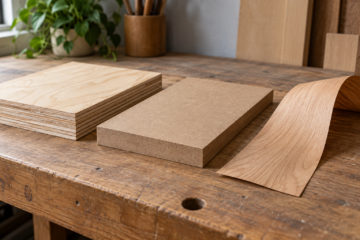
Baltic birch plywood is built from many thin birch veneers, with birch face plies and a relatively consistent all-birch core. The layers are usually free of the large internal voids found in inexpensive plywood. Its edge shows a regular stack of pale plies, which is why it is popular for modern shelving and cabinets.
ApplePly is a hardwood plywood product made with a decorative hardwood face and a more engineered core construction. Depending on the product, the face may be maple, cherry, walnut, or another hardwood. The exposed face is the main attraction: it can look like a finished piece of furniture after sanding and clear coating. ApplePly is also commonly sold in useful furniture-grade thicknesses and is generally flatter and more consistent than commodity plywood.
Check the actual product specification before ordering. “Baltic birch” is sometimes used loosely for plywood made outside the traditional Baltic region, and imported sheet thicknesses may be listed in millimeters. A nominal 3/4-inch sheet may measure about 18 millimeters, or roughly 0.71 inch, rather than a full 0.750 inch.
Face and Edge Appearance
For a shelf with a clear finish, the broad face normally matters more than the core. Baltic birch has a light, relatively plain face with small grain and occasional patches or mineral streaks. It looks clean and understated, but it does not have the depth or figure of a good maple, cherry, or walnut face veneer.
ApplePly’s appearance depends on the face species and veneer grade. A clear finish can emphasize attractive grain, but it also makes color variation, veneer joints, patches, and sanding marks easier to see. Request or inspect the actual sheets when possible; plywood faces can vary substantially even within the same product line.
Baltic birch has the advantage on exposed edges. Its thin, uniform plies produce a deliberate striped look. ApplePly edges can be attractive, but they may show a different core pattern, face-ply transition, or occasional gaps depending on the construction. If the shelf edge will be visible, cut a sample and apply finish before committing to a full project.
| Feature | Baltic birch | ApplePly |
|---|---|---|
| Best visual use | Clean, pale faces and exposed laminated edges | Furniture-grade natural faces |
| Core consistency | Usually very consistent with few voids | Consistent engineered core, product-dependent |
| Clear-finish appeal | Good, but relatively plain | Usually better when grain and species matter |
| Typical cost | Lower to moderate | Moderate to high |
| Exposed edge | Often attractive without banding | May need edge treatment or careful evaluation |
| Availability | Common at specialty plywood suppliers | More limited and often supplier-dependent |
Strength, Thickness, and Sag
Neither plywood automatically makes a long shelf sag-proof. Shelf depth, load, support spacing, and thickness matter more than the brand name. A 30-inch shelf carrying books is a different problem from a 60-inch shelf holding lightweight objects.
For shelves up to roughly 30 to 36 inches between supports, 3/4-inch plywood is often adequate for moderate household loads when the shelf is at least 10 inches deep. At longer spans, add a front stiffener, center divider, cleat, or metal shelf support. A solid-wood nosing 1 to 1-1/2 inches tall can dramatically reduce visible sag without doubling the plywood thickness.
Baltic birch’s many plies give it good screw-holding and predictable machining. ApplePly is also strong and stable, but the exact core and face construction affect fastener holding. Avoid placing screws too close to an edge; keep the pilot hole at least 3/8 inch from the edge on 3/4-inch stock, and use a pilot hole sized for the screw’s solid shank rather than forcing a large screw into the plywood.
Cutting and Preparing the Surface
Use a sharp, fine-tooth blade. A 60- to 80-tooth table-saw or track-saw blade gives cleaner clear-finish edges than a general-purpose framing blade. Support the sheet fully, and put the best face up on a table saw or down when using a handheld circular saw, depending on the blade’s tooth direction and tear-out pattern.
Sand the faces lightly with 150 grit, then 180 grit. Stop at 180 or 220 grit for most waterborne finishes. Sanding much finer can burnish the veneer and reduce finish adhesion. Do not aggressively flatten a plywood face: the decorative veneer may be only about 1/32 inch thick or less, and it is easy to sand through at edges or patches.
For small dents, use a damp cloth and brief heat only with caution; plywood veneer can lift. Fill screw holes with a color-matched filler, not ordinary white spackle. On Baltic birch edges, break the sharp corner with 180-grit paper. A tiny roundover, around 1/16 inch, reduces chipping and gives clear finish a smoother highlight.
Choosing a Clear Finish
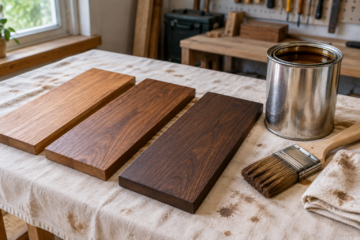
Water-based polyurethane keeps birch and maple relatively light and dries quickly. Oil-based polyurethane adds amber color and can make cherry or walnut look richer, but it also darkens pale birch. Hardwax oil gives a low-build, natural feel but provides less film protection against standing water and abrasion than polyurethane.
For a frequently handled shelf, use a durable water-based polyurethane or a comparable furniture finish. Apply at least three thin coats to the top and front edge, sanding lightly with 320 grit between coats when the label calls for it. Finish the underside and all edges as well. Coating only the top can encourage uneven moisture exchange and slight cupping.
Both plywood types benefit from a test board. Some birch faces blotch or look uneven under oil-based products, while dark ApplePly species can become much darker than expected. A clear coat will not hide glue squeeze-out, sanding scratches, or veneer repairs; it highlights them.
Which One Should You Buy?
Choose Baltic birch when the edge will be visible, the shelf will be painted, the design is utilitarian, or you need predictable cutting and screw holding at a reasonable price. It is also the sensible choice when the clear finish is mainly protective rather than decorative. A quality sheet from a plywood supplier is usually a better buy than thin, damaged panels from a general hardware aisle. Look for 3/4-inch Baltic birch plywood when small project panels are sufficient.
Choose ApplePly when the broad faces are the visible design feature, the project needs a particular hardwood appearance, and the higher sheet price fits the budget. It is not automatically stronger enough to eliminate shelf supports, and it is not worth the premium if you plan to paint the project or cover every edge with solid-wood banding.
For many clear-finished shelves, the best value is a hybrid approach: use ApplePly for prominent exterior panels and Baltic birch for hidden dividers, backs, or painted components. Buy extra material for visible parts, inspect both faces before cutting, and make the finish sample before building the entire shelving unit.
0 Comments