What's inside
As an Amazon Associate I earn from qualifying purchases. This post may contain affiliate links at no extra cost to you.
Sapele and Spanish cedar can both produce an attractive interior door, but they behave differently under stain and clear finish. Sapele is usually the better choice when you want a dense, hard-wearing surface with a mahogany-like look. Spanish cedar is lighter and easier to work, with a softer surface and a distinctive cedar scent. For either species, the finish result depends as much on sanding, veneer quality, and sample testing as on the wood itself.
As an Amazon Associate we earn from qualifying purchases at no extra cost to you.


Our Top Picks
 Varathane Water-Based Ultimate Satin PolyurethaneHalf Pint (Pack of 1)3 x 3 x 3 inches0.64 poundsCheck on Amazon

Quick comparison
| Consideration | Sapele | Spanish cedar |
|---|---|---|
| Typical appearance | Reddish brown; often striped or ribbon-figured | Pinkish to reddish brown; usually less dramatically striped |
| Hardness and weight | Denser and harder; resists dents better | Lighter and softer; dents more readily |
| Working and sanding | Can tear out where grain reverses; figured faces may need careful sanding | Generally easy to machine and sand; soft fibers can compress or fuzz |
| Finish concerns | Figure and color can vary; oily surface may affect some bonding | May show uneven stain absorption; softer areas can look blotchy |
| Best fit | Doors likely to take regular knocks, or a bold figured look | Lightweight doors, or projects where easy machining matters |
Both names cover a range of boards and veneers, so treat these as typical tendencies, not guarantees. Ask to see the actual door face or veneer lot before choosing.
Appearance and finish
Sapele’s grain can alternate between straight and interlocked, creating stripes that shift as you move around the door. A clear finish often makes that figure more prominent. That is an advantage if you want visual movement, but a disadvantage if you expect a quiet, uniform panel. A dark stain can reduce the contrast, though it may also obscure the grain you paid for.
Spanish cedar tends to read as calmer and more even, with warm pink, tan, or reddish tones. Its natural color can deepen under a clear finish. Species color varies, and boards within one door can differ, so do not assume a stain chart will predict the finished result.
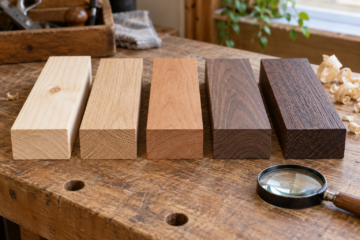
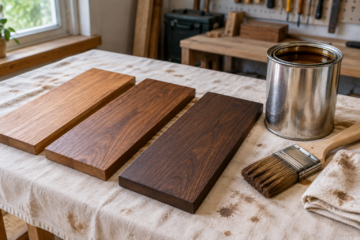
For a natural look, make test samples from offcuts of the same material and sand them exactly as you plan to sand the door. Compare clear finish, a light stain, and any tinted topcoat in the room’s actual lighting. A sample on unrelated wood will not tell you how either species will absorb color.
Durability in a busy home
Sapele’s greater density gives it an edge around handles, corners, and other areas that see bumps. Spanish cedar is lighter, which can be useful for a large door or for reducing the load on hinges, but its softer surface is easier to dent. Neither wood makes a poor choice automatically: a bedroom door that sees little abuse may not need the extra dent resistance of sapele.
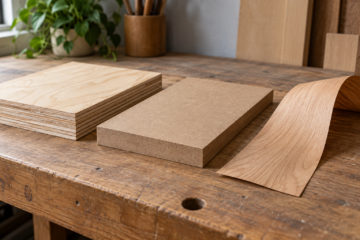
Interior doors are often veneered rather than made from solid lumber. In that case, the face veneer is thin, and aggressive sanding can cut through it regardless of species. Check the manufacturer’s sanding instructions. Start with light hand sanding, typically around 150 or 180 grit for an unfinished face, then finish at 180 or 220 if the finish maker allows it. Sand with the grain and use a block on flat panels. Do not use a power sander on a thin veneer unless the door maker specifically permits it.
Staining and surface preparation
Both woods can show uneven color with penetrating stain. Spanish cedar’s softer regions may absorb stain more deeply, while sapele’s changing grain can create strong light-and-dark bands. If a test patch looks blotchy, try a compatible sanding sealer or conditioner, or use a gel stain or tinted clear coat to keep more color near the surface. Follow the coating manufacturer’s directions for compatibility and drying time; products labeled “conditioner” do not all work the same way.
Before finishing, remove dust with a vacuum and a clean, lint-free cloth. Avoid leaving sanding dust in corners or panel profiles, where it can become trapped under clear coats. If the door is bare, test the complete finish schedule on a sample: stain, sealer if used, and topcoat. Let each layer dry as specified. Applying a topcoat too soon can trap solvent or cause poor adhesion.
For a clear finish, use a coating intended for interior woodwork, such as a water-based polyurethane or a wiping varnish, and apply thin, even coats. Water-based finishes usually preserve a lighter appearance; oil-based finishes typically add warmth and ambering. A water-based coating can raise the grain slightly, so a light de-nib between coats may be needed. Do not sand through the finish at edges or profiles.
Which should you buy?
Choose sapele if you want a richer, more pronounced grain and a harder face, and you are comfortable selecting boards or a veneer pattern carefully. It is also a sensible choice for a door that will see regular handling. If the budget is tight, a well-made sapele-veneered door can be a better buy than paying extra for clear-grade solid stock that will be mostly hidden by opaque paint.
Choose Spanish cedar if low weight and easy machining matter more than dent resistance, or if you prefer its less dramatic appearance. It is not automatically cheaper, so compare finished-door prices, veneer quality, and whether the door is supplied unfinished or prefinished. If you plan to paint the door, the species’ natural color and figure matter much less; a sound, stable door with a smooth face is often the more practical purchase.
For an unfinished door, useful supplies include interior water-based polyurethane for a lighter clear finish, or interior gel stain when a test shows that a penetrating stain would look uneven. Check the door maker’s finish restrictions before buying either.
Avoid these common failures
Do not stain the door before checking both faces and edges: color can vary across a panel, and an unseen patch may take stain differently. Do not leave one face unfinished while coating the other; uneven moisture exchange can contribute to warping. Seal the top and bottom edges as well as the faces, following the door manufacturer’s guidance.
Finally, avoid treating “cedar” as a finish instruction. Spanish cedar is not the same as aromatic cedar, and neither its scent nor its name predicts stain compatibility. Make a full finish sample, let it cure, and inspect it under the light where the door will hang. That inexpensive test is more reliable than choosing by species reputation alone.
0 Comments