What's inside
As an Amazon Associate I earn from qualifying purchases. This post may contain affiliate links at no extra cost to you.
American mahogany and Spanish cedar can both make attractive lacquered furniture, but they are not interchangeable. American mahogany is the better choice when you want a firm, relatively dent-resistant surface and a familiar reddish-brown appearance. Spanish cedar is lighter and often cheaper, but it is softer, more prone to dents, and can have a strong cedar odor. With either species, a good finish depends more on sound surface preparation and compatible lacquer than on the wood name alone.
As an Amazon Associate we earn from qualifying purchases at no extra cost to you.


Our Top Picks
Know what you are buying
“American mahogany” usually refers to genuine mahogany, Swietenia macrophylla, also sold as big-leaf mahogany. Confirm the species with the supplier: trade names can be loose, and “mahogany” may describe unrelated woods with different working and finishing properties. Spanish cedar, Cedrela odorata, is not a true cedar. It is a tropical hardwood often used where low weight and easy machining matter.
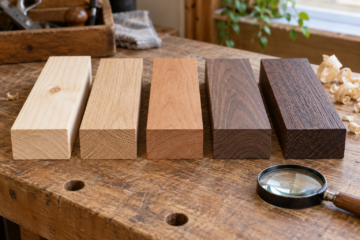
Ask for clear, kiln-dried stock and inspect the actual boards. Color varies within both species, and Spanish cedar can show pale sapwood alongside darker heartwood. On a lacquered piece, those differences remain visible unless you use an opaque finish. If matching several boards matters, buy them together and compare them under the lighting where the furniture will be used.
How they compare under lacquer
| Property | American mahogany | Spanish cedar | What it means for furniture |
|---|---|---|---|
| Typical density | About 35–40 lb/ft³ | About 27–32 lb/ft³ | Spanish cedar is noticeably lighter; mahogany tends to feel more substantial. |
| Hardness | About 800 lbf Janka | About 600 lbf Janka | Mahogany generally resists dents better, though neither is as hard as oak or maple. |
| Workability | Usually machines and sands cleanly; interlocked grain can tear out | Easy to cut and shape; softer fibers can bruise or fuzz | Use sharp cutters and light pressure, especially near edges and profiles. |
| Color and odor | Pinkish to reddish brown; generally mild odor | Pale pink to reddish brown; often distinctly aromatic | Color and odor vary by board. Test before committing to a clear finish. |
| Relative cost | Often higher | Often lower | Prices vary by region, thickness, and grade; compare finished-board cost, not just price per board foot. |
Janka figures are typical reference values, not a guarantee for any particular board. Lacquer adds a protective film, but it does not make soft wood dent-proof. A heavy object dropped on a Spanish cedar tabletop can still leave a mark through the coating.
Choose for the job, not the label
For a desk, dining table, cabinet door, or other piece likely to get bumped, American mahogany is usually worth the extra cost if the budget allows. Its greater density gives you a little more resistance to everyday knocks and a firmer feel when routing edges or fitting hardware. It is not immune to dents, so use coasters and pads where the surface sees hard use.
Spanish cedar is a sensible lower-cost option for lightweight cabinets, interior panels, drawer parts, and decorative furniture that will not take frequent impacts. It can also suit a painted piece, where natural color matters less. Avoid choosing it solely because it is called cedar: its odor can linger, and its softness can be a drawback for exposed corners, chair rails, or table edges.
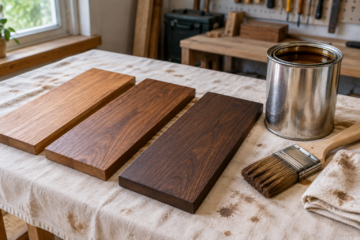
Both species are suitable for lacquer when the stock is dry, clean, and properly sanded. If you are unsure about the cedar smell or the final color, make a test panel from an offcut. Finish one face and edge, let it cure, then judge it in the room before buying enough lumber for the project.
Prepare the wood carefully
Start with a flat, glue-ready surface and remove machining marks before finishing. Sand through 120, 150, and 180 grit; for many clear lacquer systems, 180 grit is a useful stopping point. Going much finer can reduce mechanical bite without improving the appearance. Follow the lacquer maker’s instructions if they specify a different final grit.
Mahogany’s interlocked grain can tear during planing or routing. Take shallow cuts, use a sharp blade, and sand scratches with the grain where possible. Spanish cedar is softer, so aggressive sanding can dish broad surfaces or round over crisp edges. Use a sanding block on flat panels and vacuum dust from pores and corners. Don’t press hard with a random-orbit sander; let the abrasive do the work.
Before spraying or brushing, remove dust with a vacuum and a clean, lint-free cloth. Avoid oily tack cloths unless the lacquer manufacturer approves them. If the wood has glue squeeze-out, remove it before sanding: even a thin glue smear can leave a pale, dull patch that becomes obvious under clear lacquer. Check with raking light, then wipe the surface with the solvent recommended for the coating system.
Apply lacquer without common defects
Use a lacquer system intended for furniture and follow its stated sealer, reducer, and recoat schedule. A compatible dewaxed shellac sealer can help isolate odor or uneven absorption, but test it with the lacquer first. Some products are formulated to work together; mixing unrelated coatings can cause lifting, poor adhesion, or a cloudy finish.
Apply thin, even coats rather than trying to build the whole film in one pass. A wet, heavy coat can sag on vertical surfaces, trap solvent, or dry with ripples. Sand lightly between coats only when the product instructions call for it, commonly with 320 grit after the film has dried. Do not sand through the sealer at corners, where bare patches can absorb finish differently.
Work with strong ventilation and the protective equipment specified by the product label. Lacquer solvent vapor is a serious fire and health hazard; keep it away from flames, pilot lights, sparks, and unprotected electrical equipment. If you are brushing rather than spraying, choose a brushing lacquer and compatible brushing lacquer. Conventional spray lacquer may set too quickly to level well when brushed.
A practical buying check
Compare clear, straight boards at the same thickness and grade, and account for waste from knots, color variation, and machining. Ask the seller whether the lumber is kiln-dried and acclimate it in the shop before cutting; a target around 6–8% moisture content is common for indoor furniture, though local conditions matter. If the project is painted, or if it is a low-impact cabinet, Spanish cedar may be the economical choice. For a visible, frequently handled surface where dent resistance and a more substantial feel matter, American mahogany is the safer bet.
0 Comments