What's inside
As an Amazon Associate I earn from qualifying purchases. This post may contain affiliate links at no extra cost to you.
White oak and ash can both produce clean, light-colored furniture with a visible grain, but they do not look or behave quite the same. White oak usually has a warmer, more muted appearance and is a safer bet where moisture resistance matters. Ash tends to be paler, with bold, open grain and a little more visual contrast. For a dining table, cabinet, or desk, the better choice depends on the look you want, the price and availability in your area, and how carefully you plan to finish it.
As an Amazon Associate we earn from qualifying purchases at no extra cost to you.


Our Top Picks
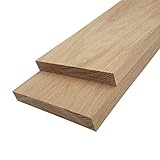
 Barrington Hardwoods Quarter Sawn White Oak Lumber Board3/4" x 4" x 12" (2pcs)12 x 4 x 0.75 inches2.5 PoundsCheck on Amazon
 Polyurethane Wood Finish Water Based Polyurethane Clear Gloss100 ml1.6 x 1.6 x 4.7 inchesCheck on Amazon

How they look under a natural finish
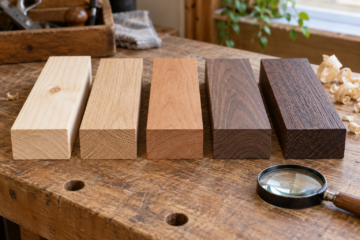
White oak ranges from light tan to medium brown, often with a slightly golden or olive cast. Its grain is typically straight and prominent, with visible rays that can show as flecks on quarter-sawn boards. A clear finish deepens the color; it will not stay as pale as unfinished wood.
Ash is generally lighter, often cream to pale brown, and its grain can have strong, sweeping bands. That contrast makes ash look lively on a broad tabletop or cabinet front. Boards vary, though: heartwood can be noticeably darker than sapwood, so match pieces before assembly if you want a uniform surface.
Neither species is reliably “white” once finished. Test the actual boards with the finish you intend to use. A sample cut from the same stock is more useful than a store display, because color varies between trees and even within one board.
White oak vs ash at a glance
| Factor | White oak | Ash |
|---|---|---|
| Typical natural color | Light tan to medium brown; often warm | Cream to pale brown; often brighter |
| Grain | Strong, usually straight; prominent ray fleck when quarter-sawn | Bold, open grain with broad, contrasting bands |
| Hardness | About 1,360 lbf on the Janka scale | About 1,320 lbf on the Janka scale |
| Moisture resistance | Good for a domestic hardwood; tyloses help limit water movement | Lower; not a first choice for wet or outdoor exposure |
| Workability | Machines well, but can be hard on cutting edges | Machines and bends well; can splinter at edges |
| Typical buying consideration | Often costs more, especially in selected or quarter-sawn stock | Can be less expensive, depending on local supply and grade |
Janka figures are useful for comparing dent resistance, not for predicting exactly how a finished piece will wear. Both are hard enough for everyday furniture, but either can dent if a heavy object is dropped on it.
Choose for the room and the design
White oak is the more forgiving choice for a dining table, kitchen furniture, or a piece likely to see spills. Its natural resistance to water is relative, not waterproof: standing water can still stain or damage the surface, and the finish needs to be maintained. For outdoor furniture, use a species and construction suited to exterior exposure rather than relying on white oak alone.
Ash is a good buy for bedroom furniture, shelving, desks, and other indoor pieces where its pale color and pronounced grain fit the design. It is also a sensible lower-cost alternative when white oak is expensive or hard to find locally. If both species are available at similar prices, choose by appearance and project conditions rather than assuming one is automatically better value.
Check the boards for straightness, knots, checks, and color variation before paying. For a tabletop, buy enough stock to select and arrange the boards; a bundle of narrow boards may vary more in color than a single wide panel.
Sanding and surface preparation
Both species have open pores, so a smooth surface can still show a textured grain. Start with sharp tools and avoid trying to erase deep planer marks with a very fine final grit. For typical furniture, work through 80 or 100, 120, and 150 grit; use 180 only if your finish instructions call for it. Sanding much finer can reduce finish adhesion or make stain uptake less even.
On ash, inspect end grain and edges closely. The open grain can splinter, particularly where a router exits a cut. Take light passes and use a backer board on crosscuts. On white oak, avoid leaving iron filings or steel-wool residue on the surface: iron can react with tannins and make dark blue-black marks, especially if the wood gets damp. Use clean abrasives and vacuum dust before coating.
Raise the grain only if your water-based finish requires it: wipe the bare surface lightly with a damp cloth, let it dry fully, then knock down the raised fibers with a light pass at the final sanding grit. Do not scrub hard enough to create shiny burnished patches.
Getting a natural-looking finish
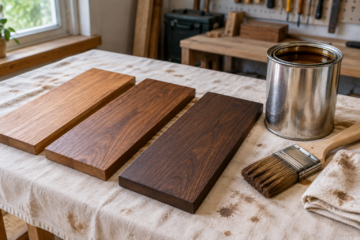
For the clearest, simplest look, use a clear water-based finish. It generally adds less amber color than oil-based polyurethane, though it may leave white oak looking cooler and can emphasize differences between sapwood and heartwood. Oil-based finishes warm both woods and can make ash less pale. Test at least two coats on a sample, since the first coat rarely predicts the final color accurately.
A hardwax oil can give a low-sheen, natural feel and makes small repairs practical, but it usually offers less protection against standing water and heat than a film finish. Follow the product’s coverage and cure instructions; a surface that feels dry may still need days before it is ready for heavy use.
For a durable dining or work surface, choose a furniture-grade water-based clear finish or another coating rated for the expected use. Apply thin, even coats rather than one heavy coat. Heavy application can leave runs, cloudy areas, or a plastic-looking surface. Lightly scuff between coats only as directed by the label, and remove dust before recoating.
What to buy for your project
Choose white oak if its warmer color suits the room, moisture resistance is useful, or you want the fleck of quarter-sawn boards. Choose ash if you prefer a paler, more animated grain and can buy sound, well-matched stock at a better price. For a low-use indoor piece, the cheaper species is entirely fine if you like its appearance.
Ask the supplier whether boards are kiln-dried and surfaced, and confirm thickness before planning joinery. If you are buying rough lumber, allow extra thickness and width for milling defects and color selection. A small set of finish sample boards can help compare coats, but samples cut from your own lumber will give the most reliable result.
0 Comments