What's inside
As an Amazon Associate I earn from qualifying purchases. This post may contain affiliate links at no extra cost to you.
Ash and beech can both produce pale furniture and interior trim, but they do not finish alike. Ash has a more open, pronounced grain that stays visible under a matte clear coat. Beech is finer and more even-looking, though its pinkish cast and blotchy response to stain can complicate a very light finish.
For a pale, natural result, the deciding questions are how much grain you want to see, whether the wood will get dents, and whether you plan to use clear finish or stain. Neither species is automatically the better choice: clear matte finish usually favors ash for a distinctly grained look and beech for a quieter surface.
As an Amazon Associate we earn from qualifying purchases at no extra cost to you.

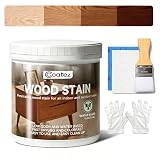
Our Top Picks
 Varathane Water-Based Ultimate Matte PolyurethaneQuart (Pack of 1)9.8 x 5.5 x 6.3 inches2.2 poundsCheck on Amazon


Ash vs. beech at a glance
| Factor | Ash | Beech |
|---|---|---|
| Appearance under clear matte finish | Open, bold grain; usually pale cream to light brown | Fine, relatively uniform grain; often cream with a pink or reddish cast |
| Typical hardness | About 1,320 lbf Janka for white ash | About 1,300 lbf Janka for American beech |
| Stain behavior | Open pores can make color look pronounced or uneven without careful application | Can turn blotchy, especially with pale or unevenly applied stains |
| Best fit | Visible grain, furniture, trim, and handles | Subtle grain, indoor furniture, and parts that benefit from a smooth, even look |
| Main caution | Large pores remain visible beneath thin finishes | Natural color can look warmer than expected; not a wood for damp locations |
Hardness figures are approximate and vary by species and test source. Both woods are hard enough for many indoor furniture uses, but neither number predicts how a finished tabletop will handle every impact. Beech and ash are both susceptible to dents and surface wear in heavy use.
Choose by the look you want
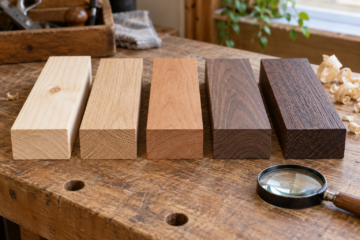
Choose ash if you want the grain to be part of the design. Its open earlywood and latewood bands create a strong pattern, especially on broad, flat-sawn boards. A matte clear coat protects the surface without hiding that contrast. On pieces with many joined parts, expect the grain to vary from board to board; sorting stock before assembly helps avoid abrupt visual changes.
Choose beech if you want a more restrained, fine-grained surface. It is often used where an even, clean appearance matters, but “pale” does not mean colorless: beech can carry a warm pink or salmon tone. Buy and finish a sample from the same batch as the project before committing. A clear coat can make the warmth more apparent than it looks on raw, freshly sanded wood.
If the goal is a very white, nearly uniform surface, neither wood guarantees that result with clear finish alone. A light, opaque paint will conceal grain and natural color more reliably, while a white-tinted finish can mute the wood but may look streaky if applied unevenly.
Clear matte finish: keep the surface simple
For a natural pale finish, start with clean, dry, well-sanded wood. Sand evenly through the grits, commonly stopping at 180 or 220 for clear coating; sanding much finer can reduce absorption for some products and make stain application less predictable. Remove dust thoroughly, then test the complete finish schedule on an offcut. Look at it after it dries, because water-based and oil-based products can change the wood’s color differently.
A water-based matte clear coat generally adds less amber color than an oil-based finish, but it is not guaranteed to leave wood unchanged. Use a product labeled for furniture or interior wood and check the manufacturer’s instructions for sanding between coats and recoat times. A water-based matte polyurethane is a practical category to consider when preserving a pale appearance is the priority.
Matte does not mean invisible. A clear film may deepen the wood slightly, and low-sheen finishes can still show lap marks, dust nibs, or uneven application in raking light. Apply thin, even coats rather than trying to build protection in one heavy pass. Follow the label for drying and curing: a surface can feel dry before it is ready for full use.
Staining without blotches or muddy grain
Staining either species takes more testing than applying a clear coat. Ash’s pores can hold pigment strongly, making grain contrast more dramatic. Beech can absorb stain unevenly, leaving cloudy or dark patches. These effects are not flaws in the wood; they are common consequences of uneven absorption and stain settling differently across the surface.
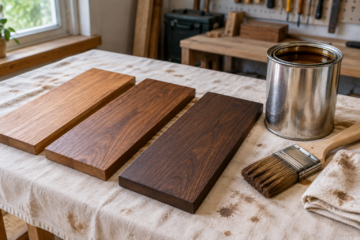
Test the exact stain and topcoat on scrap prepared with the same sanding sequence as the project. Apply stain consistently, wipe it on and off as directed, and compare the dry sample in the room where the item will be used. For beech, a wood pre-stain conditioner may reduce uneven absorption, but it can also make the color lighter or less distinct. Test it rather than assuming it will solve blotching.
For a pale result, avoid choosing stain by its name alone. “Natural,” “white,” and “pickled” vary among brands and can turn either wood gray, yellow, or pink depending on the species. A lightly tinted clear coat may give more control than a penetrating stain, but it can be harder to apply evenly and may need careful stirring so the pigment stays distributed.
Buying and using the wood
For a visible-grain project, inspect ash boards for grain direction and color consistency. For a quieter surface, inspect beech for pink cast and board-to-board variation. Ask for kiln-dried stock intended for interior work, and avoid boards with end checks, deep dents, or large areas of discoloration if the pale appearance matters.
Both species work well with sharp cutters, but their grain can tear out around knots or changing grain direction. Use a sharp plane or cutter, take light passes, and sand scratches out before finishing; a matte coating will not hide poor preparation. Beech is not a good choice for damp rooms or outdoor projects because it is not naturally durable in wet conditions. Ash also needs appropriate protection from moisture and is not a substitute for exterior-rated material.
For a simple indoor shelf, drawer front, or table that will be painted, the cheaper suitable stock is often the sensible buy: the finish will cover most appearance differences. For a clear-finished piece, pay for boards that look right together, and spend time on sample finishing. That small test is cheaper than discovering after assembly that the ash grain is too bold or the beech is warmer than you wanted.
0 Comments