What's inside
As an Amazon Associate I earn from qualifying purchases. This post may contain affiliate links at no extra cost to you.
Hard maple and hickory are both dense hardwoods that can make a durable countertop under a clear finish. Hard maple is usually the easier choice to buy, machine and keep looking even. Hickory is tougher in some respects, but its strong color variation, harder machining and movement across the grain make it less forgiving. The right pick depends on whether you value a uniform surface or a more varied look—and on how well you can control moisture and finish the wood.
As an Amazon Associate we earn from qualifying purchases at no extra cost to you.


Our Top Picks

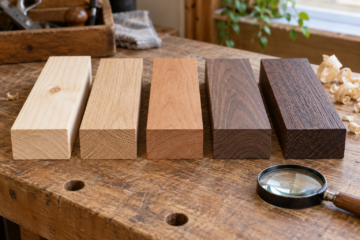
Hard maple vs. hickory at a glance
| Factor | Hard maple | Hickory |
|---|---|---|
| Janka hardness | About 1,450 lbf | About 1,820 lbf |
| Appearance | Mostly light, fairly consistent color | High contrast between pale sapwood and darker heartwood |
| Machining | Dense; can burn or show tool marks | Very hard; can be difficult to mill and drill cleanly |
| Movement across grain | Moderate to high | High |
| Best fit | Calm, uniform appearance and simpler finishing | Maximum hardness and a bold, mixed-color look |
Janka figures measure the force needed to press a steel ball into wood; they do not predict how resistant a finished counter will be to every dent or scratch. Neither species is knife-proof, and a clear coat can be damaged even when the wood beneath it is hard.
Which one stands up better?
Hickory’s higher Janka rating gives it an advantage against some impact dents. That is useful on a busy work surface, but the difference is not a substitute for a cutting board or a sound finish. A dropped heavy pan can dent either wood, while sliding gritty cookware can scratch the coating on both.
Hard maple is already hard enough for most home countertops. Its tight, fine texture also gives a smooth surface after careful sanding. Hickory’s greater hardness can mean more effort at the saw, router and drill, and dull or poorly set cutters are more likely to leave burn marks, tear-out or rough edges. Pre-drilling screw holes is sensible with either species; it is especially important near the ends of hickory boards.
For a counter that sees routine cooking but not direct knife work, a well-built maple top is generally durable enough. Choose hickory if you specifically want extra resistance to dents and accept the added work and visual variation. If either top is exposed to standing water, no clear finish removes the need to wipe spills and protect vulnerable seams.
Appearance and board selection
Hard maple usually reads as pale cream to light tan, though mineral streaks and occasional darker marks occur. That consistency makes it a safer choice when the counter must match light cabinets or a simple interior. Maple can blotch when stained, so many clear-coated tops are left natural or given a tested, subtle tint.
Hickory often mixes nearly white sapwood with brown or reddish heartwood in the same board. That contrast can be the point, but it can also look busy across a large counter. Ask to see the actual boards, not just a small sample, and lay them out in the order they will be glued. If you want a calmer result, buy stock sorted for color and expect to pay more—or pick maple.
For either species, use kiln-dried lumber suited to indoor conditions. A practical target is roughly 6–8% moisture content for a heated home, with boards acclimated in the room before assembly. Check several boards with a wood moisture meter. A top assembled from wet stock can shrink, open glue joints or crack after installation.
Build for wood movement
Solid wood expands and contracts mostly across its width as humidity changes. A 24-inch-wide top can move enough to stress a rigid attachment, even if each board is properly glued. Attach it with countertop clips, slotted screw holes or another method that lets the top shift; do not fasten it tightly through round holes across the full width.
For an edge-glued panel, joint the edges straight and square, then use a suitable interior wood glue and even clamping pressure. Follow the glue maker’s temperature and clamp-time instructions rather than rushing the panel. Hickory’s hard, sometimes irregular grain makes clean joints and careful alignment especially important. A water-resistant interior wood glue is a reasonable category to consider for a kitchen, but it does not make a countertop waterproof.
Choose and apply a clear finish
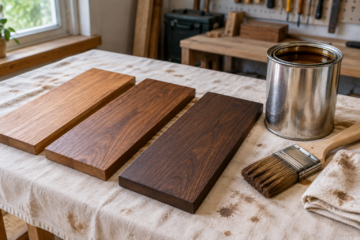
Decide whether the counter is decorative, used for light prep, or likely to get frequent splashes. A film finish such as a countertop-rated waterborne coating or oil-based polyurethane can protect the surface from spills better than a penetrating oil, provided the entire top is sealed. Read the product label for food-contact and cure guidance; “water-based” or “natural” does not automatically mean suitable for direct food contact.
Penetrating oils are easier to renew and do not peel like a film, but they need more frequent maintenance and offer less protection against standing water and stains. Film finishes can scratch or wear through, and repairs may show. For either wood, coat the underside and edges as well as the top, paying particular attention to sink cutouts, end grain and seams. Finish all faces before installation where practical.
Sand evenly through a sensible progression, such as 80, 120 and 150 grit, removing scratches at each step. On maple, test the final sanding grit and finish on an offcut: very fine sanding can reduce absorption and make some finishes look uneven. Vacuum dust rather than pushing it into the grain, and use the finish maker’s specified sanding and recoat schedule. A water-based clear finish rated for counters can preserve a lighter appearance, while oil-based coatings usually add more amber color.
What to buy for your project
Buy hard maple if you want a light, restrained counter, have limited woodworking experience, or need to match boards with less sorting. It is the sensible default for many clear-coated tops, and its lower hardness than hickory is rarely a practical problem when the surface is used correctly.
Buy hickory if the contrasting grain is a deliberate design choice and dent resistance matters more than easy machining. Inspect the stock carefully, allow time for sharp tooling and test your finish on both pale and dark areas. In either species, straight, dry boards and sound construction matter more than a small difference in hardness. If the cheaper, readily available maple meets the look and use requirements, there is little reason to pay extra for hickory.
0 Comments