What's inside
As an Amazon Associate I earn from qualifying purchases. This post may contain affiliate links at no extra cost to you.
Walnut and wenge can both deliver a dark, oil-rubbed look, but they get there in different ways. Walnut starts brown and takes oil to a warm, sometimes reddish tone. Wenge is naturally very dark, with high contrast between its nearly black and brown fibers. Choose walnut for a more forgiving, easier-to-work surface; choose wenge when its striking grain and near-black color justify extra cost and care.
As an Amazon Associate we earn from qualifying purchases at no extra cost to you.


Our Top Picks


What the finished wood looks like
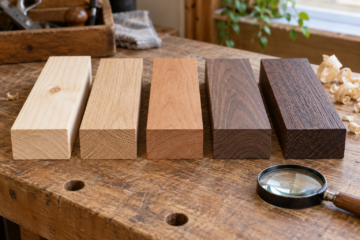
American black walnut is typically medium to dark brown, though boards vary considerably. Oil deepens the color and brings out the grain, but it does not turn ordinary walnut uniformly black. Sapwood can be pale, and even heartwood varies from board to board. A “dark walnut” finish may mean simply oil on dark heartwood—or a stain applied to a lighter or mixed-color board.
Wenge is naturally dark brown to nearly black, with bold, straight grain and pale streaks that can remain visible after oiling. Its texture is coarse and open, so it looks less smooth and uniform than walnut. Oil enriches its color, but the result is still wenge, not a flat black surface. If you want even, opaque black, consider paint rather than choosing a wood species for that job.
Walnut vs. wenge at a glance
| Consideration | Walnut | Wenge |
|---|---|---|
| Natural color | Brown, with board-to-board variation and possible pale sapwood | Very dark brown to nearly black, often striped |
| Grain and texture | Moderate, usually easier to make smooth | Pronounced straight grain; coarse, open pores |
| Working and sanding | Generally straightforward with sharp tools | Hard and splinter-prone; dust requires care |
| Oil appearance | Warmer, richer brown | Darker, high-contrast grain |
| Cost and availability | Commonly available in furniture grades | Often more expensive and less readily available |
| Best fit | Dark furniture with a warm, understated look | Accent pieces or furniture where dramatic dark grain is the point |
Which one should you buy?
For a dining table, cabinet, or desk that will be seen across a room, walnut is usually the easier purchase. It is widely sold, works well with common joinery, and is less punishing to flatten and sand. Inspect boards for sapwood and color variation if you need a consistently dark top. A walnut offcut or sample finished with your intended oil is more useful than judging the raw board at the lumberyard.
Wenge makes sense for a small tabletop, cabinet front, inlay, or other feature where its dark striped grain will be visible. It is a costly choice for a large piece, and its coarse texture can be harder to make pleasant to touch. Buy enough material from the same batch, and check it under the lighting where the furniture will live: very dark surfaces can lose detail in a dim room.
Price varies by region, thickness, grade, and board width, so compare actual usable yield rather than price per board foot alone. If walnut is the less expensive option, it is not a compromise when a warm brown finish suits the design. Staining walnut darker can also obscure natural variation or look blotchy; test first rather than assuming stain will improve it.
Preparation and oil application
On either species, begin with clean, flat stock and sand evenly. A practical sequence for most furniture surfaces is 120, 150, then 180 grit; stop at 180 or 220 unless the finish maker specifies otherwise. Sanding much finer can reduce oil absorption and leave a less even-looking surface. Remove dust with a vacuum and a clean, lint-free cloth. Do not rely on oil to hide scratches: it often makes them more visible.
Walnut usually sands predictably, though torn grain can show near figure or grain reversals. Use sharp abrasives and inspect with raking light before finishing. Wenge can splinter along its long grain, and its abrasive dust is an irritant. Wear eye protection and a well-fitting particulate respirator, and use dust extraction; avoid blowing dust into the room with compressed air. Ease sharp edges slightly before oiling, since a crisp edge may absorb finish differently and wear through sooner.
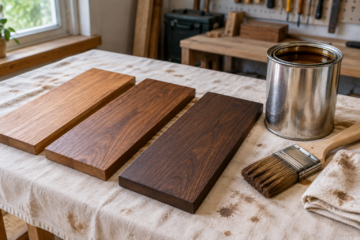
For a straightforward oil finish, choose a penetrating furniture oil or hardwax oil intended for indoor wood surfaces. Apply a thin coat, follow the label’s dwell time, and wipe off all excess. Pooled oil can stay tacky, especially in pores and corners. A second coat may deepen the sheen, but more coats do not necessarily make the surface more durable. Compare hardwax oils for furniture and check the product’s cure time and maintenance instructions before buying.
Test the whole process on an offcut, including sanding, oil, and any topcoat. On wenge, a test also reveals whether the open pores and pale grain lines give the contrast you want. If a smoother, pore-filled look is the goal, use a compatible grain filler before the oil and confirm compatibility on a sample. Do not assume every oil accepts a separate varnish or topcoat.
Drying, durability, and safety
An oil-rubbed surface is not maintenance-free. It can be repaired locally more easily than many film finishes, but it may show water rings, abrasion, and food or drink spills if the chosen product offers limited protection. For a heavily used tabletop, check that the finish is rated for furniture or worktops, and follow its full cure time before regular use. “Dry to touch” does not mean fully cured.
Oil-soaked rags can heat up and ignite as they dry. Lay them flat outdoors to dry where permitted, or store and dispose of them exactly as the finish label directs; never leave a balled-up rag in a bin. This precaution matters with both woods and is part of the finishing job, not an optional extra.
Choose walnut when you want an approachable, warm dark finish and a manageable build. Choose wenge when you specifically want its near-black color and striped grain, and are prepared for higher material cost, more demanding dust control, and extra attention to splintering. For either species, a finished sample is the cheapest way to avoid an expensive mismatch.
0 Comments