What's inside
As an Amazon Associate I earn from qualifying purchases. This post may contain affiliate links at no extra cost to you.
For a clear-coated panel, the choice is mostly about appearance, stability and how much solid wood you need—not which material is inherently “better.” Veneered plywood gives you a real-wood face over a stable core, often with less movement and waste. Solid wood gives you natural grain through the full thickness, which matters for edges, shaping and repairs. Both can look excellent, and both can disappoint if the surface is poorly prepared or the finish is applied unevenly.
As an Amazon Associate we earn from qualifying purchases at no extra cost to you.


Our Top Picks
 Polyurethane Wood Finish Water Based Polyurethane Clear Gloss100 ml1.6 x 1.6 x 4.7 inchesCheck on Amazon

What you’re buying
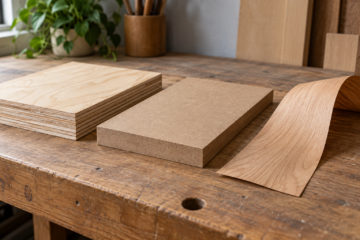
Veneered plywood is a panel with a thin layer of real wood bonded to a core, typically plywood, MDF or particleboard. The face veneer may be only about 0.5–1 mm thick, though products vary. The core supplies most of the panel’s strength and stability; the veneer supplies the visible grain. Check the panel’s description rather than assuming every “hardwood plywood” has the same core or face quality.
Solid wood panels are made from boards joined edge to edge. Their grain continues through the thickness, but the boards expand and contract across their width as humidity changes. A wide solid panel therefore needs a suitable construction and attachment method that allows movement. A plywood panel generally changes dimensions less under ordinary indoor conditions, although it is not immune to moisture or poor storage.
At a glance
| Factor | Veneered plywood | Solid wood |
|---|---|---|
| Visible surface | Real wood grain; veneer sheets may have seams or repeated patterns | Natural board-to-board variation across the panel |
| Dimensional movement | Usually lower, depending on core and construction | Greater across the grain; allow for seasonal movement |
| Edges | Core is exposed unless banded or framed | Wood continues through the edge and thickness |
| Sanding margin | Limited by the thin face veneer | More material to sand, within reason |
| Typical best use | Large cabinet sides, doors and flat panels | Thick tops, shaped parts and exposed solid edges |
| Common failure | Sanding through the face or telegraphing core defects | Cracking, cupping or joint failure from movement |
Appearance and matching
Veneer is often the easier route when you need a broad, consistent face. A manufacturer can arrange leaves as book-matched, slip-matched or sequence-matched panels. Those layouts affect whether the grain mirrors at a seam, runs in one direction or continues across several panels. Ask how the sheets are matched if adjacent cabinet doors or wall panels must look related. A lower-cost panel can have attractive wood but less predictable grain, color or patching.
Solid wood gives you more control over board selection if you buy rough or surfaced lumber and assemble the panel yourself. It also shows natural variation more plainly: color differences, knots and grain direction may stand out after clear coating. For a calm, uniform look, solid wood is not automatically the better choice; careful board selection takes time and can increase the cost.
Stability and construction
For a large, flat panel—such as a cabinet side, built-in face or wall panel—veneer over a suitable plywood core is often the practical choice. It is generally less prone to seasonal bowing than a wide panel made from solid boards. Keep the panel dry before finishing, seal all faces and edges where appropriate, and use fasteners or clips suited to the core.
Solid wood makes sense when the panel needs a thick, durable edge, a rounded profile, or repeated machining that would expose the core of plywood. But do not glue up a wide panel and screw it rigidly to a frame across its grain. For a 24-inch-wide panel, seasonal movement can be noticeable; use clips, elongated screw holes or another method that lets it move. The exact movement depends on species, grain orientation and indoor humidity.
Preparing for a clear coat
Start with a clean, dry surface. Veneer needs a light touch: sand by hand or with a well-controlled sander, following the grain, and use fine pressure. On a thin face veneer, aggressive sanding or lingering with a power sander can cut through to a different-colored core before you notice. A sensible starting point is 150 or 180 grit, followed by 180 or 220 if the finish system calls for it. Follow the coating maker’s instructions; sanding finer is not always better, especially if it reduces stain absorption.
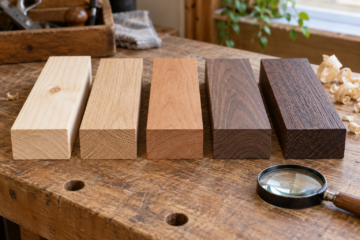
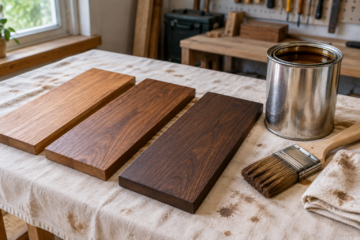
Solid wood tolerates more sanding, but it can still develop scratches that become obvious under a clear finish. Sand evenly through the grits rather than skipping from coarse to fine. Vacuum the surface and remove dust with a method compatible with the coating. Test the finish on an offcut or hidden area: clear finishes can darken wood, emphasize end grain and make color differences more visible. If you want to compare water-based and oil-based results, use a clear-finish sample set or prepare test pieces from the same stock.
Check for glue squeeze-out before finishing. Glue on solid wood blocks stain and can leave pale patches; on veneer, sanding through while trying to remove a spot is an especially costly mistake. Inspect under raking light and use a pencil mark on the surface while sanding so uneven low spots are easier to see.
Choosing the material and finish
For furniture and interior panels, a clear water-based finish often keeps pale woods closer to their raw color, while oil-based finishes commonly add warmth and amber tone. Neither description guarantees the result: species, formulation and film thickness matter. Use compatible products, and do not assume a stain, sealer and topcoat can be combined without checking their labels. A water-based clear wood finish is a reasonable category to test when color shift needs to be limited.
Buy veneered plywood when the main face is broad and flat, the core suits the job, and you can protect the edges or cover them with solid edging. It is also a sensible budget choice for painted or clear-coated cabinet interiors where the face veneer is acceptable and the panel will not be heavily reshaped. Choose solid wood when exposed edges, thick profiles, carving or future resurfacing matter enough to justify the extra material and movement planning.
Before buying, check a full-size sample if the grain is important, confirm panel thickness and core type, and inspect both faces for patches, scratches and flatness. For solid stock, buy enough boards to select for color and grain, and let the wood acclimate in the room where it will be used. The right choice is the one whose construction matches the panel’s job and whose surface you can finish without sanding through, trapping glue or restricting wood movement.
0 Comments