What's inside
As an Amazon Associate I earn from qualifying purchases. This post may contain affiliate links at no extra cost to you.
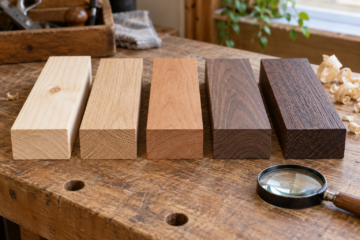
Quarter-sawn sycamore and flat-sawn maple can both produce pale, clear-finished furniture, but they do not look or behave alike. Sycamore is the choice when you want conspicuous ray fleck and a lively figure; maple is usually the safer pick for a quiet, consistent surface. The finish matters as much as the species: a clear coat will deepen both woods and can make uneven color or sanding marks more obvious.
As an Amazon Associate we earn from qualifying purchases at no extra cost to you.


Our Top Picks
 Minwax 233334444 Polycrylic Protective Wood Finish8 fl oz2.9 x 2.9 x 3 inches0.66 poundsCheck on Amazon

What the cut changes
Quarter-sawn sycamore is cut with growth rings oriented roughly perpendicular to the board face. Its medullary rays show as pale, irregular flecks or ribbons across the grain. Their size and prominence vary by board, so inspect the actual stock rather than relying on a species description. Sycamore’s background color is typically pale cream to light brown, and boards may show color variation.
Flat-sawn maple is cut with growth rings closer to parallel with the face. The result is generally a calmer, more familiar grain pattern, with broad arcs and occasional curls or mineral streaks. “Maple” covers multiple species and grades; hard maple is often denser and lighter, while soft maple can vary more in color. Ask the seller which species you are buying if color and hardness matter.
Side-by-side comparison
| Factor | Quarter-sawn sycamore | Flat-sawn maple |
|---|---|---|
| Visual character | Prominent ray fleck; more visual movement | Usually quieter grain, with broad cathedral patterns |
| Color under clear finish | Pale, but boards can vary and may warm noticeably | Often pale and more uniform, depending on species and grade |
| Best fit | Panels, cabinet fronts, or furniture where figure is a feature | Large surfaces or a restrained, clean look |
| Working and finishing | Check for tearout near changing grain; test the finish on offcuts | Dense maple can show scratches and blotchy stain; clear finish avoids much of the staining problem |
| Buying consideration | Strong figure can mean more waste when matching boards | Often easier to find in broad, consistent stock; grade still matters |
Choose by the finished appearance
Pick quarter-sawn sycamore if you want the surface to have visible figure without adding stain. The ray fleck reads clearly through a transparent finish, especially on a broad, flat panel. That figure is also less forgiving of mismatched pieces: adjacent boards may have different fleck patterns, so buy extra stock and lay out the boards before cutting.
Choose flat-sawn maple if you want the finish and form—not the grain—to lead. It suits tabletops, shelves, and cabinetry where a calm pale field is useful. Flat-sawn maple is not perfectly uniform: cathedral grain, small knots, and mineral streaks can interrupt the surface. Select for the actual board color and grain, not just the label or sample photo.
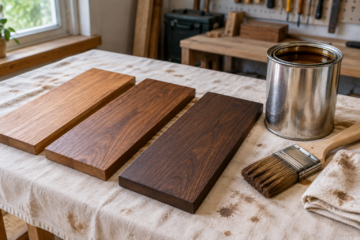
Neither choice guarantees a colorless result. Oil-based clear finishes usually add more amber warmth than water-based finishes, and both woods can look darker after coating than they do freshly sanded. Make a sample from an offcut with the complete finish schedule. View it in the room’s daylight and evening lighting before committing.
Prepare the surface for a clear coat
Start with sharp, clean tooling. Plane or scrape where practical, then sand through a consistent sequence such as 120, 150, and 180 grit. On maple, going much finer before a typical film finish can reduce adhesion; follow the coating maker’s instructions. For quarter-sawn sycamore, inspect the ray fleck under raking light and sand with the grain for the final pass. Cross-grain scratches can become conspicuous once clear coat darkens the surface.
Use a vacuum and a clean, dry cloth to remove dust. Avoid aggressive tack cloths that can leave residue. Apply finish to a test piece and check for raised grain, lap marks, or unexpected color. Water-based finishes can raise grain, so many woodworkers apply a light first coat, let it dry, then sand gently with 320 grit before the next coat. Do not sand through the first coat on edges or corners.
For a low-color result, compare a water-based clear wood finish with the finish you would otherwise use on a sample board. Water-based products often preserve a paler look, but application can be less forgiving: overlaps and dried edges may show on a large surface. Work at the stated spread rate and keep a wet edge.
Avoid common failures
Do not use stain to “even out” naturally variable sycamore without testing. The ray fleck and softer areas can take color differently, making contrast stronger rather than hiding it. Maple is also prone to blotching with many penetrating stains. If you need a stained maple surface, test a compatible conditioner or washcoat on scrap; it can reduce blotching, but may also make the color lighter or less uniform. For a pale clear finish, omitting stain is usually the more predictable route.
Watch for glue squeeze-out. Dried glue blocks finish and leaves pale spots that may only show after coating. Remove squeeze-out while it is still workable, then inspect the joint under raking light before sanding. On dense maple, a dull blade or aggressive feed can leave burnishing or burn marks that sanding must remove; on figured sycamore, planing against changing grain can tear fibers below the surface.
For larger pieces, use a wood moisture meter to check stock before milling. Aim for wood acclimated to the room where the piece will live; roughly 6–8% moisture content is common for heated indoor spaces, but local conditions vary. Milling or finishing stock that is still losing moisture can lead to gaps, movement, or a cracked finish.
Which one should you buy?
Buy quarter-sawn sycamore when the ray fleck is the point and you can choose boards in person or from clear photos. Pay attention to figure continuity and allow extra material for matching. Buy flat-sawn maple when you want a restrained pale surface, broad availability, or a less demanding grain match. If the budget is tight, sound flat-sawn maple is a sensible choice—not a downgrade—provided its natural color and cathedral grain suit the design.
In either species, spend time on board selection and the finish sample before buying enough for the whole project. A few minutes spent checking color, grain, and finish compatibility can prevent the most common disappointment: a “pale” wood that turns warmer, more contrasted, or less uniform than expected.
0 Comments