What's inside
As an Amazon Associate I earn from qualifying purchases. This post may contain affiliate links at no extra cost to you.
Our Top Picks
 Varathane Total Control Dark Walnut Gel StainHalf Pint (Pack of 1)2.88 x 2.88 x 2.97 inchesCheck on Amazon
 Polyurethane Wood Finish Water Based Polyurethane Clear Gloss100 ml1.6 x 1.6 x 4.7 inchesCheck on Amazon
Short answer
For stained interior shelving, pine is usually the easier, less expensive choice if you want a light or medium color and can accept knots and some color variation. Douglas fir is a better fit when you want a stronger, more substantial shelf or a straight-grained, more formal look—but it can be harder to stain evenly and is often sold as construction lumber rather than furniture-grade stock.
Neither species behaves like oak or walnut under stain. Both are softwoods, and both can turn blotchy, especially with dark stain. Buy boards for appearance, test the finish on offcuts, and choose based on the actual shelf load and look rather than the species name alone.
As an Amazon Associate we earn from qualifying purchases at no extra cost to you.


Douglas fir vs. pine at a glance
| Factor | Douglas fir | Pine |
|---|---|---|
| Appearance | Often straight, pronounced grain; color ranges from pale tan to reddish brown | Usually pale yellow to creamy white; knots and grain vary by species and grade |
| Staining | Can absorb stain unevenly; strong grain remains visible | Can blotch, particularly with dark or strongly pigmented stain |
| Strength and stiffness | Generally a strong, stiff choice for its weight | Varies widely by species and board quality; common shelving pine can dent more readily |
| Availability | Common in construction lumber; clear, dry boards may take more searching | Widely available in shelving boards and general-purpose boards |
| Best use | Longer or more heavily loaded shelves, if properly sized and supported | Budget shelves, short spans, and projects where knots and dents are acceptable |
Choose by span and load first
A shelf’s thickness, depth, span, and support spacing matter more than the species label. A 3/4-inch board can sag over a long, unsupported span even if it is made from Douglas fir. For a book shelf, keep the span modest, add a center support, or use a thicker board. As a practical starting point, a 3/4-inch shelf carrying books is more comfortable over a span around 24 to 30 inches than over 36 inches or more; actual deflection depends on the board, load, and how it is supported.
Douglas fir’s stiffness makes it attractive for longer spans, but do not assume a construction-grade 2-by board is automatically suitable for fine shelving. It may be wet, rough, or marked with large knots. Pine is fine for shorter spans and lighter loads, and it is often the sensible budget option for pantry or utility shelves. For either wood, reject boards with a pronounced bow, twist, loose knots, or cracks near the ends.
Inspect the boards before buying
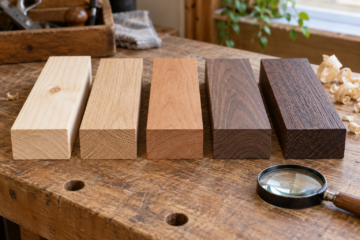
“Pine” covers multiple species and grades, so two boards from the same rack may stain differently. Douglas fir also varies in color and grain. Take time to compare boards in daylight, and check both faces: the side that looks best in the store may not be the face you want exposed after installation.
For a clean, furniture-like finish, look for clear or select boards rather than the cheapest knotty stock. Knots can look appealing, but resin around a knot may resist stain or seep through some finishes. If you prefer the knotty look, make sure knots are tight, not loose or cracked. A small color difference between boards is normal; a dark stain can make it more noticeable rather than hiding it.
How to get a more even stain
Sand with the grain, using a fresh abrasive. For most shelving, start at 100 or 120 grit if the surface is rough, then finish at 150 or 180 grit. Sanding much finer can reduce stain absorption and leave the color lighter. Remove dust with a vacuum and a clean, lint-free cloth. Do not press hard on a random-orbit sander: uneven pressure can leave swirls that show clearly after staining.
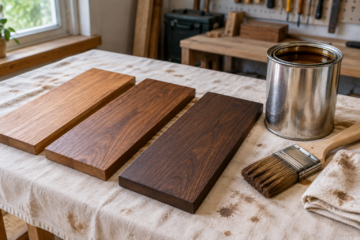
Test the complete finish schedule on an offcut from the same board. Apply any conditioner exactly as directed, then stain and topcoat. A pre-stain conditioner can reduce blotching, but it may also make the color lighter or less vivid. Follow the label’s timing; applying stain outside the stated window can produce a weak or uneven result. For a more controlled color, consider a gel stain category rather than a thin, penetrating stain: compare gel stains for wood.
Use a light stain first if you are unsure. Dark walnut-colored stain on pale pine or fir can emphasize uneven absorption, sanding marks, and differences between boards. Wipe off excess according to the product directions, and let the stain dry fully before applying a clear finish. If the test board looks blotchy, change the preparation or finish choice rather than assuming another coat will hide it.
Protect the surface and account for wood movement
Stain colors wood; it does not protect it. Shelves need a clear topcoat to resist scuffs, dusting, and occasional spills. A water-based clear finish generally keeps the wood lighter, while oil-based finishes add an amber cast. Apply thin, even coats and lightly sand between coats only as the finish maker directs. A water-based polyurethane clear finish is a practical option when you want less ambering; always test it over the chosen stain because the combination can shift the color.
Do not coat only the visible face if the shelf is likely to see changing humidity. Finish the edges and underside too, especially in a kitchen or basement, while recognizing that a coating slows moisture exchange rather than stopping it. Attach the shelf with brackets or cleats sized for the load, and avoid rigidly trapping a wide solid-wood shelf across its width. Wood expands and contracts across the grain with seasonal humidity changes; allow a little room at the wall or use a fastening method that accommodates movement.
Which should you buy?
Choose pine when price and easy availability matter, the shelves are short or moderately loaded, and you like a pale, knotty appearance. It is a perfectly reasonable choice for many home shelves, especially when you use sound boards and a light stain or clear finish. Choose Douglas fir when stiffness and a straight, pronounced grain are priorities, and you can source dry, attractive stock. Either species can make good stained shelving, but neither guarantees a uniform dark color. The offcut test is the most reliable way to find out whether the board and stain will work together.
0 Comments