What's inside
As an Amazon Associate I earn from qualifying purchases. This post may contain affiliate links at no extra cost to you.
A clear finish shows the wood rather than hiding it, so species choice matters more than it does under paint. Grain pattern, color change, hardness, pore texture, movement, and even glue stains will remain visible. For most dining tables, white oak, walnut, hard maple, and cherry are the safest choices. The best one depends on whether you want a pale modern surface, a dark formal table, or a species that develops character with age.
As an Amazon Associate we earn from qualifying purchases at no extra cost to you.


Our Top Picks
 YESWOOD 71’’ Black Walnut Dining Table for 6-835.43 x 70.87 x 29.21 Inches121.03 poundsCheck on Amazon
 Squireewo 71 Inch Solid Wood Dining Room Table71" L x 35" W x 30" H35 x 71 x 30 inches94 poundsCheck on Amazon
 Walker Edison Mid-Century Modern Solid Wood Tapered-Leg Dining59" L x 36" W x 30" H36 x 59 x 30 inches73 poundsCheck on Amazon
 Varathane Water-Based Ultimate Satin PolyurethaneHalf Pint (Pack of 1)3 x 3 x 3 inches0.64 poundsCheck on Amazon
What Makes a Good Dining-Table Species
A tabletop needs enough hardness to resist dents from plates, toys, and everyday use. It also needs predictable movement and a surface that can be sanded flat without tearing out. Hardness is commonly compared using the Janka scale. White oak is about 1,360 lbf, black walnut about 1,010 lbf, hard maple about 1,450 lbf, and cherry about 950 lbf. These numbers are useful, but they do not tell the whole story. A sharp corner on any species will dent more easily than a softened edge, and a poor finish will fail regardless of the wood.
Tabletop boards should usually be kiln-dried furniture lumber with moisture content around 6% to 8% for a heated indoor home. Let the boards acclimate in the room for at least several days, preferably one to two weeks, before final milling. Building with wet lumber can produce gaps, cupping, or cracks after the table enters a dry house.
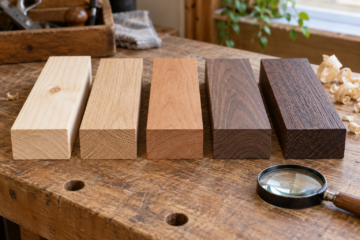
| Species | Appearance under clear finish | Janka hardness | Main advantage | Main drawback |
|---|---|---|---|---|
| White oak | Warm tan, prominent grain | About 1,360 lbf | Durable and widely available | Open pores and strong figure |
| Black walnut | Chocolate brown with lighter sapwood | About 1,010 lbf | Rich color with minimal finishing work | Expensive and somewhat softer |
| Hard maple | Very pale, fine and fairly uniform | About 1,450 lbf | Excellent wear resistance | Can look plain or blotchy with some stains |
| Cherry | Pinkish brown that darkens over time | About 950 lbf | Machines cleanly and ages beautifully | More easily dented and light-sensitive |
| Ash | Pale with bold, oak-like grain | About 1,320 lbf | Good value and high contrast grain | Can look busy under a clear finish |
Best Overall: White Oak
White oak is the most practical all-around choice for a clear-finished dining table. It is hard enough for daily abuse, commonly stocked in wide boards, and usually machines predictably. Its open pores produce visible grain lines and a tactile surface, especially with satin or matte finishes. Quarter-sawn white oak adds dramatic ray fleck, while plain-sawn boards provide a more conventional cathedral grain.
Use a clear water-based finish if you want to limit ambering. Oil-based polyurethane gives white oak a warmer honey tone and emphasizes the grain, but it will continue to yellow slightly as it ages. A penetrating oil is easy to refresh but offers less protection against standing water and stains than a film finish. For a family table, three or four coats of a quality water-based polyurethane are a sensible balance.
Best Premium Choice: Black Walnut
Walnut is often the easiest species to make look expensive. Its brown color and irregular grain need little help from stain, and a clear finish brings out the contrast between light and dark areas. It is softer than oak or maple, so dents and knife marks will appear sooner, but many owners consider that patina part of the appeal.
Choose boards with a similar color if you want a uniform top. Walnut sapwood can be nearly white and may look like an unintended stripe. It can be stained darker, but matching sapwood and heartwood is rarely perfect. Walnut is also expensive enough that a less visible species such as poplar is not a good substitute under clear finish; its green or gray cast usually looks wrong.
Best Light-Colored Table: Hard Maple
Hard maple is the strongest choice when you want a pale, clean tabletop with subtle grain. Its tight pores give it a smoother visual appearance than oak, and its high hardness resists dents. It is a good fit for contemporary furniture, but the nearly uniform surface makes sanding defects and glue spots easy to see.
Maple is also a poor candidate for casual staining. Uneven absorption can create dark patches, particularly on end grain and around glue squeeze-out. If you want color, test the exact stain and sanding schedule on offcuts first. A wood conditioner can reduce unevenness, but it can also make the final color weaker. In many cases, leaving maple natural and using a clear finish is both cheaper and more attractive.
Best for Aging: Cherry
Cherry starts pinkish or salmon-colored and deepens toward a warm reddish brown with exposure to light. The change can be substantial during the first year, so do not judge a sample kept in a dark workshop. A clear finish protects the surface while allowing this color shift to remain visible.
Cherry works cleanly with hand tools and machines, but it is softer than oak and maple. Sharp tools are important because dull cutters can burn or bruise it. It also benefits from eased edges; a 1/8-inch to 1/4-inch roundover is less likely to chip than a sharp tabletop corner. Avoid placing decorative objects permanently on one section during the first few months, because uneven sunlight can create lighter outlines.
Budget and Alternative Species
Ash is often a good cheaper alternative to white oak when its bold grain is acceptable. It is similarly hard and takes clear finish well. The color is usually paler, and the grain can be more visually active. Beech is another affordable, hard option, but it has less distinctive grain and can move noticeably if its moisture content is not stable.
Softwoods such as pine, fir, and spruce can make a serviceable dining table when budget is the priority. They dent easily, contain resin pockets, and often show uneven stain absorption. Clear water-based finish over carefully sanded pine is fine for a farmhouse or worktable, but it will not stay looking new under heavy use. The cheaper option is worthwhile when visible wear is acceptable and the table is not intended as heirloom furniture.
Preparation and Clear-Finish Preparation
Mill the boards flat, then sand progressively through 120, 150, and 180 grit. Going much finer than 180 or 220 grit can reduce finish adhesion and make some woods look uneven. Remove all glue squeeze-out before sanding; sanding cured glue only polishes it into shiny, finish-resistant patches. A sharp glue scraper or chisel is cheaper and more effective than trying to sand every spot away.
Do not glue a tabletop directly to its base across the grain. The top must expand and contract across its width. Use figure-eight fasteners, tabletop clips, or elongated screw holes that allow movement. A 36-inch-wide solid-wood top can move roughly 1/4 inch or more across the seasons, depending on species, grain orientation, and indoor humidity.
Before finishing, inspect under raking light and wipe the surface with mineral spirits if compatible with your planned finish. This reveals scratches, glue marks, and dents that normal overhead light hides. Apply finish to both faces and all edges, with extra attention to end grain. Sand lightly between coats only as directed by the finish manufacturer; aggressive sanding can cut through the film on edges. For a heavily used table, a durable film finish is generally the safer choice than an oil alone, while a penetrating oil remains reasonable for a low-maintenance, deliberately rustic surface.

0 Comments