What's inside
As an Amazon Associate I earn from qualifying purchases. This post may contain affiliate links at no extra cost to you.
For stained interior shelves, the best wood is usually a straight-grained hardwood with a surface you can sand evenly. Red oak is a practical choice if you want a pronounced grain pattern; maple suits a cleaner, subtler look but takes more care to stain evenly. If the shelves will be painted, or hidden in a closet, stain-grade hardwood may be a needless expense: paint-grade poplar or good plywood can do the job.
As an Amazon Associate we earn from qualifying purchases at no extra cost to you.



Our Top Picks
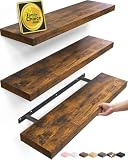
 BAYKA Rustic Brown Floating Shelves 22.5in22.5inches22.5 x 6.7 x 1.1 inches4.6 poundsCheck on Amazon


Choose wood to suit the finish
Stain colors wood rather than covering it, so the species’ grain, natural color, and density remain visible. A stain that looks brown on oak may look blotchy or unexpectedly dark on maple. Check the actual board, not just a color chart, and test the full finishing process on an offcut from the same stock.
Also distinguish solid wood from veneer plywood. Solid boards can be sanded and refinished more generously, but they expand and contract across their width as humidity changes. Veneer plywood stays more dimensionally stable and is often a sound choice for wide shelves; its thin face veneer, however, can be sanded through. Avoid aggressive sanding on plywood edges and faces.
Compare common shelf woods
| Wood | Staining behavior | Typical trade-off | Good fit |
|---|---|---|---|
| Red oak | Open, prominent grain takes stain readily | Strong grain can dominate pale or uniform colors | Traditional or rustic shelves |
| White oak | Open grain; usually a more muted, brown cast than red oak | Often costs more and may be harder to find in clear stock | Natural, medium, or darker finishes |
| Hard maple | Tight grain; pigment stain can turn blotchy | Light, smooth look, but less forgiving to stain | Clear finish or carefully tested color |
| Cherry | Fine grain; darkens naturally with light exposure | Color changes over time, and boards can vary | Warm, refined shelves |
| Poplar | Can stain unevenly; green or gray areas may show | Affordable and easy to work, but usually better painted | Painted shelves or hidden utility shelving |
| Birch plywood | Face veneer can blotch; edges need treatment | Stable and economical, but veneer is thin | Wide shelves where plywood construction suits the design |
Best practical pick: red oak
For a first stained-shelf project, red oak is a forgiving starting point. Its open pores accept many stains predictably, and its grain makes small variations in color less conspicuous than they are on maple. Choose boards with consistent grain and color if the shelves sit side by side. Oak is not automatically the best choice for every room: its strong pattern can look busy, and it is heavier than many softwoods.
For a quieter look, try hard maple, but do not assume a premium stain will prevent blotching. Test a stain conditioner or a dye-and-sealer approach on scrap first. Conditioner can reduce uneven pigment absorption, but it may also make the final color lighter. Follow the product’s timing instructions; applying stain outside the stated window can still produce a patchy result.
What to buy
Look for boards sold as hardwood lumber or furniture-grade stock, with no loose knots, deep checks, or twist. For a shelf with a clear finish, inspect both faces under good light. A board that looks acceptable in a dim lumber aisle may reveal mineral streaks or rough patches after staining. For plywood, choose a hardwood-veneered panel with a face grade suitable for visible furniture work, not construction sheathing.
Compare finished shelf dimensions with the stock available. A nominal 1-by-10 board is typically about 3/4 inch thick and 9 1/4 inches wide, not a full inch by ten inches. If a shelf must carry heavy books, thickness, depth, span, and support spacing matter as much as species. A long, shallow shelf on widely spaced brackets can sag even when made from oak. Add a center support, increase thickness, or use a stiffened plywood construction when the span demands it.
For a stained hardwood shelf, shop for stain-grade hardwood boards or suitable hardwood plywood. If you want the color of oak without assembling narrow solid boards, plywood with an oak face can be a practical alternative.
Prepare the surface before staining
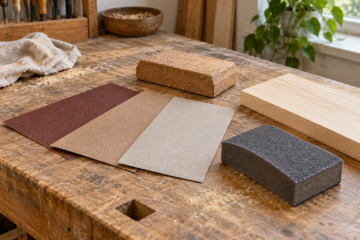
Sand solid wood progressively with 120- or 150-grit, then finish at 180 grit for most penetrating stains. Going much finer can burnish the surface and reduce stain absorption, especially on dense woods. On veneer plywood, start with 150 grit and use a light touch; a few extra passes can expose the core. Sand with the grain, remove glue squeeze-out completely, and vacuum dust before testing or staining. Glue spots resist stain and often show up as pale patches.
Apply stain evenly and wipe off excess according to its label. Let it dry fully before adding a clear topcoat; trapped stain can remain tacky or interfere with adhesion. A water-based topcoat generally preserves a lighter wood color, while oil-based finishes tend to add warmth. Test stain and topcoat together because either can change the appearance. For a straightforward finish, consider interior penetrating wood stain and a compatible clear finish, following both manufacturers’ directions.
When cheaper wood is fine
If the shelves will be painted, choose straight poplar, paint-grade plywood, or another stable, locally available material rather than paying for clear oak or maple. Fill nail holes and visible defects with a filler rated for paint, sand smooth, then prime; knots and resinous areas may need a stain-blocking primer. For an unfinished closet shelf, inexpensive plywood or construction lumber can also be reasonable if appearance is secondary, the boards are dry and flat, and the edges are acceptable.
Do not select low-grade lumber for a visible stained surface expecting dark stain to hide defects. Stain usually emphasizes scratches, glue marks, uneven sanding, and color variation rather than concealing them. Spend the extra effort on selecting clean stock and making a sample board; those steps matter more than buying an elaborate stain system.
0 Comments