What's inside
As an Amazon Associate I earn from qualifying purchases. This post may contain affiliate links at no extra cost to you.
A clear-finished threshold has a harder job than most interior trim. It gets walked on, scraped by shoes, and exposed to wet soles and grit. Pick wood for hardness and stability first, then choose a finish suited to traffic and occasional moisture. A beautiful softwood can work indoors, but it will dent sooner than a dense hardwood.
As an Amazon Associate we earn from qualifying purchases at no extra cost to you.


Our Top Picks
 Kigley Solid Wood Oak Interior Threshold36 x 3.5 x 0.63 Inches36.22 x 3.74 x 1.18 inchesCheck on Amazon
 Wonderjune Door Transition Strip Wood Threshold Transition Unfinished36 x 5 x 0.63 Inches36.61 x 5.12 x 1.18 InchesCheck on Amazon


What matters in a threshold
For a threshold that will show its natural color, look for a species with a pleasing grain, enough hardness to resist everyday dents, and boards or blanks wide and straight enough for the finished profile. Janka hardness is a useful comparison, not a guarantee: grain direction, board quality, and the finish all affect wear.
Moisture is the other concern. A threshold near an exterior door may get rained on or sit under damp shoes. No clear film makes wood waterproof, and a finish that is breached at an edge or screw hole can let water in. Use well-dried stock, seal every face and end, and keep the threshold out of standing water.
Wood options compared
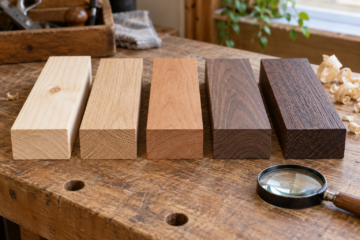
| Species | Approx. Janka hardness | Clear-finish look | Best fit and trade-off |
|---|---|---|---|
| White oak | 1,360 lbf | Prominent grain, tan to brown | Strong all-around choice; durable and widely available, though it can cost more than common softwoods. |
| Hard maple | 1,450 lbf | Light, subtle grain | Hard and clean-looking, but its pale color can amber under oil-based finishes and blotchy color can show. |
| Red oak | 1,290 lbf | Bold grain, pinkish cast | Often less expensive than white oak; less suitable where repeated wetting is likely because it is more porous. |
| Douglas fir | 660 lbf | Strong contrast in grain | Affordable and easy to find; dents more readily, so it suits light-traffic interior doors better. |
| Western red cedar | 350 lbf | Reddish-brown, aromatic | Handles moisture reasonably well, but is very soft for a walking surface and marks easily. |
Hardness figures are approximate and vary by source and growing conditions. They help explain why maple or oak generally stands up better to shoe heels than cedar or fir, but they do not account for finish quality or installation.
Best all-around choice: white oak
For most clear-finished thresholds, white oak is the practical default. It resists dents, has a familiar grain, and takes a clear finish without needing stain. Its tannins can react with iron and moisture, leaving dark marks, so avoid steel wool and use corrosion-resistant fasteners. White oak also works better than red oak where occasional dampness is expected, though neither should be treated as rot-proof or left exposed to repeated water.
Choose hard maple if you want a lighter, less pronounced grain and a very hard surface. It can be less forgiving to finish evenly: test your finish on an offcut, especially with oil-based products, which can deepen its color. Red oak is a sensible budget alternative for a dry interior doorway. Douglas fir is fine when cost and availability matter more than dent resistance, particularly in a low-traffic room.
Buying and sizing the stock
Buy a solid threshold blank or straight, clear hardwood stock thick enough to machine to the profile you need. Check for twist, cups, large knots, checks, and end cracks. A board that is bowed across its width can leave a poor fit or rock underfoot. For a typical doorway, measure the opening at several points and allow for the actual jamb shape; do not assume both sides are square.
Wood movement still matters. Leave the threshold room to move across its width rather than trapping it tightly between rigid surfaces. Acclimate the stock in the room for several days, and follow the wood supplier’s moisture guidance. If buying a pre-made threshold, confirm its width, height, and profile before ordering; a small mismatch can leave a trip edge or a gap at the floor.
Preparation and clear finish
Dry-fit and cut the threshold before finishing. Ease sharp edges slightly with sandpaper or a small round-over; a crisp corner chips more easily and gives finish a thin, vulnerable edge. Sand with the grain, working through roughly 120, 150, and 180 grit. Going much finer can reduce adhesion for some film finishes. Remove dust thoroughly, and inspect under raking light before coating.
For an interior threshold, a floor-rated polyurethane is a straightforward choice. Oil-based polyurethane adds warmth and amber color; water-based polyurethane stays clearer but may raise the grain on the first coat. Follow the label for recoat times and sanding between coats. Apply several thin coats rather than one heavy coat, including the underside and end grain. A water-based floor polyurethane is worth considering when keeping oak or maple pale matters.
Near an exterior door, prioritize sealing all faces and edges and maintaining the finish. A penetrating exterior oil is easier to renew but generally offers less abrasion protection than a hard film finish. A film finish can protect well, but once it cracks or peels, water may get beneath it and repairs take more work. Choose a product labeled for the exposure, then inspect the threshold periodically, especially at the ends and around fasteners.
Avoid these common failures
Do not use stain to disguise poor wood selection. On a threshold, clear finish shows the grain and color, and stain cannot make soft cedar resist heel dents. If you want a different color, test samples on offcuts; maple and pine can take stain unevenly, and a compatible conditioner or sealer may help, but testing is essential.
Do not finish only the visible top. Unsealed undersides and end grain can absorb moisture unevenly, encouraging cupping or finish failure. Also avoid installing freshly coated wood before the finish has cured enough for foot traffic. Dry-to-touch is not the same as fully cured; check the product instructions and protect the surface from grit during that period.
For a typical dry interior doorway, white oak is the strongest balance of durability and appearance; hard maple suits a lighter look, while fir is a reasonable lower-cost option for gentle use. If you need to shape a blank, a white oak threshold blank can save milling time. For a threshold exposed to weather, treat water management and maintenance as part of the material choice, not as something a clear coat can solve on its own.

0 Comments