What's inside
As an Amazon Associate I earn from qualifying purchases. This post may contain affiliate links at no extra cost to you.
For clear-finished cabinet shelves, the best wood depends on how much weight the shelf must carry, how visible the grain will be, and whether you want to stain it. For most painted or lightly finished cabinets, cabinet-grade plywood is a practical choice. For exposed shelves where solid wood grain is part of the look, maple, cherry, and white oak are reliable options. Pine costs less, but it dents easily and can look blotchy under stain.
As an Amazon Associate we earn from qualifying purchases at no extra cost to you.


Our Top Picks
 Polyurethane Wood Finish Water Based Polyurethane Clear Gloss100 ml1.6 x 1.6 x 4.7 inchesCheck on Amazon


Choose by how the shelf will be used
A short shelf holding cups has different needs from a long pantry shelf loaded with jars. Thickness, support, and span matter as much as species. A 3/4-inch shelf that works across a 24-inch cabinet may sag across a 36-inch opening under a heavy load, especially if it is solid wood or particleboard.
As a rough starting point, use 3/4-inch material for ordinary cabinet shelves and add a front edge strip or center support for long spans or heavy storage. A hardwood nosing about 1 to 1 1/2 inches tall stiffens a plywood shelf and hides its plies. For frequently loaded shelves wider than 30 inches, consider a center divider, a thicker shelf, or a structural calculation rather than relying on species alone.
Wood options at a glance
| Material | Appearance under clear finish | Strengths | Trade-offs |
|---|---|---|---|
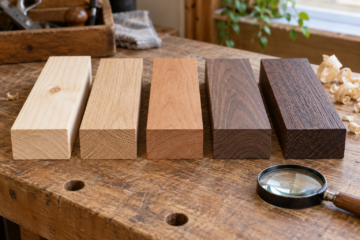
| Maple | Fine, pale, fairly even grain | Hard surface; clean, restrained look | Can show glue marks and sanding scratches; may amber under oil-based finishes |
| White oak | Strong grain, often prominent fleck | Hard-wearing; distinctive grain | More visually busy; open pores need filling for a glass-smooth finish |
| Cherry | Fine grain that darkens with light | Easy to work; warm color develops naturally | Color varies between boards and changes with exposure |
| Birch plywood | Light face veneer with subtle grain | Stable, broad panels; economical compared with solid hardwood | Thin face veneer limits sanding; exposed edges need banding or trim |
| Pine | Visible knots and strong light-dark contrast | Inexpensive and widely available | Soft, dent-prone, and prone to blotching with stain |
Best solid wood choices
Maple is a good all-around choice for a pale, durable shelf. Its tight grain suits a clean modern look, and its hardness helps resist dents from dishes and cans. Its smooth appearance is unforgiving, though: sanding scratches, glue residue, and uneven finish sheen stand out. Sand evenly through the grits, and inspect the surface in raking light before finishing.
White oak is a strong pick when you want visible grain and a more textured look. It is hard enough for busy shelves, but its open pores remain visible beneath many clear finishes. That is not a defect; it is part of the appearance. If you want a level, pore-free surface, use a compatible grain filler before the topcoat, and test the full schedule on scrap.
Cherry works well for warm, traditional cabinets. It is easier to work than maple and takes clear finish well, but boards can vary in color, and cherry darkens with light exposure. A shelf partly shaded by a cabinet door may age differently from one near a window. Buy boards together when color matching matters, and expect the finished color to change over time.
When plywood is the better buy
For wide shelves, plywood is usually more stable than a wide solid-wood panel. Cabinet-grade birch plywood has a clear-finishable face and a veneer core that resists the seasonal movement of solid lumber. Check the actual panel thickness and face quality: a nominal 3/4-inch sheet may measure less, and veneer patches or defects can be hard to hide under a transparent finish.
Plywood edges expose layers, so plan to apply hardwood edge banding or glue on a solid-wood nosing. Iron-on veneer banding is convenient for light-duty shelves; a solid strip gives more impact resistance and adds stiffness. Avoid sanding plywood faces aggressively. Face veneer can be very thin, and a few careless passes with coarse paper can cut through to the core.
Look for cabinet-grade birch plywood when you need a broad shelf blank with a consistent face. If the shelf will be painted, lower-cost plywood or a suitable composite panel may be perfectly adequate; paying for attractive grain makes little sense when it will be covered.
Where cheaper wood makes sense
Pine is a sensible budget option for utility shelves, closets, or rustic interiors where dents and knots are acceptable. It is softer than maple or oak, so cans, cookware, and sliding boxes can leave marks. Clear finish preserves its natural contrast, while stain can make the result uneven: earlywood absorbs more color than dense latewood, and knots may darken differently.
If you want stained pine, test a sample cut from the same board. A compatible pre-stain conditioner or washcoat can reduce blotching, but it will not make pine look like oak or maple. For a cheap shelf that will be painted, knot-free pine boards or plywood are often fine after filling defects and priming.
Prepare the surface for a clear finish
Start by choosing dry, flat stock without twists or cupping. Sand solid wood through 120, 150, and 180 grit for most clear finishes; going much finer can reduce penetration for oil-based products and may leave a slick surface. Sand with the grain, remove dust, and check edges and corners, where scratches show readily. On plywood, follow the veneer supplier’s guidance and use light pressure.
Apply finish to a test piece made from the same material, including any edge banding or glue joints. Glue squeeze-out blocks finish and can appear as pale patches, so scrape it away before sanding. For a straightforward protective coating, a water-based clear polyurethane tends to keep pale woods lighter than many oil-based finishes, which add an amber cast. Follow the label for recoat times and ventilation, and let the coating cure fully before loading shelves.
A practical buying decision
Choose maple for a pale, hard-wearing solid-wood shelf; white oak for bold grain; and cherry for a warm finish that will deepen with age. Choose cabinet-grade plywood when shelf width, stability, and cost matter more than a solid-wood edge. Choose pine when price or a rustic look outweighs dent resistance. Whatever the material, support long spans properly and test the clear finish before coating the finished shelves.

0 Comments