What's inside
As an Amazon Associate I earn from qualifying purchases. This post may contain affiliate links at no extra cost to you.
For a stained bathroom towel shelf, the best all-around choice is straight-grained white oak. It is hard, stable when properly dried, and takes stain more evenly than many open-grained woods. Teak is a strong alternative if you want a naturally water-resistant wood and are willing to pay more. The shelf’s finish and installation matter as much as the species: standing water, unsealed end grain, and poor wall fastening can ruin a good board.
As an Amazon Associate we earn from qualifying purchases at no extra cost to you.


Our Top Picks
 Towel Racks for Bathroom Wall Mounted with Wooden35*11.8*9inch8.86 x 11.81 x 35.04 inches5.32 poundsCheck on Amazon
 Varathane Water-Based Ultimate Satin PolyurethaneHalf Pint (Pack of 1)3 x 3 x 3 inches0.64 poundsCheck on Amazon


Choose for the room, not just the stain color
A towel shelf usually sees splashes and damp air, not constant immersion. That makes a well-sealed, affordable wood a reasonable choice in most bathrooms. If the shelf sits directly above a shower, beside a frequently wet sink, or in a poorly ventilated room, favor a more moisture-tolerant species and take extra care sealing every face and edge.
White oak is a practical stained choice because its prominent grain looks intentional under a transparent finish. Teak has natural oils that help it tolerate moisture, but those oils can complicate glue-up and finishing. Poplar is inexpensive and easy to work, but its greenish or brown streaks often look muddy under stain. Pine costs less still, though soft earlywood absorbs stain unevenly and dents easily.
Wood options at a glance
| Wood | Stain appearance | Bathroom trade-off | Best fit |
|---|---|---|---|
| White oak | Distinct grain; accepts many stains | Good durability; can blotch less than pine, but pores may need grain filler for a glass-smooth finish | Best general-purpose stained shelf |
| Teak | Warm, usually better shown with a clear finish | Naturally moisture resistant; expensive and oily, so bonding and coating need care | Wet locations or a higher-budget project |
| Maple | Fine, subtle grain; light colors can look clean | Hard and durable, but stain may blotch without careful preparation | A smooth, restrained look |
| Poplar | Often uneven or greenish beneath stain | Affordable and easy to machine; dents more readily than oak or maple | Paint, or a low-cost shelf where appearance is secondary |
| Pine | Strong contrast between growth rings; stain can turn patchy | Cheap and widely available; soft and prone to dents | Budget builds with a conditioner and forgiving, darker finish |
What to buy
Look for a kiln-dried board around ¾ inch thick, with no loose knots, checks, or twisting. A shelf about 6 to 8 inches deep is useful for folded towels without projecting too far into a narrow bathroom. Choose the widest clear board you can find, but do not pay a premium for “waterproof” wood if the shelf is only exposed to normal bathroom humidity.
For oak, buy lumber sold as white oak rather than assuming any board labeled oak is the same. Red oak has more open pores and can take up water more readily through its end grain. A local hardwood dealer can usually identify the species and help select a flat board. For a straightforward build, compare prices with kiln-dried white oak boards; check the listed dimensions carefully, since online sizes may be nominal.
Prepare the surface before staining
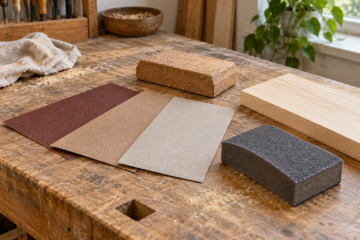
Sand evenly through 120, 150, and 180 grit, following the grain. Going much finer can reduce stain absorption and leave the color lighter or less even. Vacuum the dust and wipe with a clean, dry cloth. Test the stain on an offcut from the same board; the color on a store sample or screen will not predict the result reliably.
Oak generally takes stain more predictably than pine, but test anyway. On maple or pine, a compatible pre-stain conditioner can reduce blotching, though it may also make the final color lighter. Follow the can’s timing instructions and test the whole sequence—conditioner, stain, and topcoat—before finishing the shelf. For oak’s large pores, a grain filler is optional: skip it for a natural open-grain look, or use one if you want a level, furniture-like surface.
Seal all sides, not just the top
Stain adds color; it is not a protective waterproof coating. After it has dried according to the manufacturer’s directions, apply a clear film finish rated for interior wood. A water-based polyurethane stays relatively clear, while an oil-based one adds warmth and can amber over time. Use several thin coats rather than one heavy coat, and lightly sand between coats if the label calls for it.
Coat the underside, back edge, ends, and any holes as well as the visible top. End grain absorbs moisture quickly, so give it particular attention. Let the finish cure for the stated period before installing towels or exposing the shelf to bathroom humidity; “dry to touch” is not the same as fully cured. A water-based polyurethane for interior wood is a reasonable option when you want a clear look and straightforward cleanup. No clear coat makes a shelf immune to standing water, so wipe up puddles and keep the room ventilated.
Glue and installation matter
If the shelf is made from several boards, use a wood glue labeled for interior use and assemble flat, tight joints. For a shelf that may see frequent dampness, an appropriate water-resistant wood glue is a cautious upgrade; it does not replace a sound joint or a protective finish. On teak, remove surface oils from glue areas as directed by the adhesive manufacturer, since oily wood can weaken bonding.
Fasten the shelf brackets into wall studs where possible. A loaded shelf can pull ordinary drywall anchors loose, especially when people tug towels off it. If studs do not line up with the brackets, use anchors rated for the wall type and expected load, and follow their installation limits. Keep the shelf clear of direct shower spray when you can. Even white oak can cup, stain, or develop finish failure if water repeatedly sits on an unsealed edge.
A sensible choice by budget
Choose white oak for the best balance of stain appearance, toughness, and cost. Choose teak when the shelf will face heavier moisture and the price is acceptable; its natural resistance is useful, but it still benefits from careful detailing. If the project is inexpensive or temporary, pine is fine when you accept dents and test the stain first. For a stained shelf, avoid buying poplar solely because it is cheap: it is usually a better paint-grade wood.
0 Comments