What's inside
As an Amazon Associate I earn from qualifying purchases. This post may contain affiliate links at no extra cost to you.
For a music stand that will be clear-finished, choose wood for the job it has to do: stay flat, hold fasteners, and look good under a transparent coating. Cherry is a strong all-around choice for a home-built stand. Maple is harder and lighter in color, but can be less forgiving to finish evenly. Walnut gives a dark, attractive result without stain, at a higher material cost. For an inexpensive stand, clear-finished birch plywood is often a better buy than low-grade solid wood.
What the stand needs from its wood
A music stand’s back or book rest is broad and thin, so it can bow or cup as humidity changes. Its base and upright carry the load and benefit from stiffness and sound screw-holding. A clear finish shows grain, color variation, glue smears, and sanding scratches that paint would hide.
For a typical indoor stand, a 12- to 16-inch-wide book rest made from solid boards should be assembled from narrow, straight-grained stock rather than one wide plank. Boards about 3 to 5 inches wide are easier to find and generally less prone to troublesome movement. For a wide panel, properly made hardwood plywood is more dimensionally stable than a solid panel of the same size.
Inspect boards for twist, cracks, knots near fasteners, and end checks. Buy stock that is already close to the final moisture conditions of the room; around 6–9% moisture content is a reasonable target for heated indoor spaces in much of North America. Let lumber acclimate in the shop, stickered so air can reach both faces, before milling it.
Wood choices compared
| Material | Appearance under clear finish | Practical strengths | Main trade-off |
|---|---|---|---|
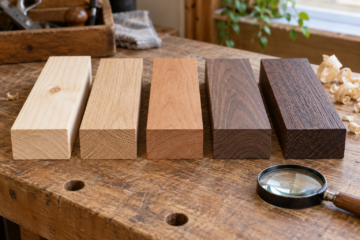
| Cherry | Warm pink-brown that deepens with light exposure | Works cleanly, glues well, and is moderately hard | Freshly milled color can vary; it darkens over time |
| Hard maple | Pale, fine, subtle grain | Hard, durable, and good for edges and wear | Can show blotchy color or sanding marks under some finishes |
| Walnut | Brown to dark brown with expressive grain | Usually looks finished without stain and machines well | Costs more; sapwood can contrast sharply with heartwood |
| Birch plywood | Light face veneer, usually restrained grain | Stable for a broad book rest; economical and easy to source | Thin face veneer limits sanding; exposed plies need deliberate edge treatment |
| Poplar | Pale to greenish or brownish, often uneven | Affordable, easy to machine, suitable for hidden structure | Color and figure are less predictable; best under paint or in less visible parts |
Best all-around: cherry
Cherry is a sensible choice when the stand will be visible in a living room, studio, or lesson space. It is less hard than maple but plenty durable for normal handling, and it is generally cooperative to plane, sand, and glue. Its grain usually looks good with a clear finish, so stain is unnecessary.
Expect cherry to change color. A freshly finished piece may look lighter and pinker than it will after months or years of exposure to light. That is normal, not a finish defect. If matching an existing stand or desk matters, compare aged samples rather than relying on the color of fresh lumber.
When to choose maple or walnut
Choose maple if you want a pale stand or need extra resistance to dents on the base and edges. Its hardness can make cutting and sanding slower, and uneven sanding may become obvious after finishing. Use sharp cutters, sand progressively through about 180 or 220 grit, and test the finish on an offcut before coating the whole stand.
Choose walnut when a dark natural color is the priority and the budget allows it. Clear finish usually adds depth without requiring stain. Keep an eye out for light sapwood if you want a uniform dark panel; either select mostly heartwood or accept the contrast as part of the design. Walnut also works well as an accent, paired with a less expensive plywood book rest.
Budget option: birch plywood and poplar
For a stand that will be used rather than displayed as fine furniture, 1/2-inch birch plywood is a practical book-rest material. Its cross-laminated construction resists the seasonal movement that can make a wide solid panel cup. Check the face veneer before buying: a thin or damaged face cannot be corrected by aggressive sanding. Start around 120 or 150 grit and finish at 180; use light pressure and avoid sanding through the veneer.
Poplar can reduce the cost of an upright or internal support, especially if that part is not prominent. It is not automatically a good clear-finish bargain: green, gray, or brown streaks can look uneven under transparent coatings. It is fine when you have inspected the actual board and like its color, or when the part will be painted. For low-cost solid stock with a more predictable face, compare clear-grade pine, but expect knots and resin pockets unless you select carefully.
Prepare the surface before finishing
Dry-fit the stand before applying finish. Remove glue squeeze-out while it is still manageable; dried glue leaves pale, shiny patches that resist stain and can remain visible even under clear coatings. Avoid wiping wet glue across the face, which can spread a thin film beyond the joint. After assembly, inspect the surface under raking light and mark dents or scratches with pencil.
Sand flat faces with a block or random-orbit sander, moving through roughly 120, 150, and 180 grit. For most film finishes, 180 or 220 is enough. Sanding much finer can reduce absorption for oil-based products and does not reliably improve a furniture-grade film finish. Round exposed edges slightly—about a 1/16-inch radius is enough—to help the finish cover them and reduce chipping. Remove dust with a vacuum and a clean, dry cloth; test any tack cloth on an offcut if it may leave residue.
Use clear finish rather than stain if you like the wood’s natural color. Stain adds another variable and can exaggerate blotching, especially on maple or mixed-color poplar. If you do want stain, test it on an offcut prepared to the same grit, then apply the same sealer and topcoat planned for the stand. A water-based clear coat tends to preserve pale maple better; oil-based finishes usually warm the color and amber with age.
For a straightforward protective coating, consider a water-based clear polyurethane if keeping the wood light matters, or an oil-based clear polyurethane for a warmer tone. Follow the label’s temperature, recoat, and cure instructions. A film finish that feels dry may still be too soft for clamps, books, or regular handling; give it several days, and longer if the product specifies, before putting the stand into service.
A straightforward buying choice
For a mostly solid-wood stand with a natural, warm look, buy straight cherry boards and make the wide book rest from several narrow pieces. For a light-colored stand, use maple if you are prepared to test the finish carefully. For a lower-cost, stable rest, use birch plywood and spend the savings on a solid cherry or maple upright. Avoid choosing lumber by species name alone: straight, dry, defect-free stock matters more than a small difference in advertised hardness.

0 Comments