What's inside
As an Amazon Associate I earn from qualifying purchases. This post may contain affiliate links at no extra cost to you.
For a clear-finished window bench, the best wood is usually hard maple: it is stable, smooth, widely available, and pale enough to suit a light, natural finish. White oak is a stronger choice if you want visible grain, while birch plywood makes sense for a painted-looking bench or a seat built from sheet goods. The right pick depends on the bench’s construction, the look you want, and how much seasonal movement you can accommodate.
As an Amazon Associate we earn from qualifying purchases at no extra cost to you.


Our Top Picks
 Polyurethane Wood Finish Water Based Polyurethane Clear Gloss100 ml1.6 x 1.6 x 4.7 inchesCheck on Amazon


Choose for the finish you want
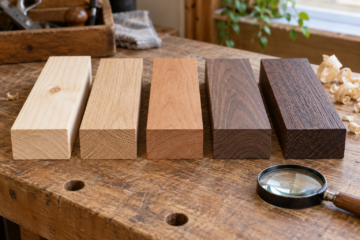
Clear finish does not make different woods look alike. It deepens color and brings out grain, and some finishes add a noticeable amber cast. Test the exact wood-and-finish combination on an offcut before building; even two boards from the same species can vary.
Hard maple has a fine, quiet grain and a naturally light appearance. It suits a clean, understated bench, but its dense, smooth surface can be tricky to stain evenly. For a clear or lightly tinted finish, that is rarely a problem. White oak has more pronounced grain and a warmer tone; its open pores remain visible under clear finish. Cherry starts light pinkish-brown and darkens with light exposure, so an initially pale bench will not stay pale.
Birch is a reasonable lower-cost hardwood for a simple bench. Like maple, it can blotch under stain, and its color and grain can vary. Clear-finished birch plywood is useful when the bench is a box or carcass rather than a solid-wood slab, but exposed veneer edges need careful treatment.
Wood options at a glance
| Material | Appearance under clear finish | Practical trade-off | Good fit |
|---|---|---|---|
| Hard maple | Light, subtle grain | Dense; can look plain and is less forgiving of stain | Clean, pale solid-wood seat |
| White oak | Warm color, prominent grain | Open pores show; usually costs more than basic birch | Visible, traditional grain |
| Cherry | Fine grain, warm reddish-brown tone | Darkens with light; boards vary in color | A bench meant to develop a richer patina |
| Birch | Pale, modest grain | Can blotch with stain; quality varies | Budget-friendly hardwood parts |
| Birch plywood | Thin, relatively even face veneer | Edges reveal plies; face veneer is easy to sand through | Bench boxes and supported panels |
Solid wood or plywood?
A solid-wood seat is attractive and repairable, but it moves across its width as indoor humidity changes. A 12-inch-wide board can change by several millimeters over the year, depending on species, grain orientation, and climate. Do not glue a wide solid seat rigidly to a fixed frame or wall cleat. Use slotted fastener holes, buttons, or another attachment that lets the top expand and contract.
For a built-in bench with a box base, good-quality hardwood plywood is often more predictable. A 3/4-inch panel is a common starting point for a supported seat, but the required thickness depends on span and support spacing. Add a solid-wood nosing to protect the front edge and hide the plywood plies. Avoid low-grade construction plywood for a clear finish: patches, voids, and rough veneer telegraph through, and sanding may expose the inner layers. Search for Baltic birch plywood when you need an exposed plywood edge or a more consistent face.
What to check when buying
Buy kiln-dried stock intended for interior work, and let it acclimate in the room for several days before milling. Choose boards that are straight, with no loose knots, splits, or severe twist. For a clear-finished seat, inspect both faces in daylight: a small color mismatch can be more obvious across a wide, uninterrupted top than it is in a stained or painted project.
For a solid seat made from several boards, buy enough stock to select for color and grain, then arrange the boards before gluing. Aim for adjacent boards with similar color, and alternate growth-ring orientation where practical to reduce cupping. If buying online, confirm actual thickness and face grade rather than relying only on a species name.
Prepare the surface and finish it
Joint and plane the boards before assembly; sanding is not a reliable way to correct uneven joints. After glue cures, scrape or sand away squeeze-out, since dried glue resists stain and leaves pale patches. Sand progressively through 120, 150, and 180 grit. For a clear-coated bench, 180 grit is generally fine enough; sanding much finer can reduce adhesion for some finishes. Keep the surface evenly sanded, especially around glue joints and end grain.
Apply a finish rated for interior furniture and follow its label for recoat times and ventilation. A water-based clear coat tends to preserve a pale maple or birch color; an oil-based finish usually adds warmth and amber. For a seat that will see regular use, apply multiple thin coats rather than one heavy coat, and lightly sand between coats only as directed. A water-based clear wood finish is a useful category to compare if keeping the wood light matters.
Stain is optional, not necessary for a clear finish. Maple and birch can take pigment unevenly, leaving dark patches or a muddy appearance. If you want a darker color, test a conditioner, dye, or stain system on offcuts from the actual boards, then let the sample dry and topcoat it. Do not judge color from a wet sample.
Avoid common bench failures
Water from a window, condensation, and spilled drinks can damage a finish or raise grain, especially at end grain and joints. Seal the underside and edges as well as the top; coating only the visible face can leave the panel more vulnerable to uneven moisture uptake. Leave a small gap between the bench and damp masonry, and do not trap water against the window trim.
For most clear-finished indoor benches, choose hard maple for a restrained pale look, white oak for stronger grain, or birch plywood for a stable box construction. The cheaper birch option is fine when its natural variation suits the room and the boards are sound. Spend more only when the appearance, exposed edges, or design calls for it—not because a bench needs an exotic species.

0 Comments