What's inside
As an Amazon Associate I earn from qualifying purchases. This post may contain affiliate links at no extra cost to you.
A clear-finished range hood puts the wood close to heat, steam, cooking grease and strong light. The best choice is usually a stable, straight-grained hardwood that suits the kitchen—not simply the hardest or most expensive species. The hood’s design and finish matter just as much: wood should be kept clear of the cooking surface as required by the appliance instructions and local code, and the finish needs to tolerate regular cleaning.
What the wood has to do
A hood cover is not a cutting board, so extreme hardness is unnecessary. More important are dimensional stability, consistent color and grain, and the ability to sand and finish without blotching. The wood will move as humidity changes; wide solid boards can cup or crack if they are fixed rigidly across their grain. Use well-dried stock, allow it to acclimate indoors for several days, and build wide panels from narrower boards or use quality veneer-faced plywood.
Heat and grease can still damage a well-finished hood. Follow the range hood manufacturer’s clearance requirements and keep wood away from burners, lamps and hot duct components. A clear coat is not a substitute for safe spacing. For a hood near a high-output range, check local requirements and consider a noncombustible liner or trim around exposed areas.
Wood species compared
| Material | Appearance and finishing | Good fit | Main trade-off |
|---|---|---|---|
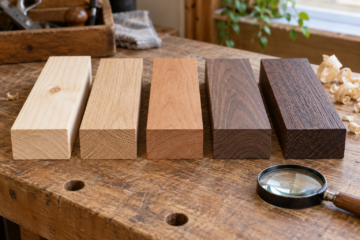
| White oak | Pronounced grain; takes clear finish evenly | Modern, rustic or traditional kitchens | Strong grain can dominate a small hood |
| Maple | Pale, subtle grain; smooth, clean look | Light, contemporary cabinets | Can show blotches or sanding marks under clear finish |
| Cherry | Fine grain that deepens to reddish brown with age | Warm, classic interiors | Color changes in light; matching old cabinets can be difficult |
| Walnut | Dark brown with varied grain | A deliberate contrast or dark-wood kitchen | Higher cost; sapwood can create color variation |
| Birch or poplar | Light, relatively plain appearance | Painted hoods or budget builds | Clear finish can reveal uneven color, greenish tones or blotching |
| Veneer-faced plywood | Depends on face veneer; stable panel construction | Broad, flat hood panels | Edges need banding or solid-wood trim; thin veneer is easy to sand through |
Best all-around choice: white oak
White oak is a reliable pick when you want visible grain and a natural clear finish. Its open grain gives it character, and it generally accepts clear coats predictably. Rift- or quarter-sawn boards have straighter, more restrained figuring than plain-sawn stock, though they cost more. For a hood that should blend with oak cabinets, bring a cabinet door or finish sample when buying wood; “white oak” does not guarantee an exact color match.
Maple is a better choice when you want a pale, quiet surface. It is hard and wears well, but its tight grain makes sanding scratches and glue residue conspicuous. Cherry suits a warmer look, but it darkens with exposure to light, so a newly finished hood may not stay the same color as surrounding wood. Walnut offers a dramatic dark finish, but it is often a costly choice for a large decorative surface.
When plywood makes sense
For wide, flat panels, veneer-faced plywood is often more stable than a single broad solid-wood slab. It is also a sensible way to control cost: use cabinet-grade plywood for the large surfaces and solid matching wood for face frames, edges and trim. Choose a face veneer thick enough for careful sanding, and do not assume a bargain panel has a repairable surface. Sanding through the veneer exposes the core and usually means replacing the panel or concealing the damage with trim.
Solid boards are useful for narrow trim and frames, but join them with the seasonal movement in mind. A wide panel should not be glued or screwed rigidly across its width. Use joinery or fasteners that let it expand and contract. Before assembly, inspect every face under raking light for dents, glue smears and mismatched color.
Buying and preparing the wood
Buy straight, dry stock with a moisture content near 6–9% for a typical heated home, measured with a moisture meter. Reject boards with twists, deep checks or knots where a clean, continuous hood face is important. If ordering online, ask about veneer grade, thickness and whether the plywood is suitable for clear finishing. A white oak veneer plywood search can help compare panel options, but verify the actual veneer and core before purchasing.
Sand in stages rather than skipping grits: start at 120 only if the surface needs real flattening, then move through 150 and 180. For many clear finishes, 180 is a good stopping point; sanding much finer can reduce adhesion for some products. Remove dust with a vacuum and a clean, lint-free cloth. Avoid leaving glue on joints or fingerprints on the surface, as both can appear as pale patches under finish.
Clear finish and maintenance
Choose a finish by reading its label for interior wood use, heat limitations and cleaning instructions. A water-based clear finish tends to preserve a pale wood color, while oil-based finishes usually add warmth and ambering. Neither makes wood fireproof. Test the product on an offcut from the same board or veneer, and view the sample in the kitchen’s lighting before coating the hood.
Apply thin, even coats according to the manufacturer’s directions; many water-based products call for light sanding between coats, while some oil-based finishes need longer drying times. A water-based clear wood finish is a practical starting point for keeping maple or oak light, but check whether the specific finish is approved for the hood’s location. Coat all faces and edges, including hidden surfaces where practical, to reduce uneven moisture exchange. Clean grease with a mild cleaner recommended for the finish, not an abrasive pad or harsh degreaser that can dull or soften the coating.
Make the choice by look and construction
For visible, natural grain and straightforward finishing, choose white oak. Choose maple for a pale, understated hood if you are prepared to make a careful sample and avoid sanding or glue mistakes. Cherry and walnut are attractive when their color is part of the plan, not when an exact match to existing cabinets is essential. For large flat surfaces or a tighter budget, veneer-faced plywood with solid-wood trim is often the more stable and economical build. Whatever you choose, safe clearance, sound panel construction and a tested finish will matter more than buying the most expensive species.

0 Comments