Key takeaways
- A plain-language guide to using a shop vac for sawdust collection, including what it does well, where it fails, and how to fix the airflow problems most shops never diagnose.
What's inside
As an Amazon Associate I earn from qualifying purchases. This post may contain affiliate links at no extra cost to you.
Most people buy a shop vac for sawdust collection, hook it to a miter saw, and then wonder why half the dust still ends up on the floor and in the air. The vacuum is not broken and you did not buy the wrong brand. You asked a high-pressure, low-volume machine to do a low-pressure, high-volume job. Those are two different tools that happen to share a hose fitting.
Here is the mechanism, because once you understand it every buying decision gets obvious. Air movers are rated two ways. CFM is cubic feet per minute, the sheer volume of air being moved. Static pressure, usually given in inches of water lift, is how hard the machine can pull against resistance. A shop vac is built for lift: a small, fast impeller that can yank a bolt off the floor through a 1.25-inch hose. A dust collector is built for volume: a big slow fan and a 4-inch or 6-inch duct that moves a river of air but cannot pull hard through a narrow straw. Think of a drinking straw versus a paper towel tube. The straw wins at suction you can feel on your palm. The tube wins at moving the actual air a table saw throws.
As an Amazon Associate we earn from qualifying purchases at no extra cost to you.



Where a shop vac for sawdust collection genuinely wins
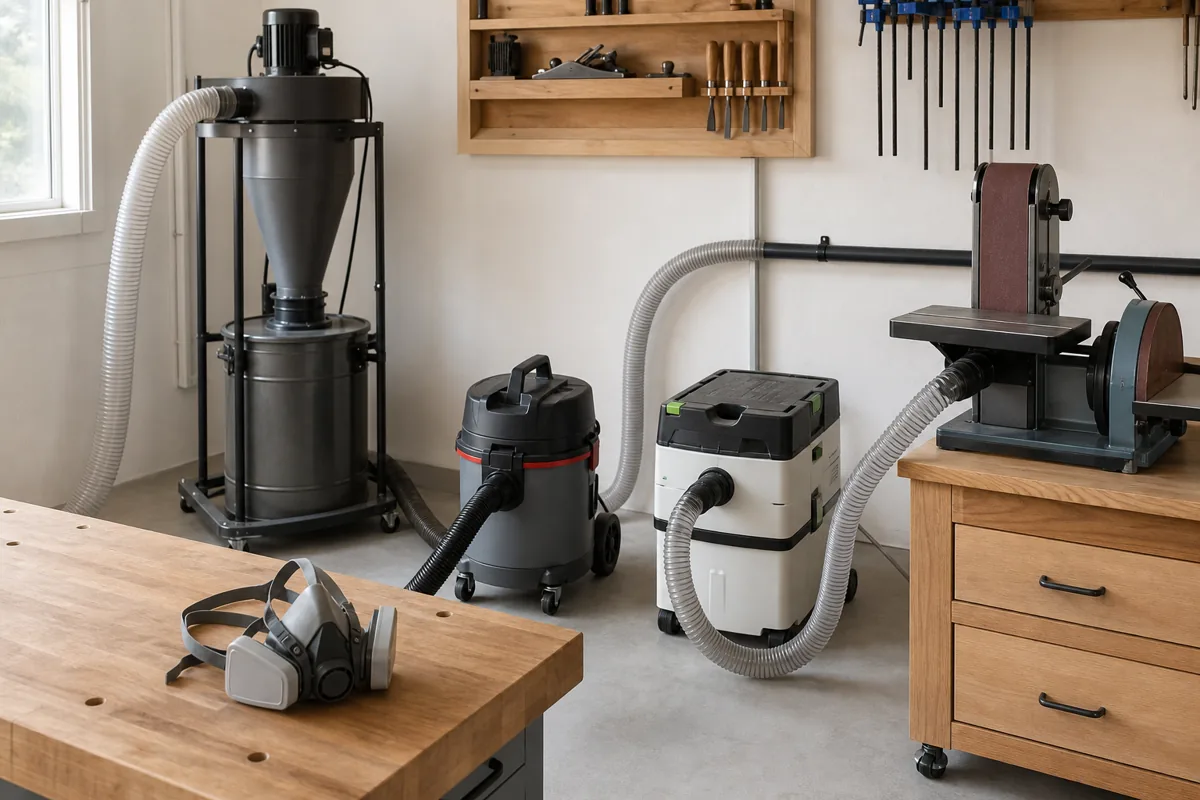
The misconception is that a shop vac is a budget dust collector. It is not. It is a chip and fine-dust capture device for tools with a small port, and at that job it beats a dust collector outright. Any tool with a 1.25-inch to 2.5-inch port was designed around vacuum-level lift, not volume:
Random orbit sanders, track saws, routers, jigsaws, oscillating multi-tools, drywall sanders, and benchtop miter saws all fall into this bucket. So does floor and bench cleanup, wet spills, and clearing a clogged cyclone. If your shop is a garage bay with a sander, a circular saw, and a router table, a good vac plus a separator is a complete system and you do not need anything else.
Where it falls down is any tool with a big open throat and a fast blade: a full-size table saw, a jointer, a planer, or a 12-inch bandsaw. Those tools generate chips in volume, and volume needs CFM. A vac will pull a token amount through a 2.5-inch hose and let the rest pile up inside the cabinet.
Matching the machine to the tool
| Tool | What it actually needs | Shop vac verdict |
|---|---|---|
| Random orbit sander | High lift, low volume | Ideal, best possible match |
| Track saw / circular saw | High lift, moderate volume | Ideal with 1.5 in or larger hose |
| Router table | High lift plus above-table pickup | Works well, split the hose |
| Benchtop miter saw | Moderate volume, awkward port | Partial capture, use a hood |
| Table saw (cabinet or contractor) | High volume through 4 in port | Poor, undersized by design |
| Jointer / planer | Very high volume of chips | Not suitable, will clog |
| Drum or wide-belt sander | High volume of fine dust | Not suitable alone |
The pattern in that table is the whole lesson. Port size is not a plumbing detail, it is the manufacturer telling you which category of air mover the tool was engineered for. A 4-inch port means CFM. A 2.5-inch port means lift.
Mid-size shop vacuum, 4 to 6 gallon, with 2.5 in hose
For most one-car-garage shops this is the sweet spot. Four to six gallons is enough capacity to sand a project without stopping, and it still fits under a bench. Ignore the peak horsepower number printed on the tank; it is a marketing figure measured at a stalled motor. Look instead for a stated water lift, a 2.5-inch hose port, and whether the filter is a pleated cartridge you can find replacements for in two years.
The three things that quietly kill your suction
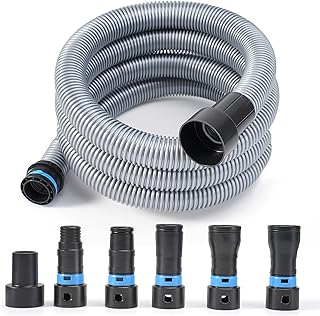
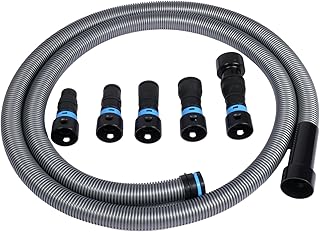
Hose diameter and length. Resistance in a hose climbs sharply as diameter shrinks, and corrugated hose is far worse than smooth-wall. Swapping a 1.25-inch hose for a 2.5-inch hose on a sander often does more for capture than buying a bigger vacuum. Keep hose runs as short as you can actually work with, and skip the extra extension wands when a tool is connected.
Filter loading. Fine sanding dust does not fill the tank, it fills the filter pores. A vac can lose a large fraction of its airflow within minutes of sanding drywall compound or MDF while the tank still looks nearly empty. This is the single most common reason people think their vacuum “died.” Tap or blow out the filter far more often than feels necessary, and run a HEPA or fine-dust rated cartridge if you sand indoors.
No pre-separator. A cyclone separator between the tool and the vac drops the heavy chips into a bucket before they ever touch the filter. It costs some static pressure, but it keeps the filter clean, which means your average suction over an hour of work is dramatically higher than without it. This is not an accessory, it is the fix for problem number two.
- ✔ Excellent lift for sanders, routers, and track saws
- ✔ Portable, cheap to buy, doubles as shop cleanup
- ✔ Handles wet pickup that dust collectors cannot
- ✔ Small footprint, no ductwork required
- ✔ Auto-start outlets on many models sync with the tool
- ✘ Far too little CFM for table saws, jointers, and planers
- ✘ Loud, often 85 to 95 decibels at the operator
- ✘ Filter clogs fast on fine dust and airflow drops with it
- ✘ Small tanks fill quickly during heavy sanding
- ✘ Standard bag or filter may not capture the respirable fines that matter most
Building a system that actually works in a small shop
The setup that solves this for most hobby shops is not one machine, it is two cheap ones with clear jobs. Run the shop vac plus a cyclone separator for every hand tool and benchtop tool. Add a single-stage dust collector, even a small 1 to 1.5 horsepower unit, and roll it between the table saw, jointer, and bandsaw with a short 4-inch hose. Neither machine tries to do the other’s job and both work near their design point.
If a second machine is not happening, prioritize in this order. First, a fine-dust filter on the vac, because the dust you cannot see is the dust that stays in your lungs. Second, a cyclone separator to protect that filter. Third, the largest practical hose diameter to each tool. Fourth, a dedicated hood or shroud on the tools with bad ports; a shop-built plywood box behind a miter saw captures more than any upgrade to the vacuum itself. Fifth, an air filtration unit or box fan with a furnace filter to catch what escapes, and a respirator when you are sanding.
Cyclone dust separator for shop vacuums
If you buy one accessory, buy this. A bucket-lid or standalone cyclone strips out the chips and most of the dust before your filter sees them, which is what keeps suction consistent instead of fading after ten minutes. Check that the inlet and outlet match your hose size so you are not stepping down to 1.25 inches somewhere in the chain, and seal the lid gasket properly or you will lose more than the cyclone costs you.
Noise, filters, and the details buyers skip
Shop vacs are loud in a way that changes how much you use them. A muffler kit, or simply routing the exhaust away from your head, helps. Some newer cordless and brushless models are noticeably quieter, and the battery platforms from DeWalt XR, Milwaukee FUEL, and Makita LXT all offer compact vacs that pair well with sanders and track saws for jobsite work, though runtime on a battery is limited compared to plugging in.
Two features are worth paying for. An auto-start outlet that powers the vac when you trigger the tool means you will actually use it every time. Variable suction matters more than it sounds, because full suction on a random orbit sander can pull the pad down hard enough to slow the tool and leave marks. Also confirm the model uses a common filter format rather than a proprietary one, since replacement filters over the life of the machine will likely cost more than the vacuum did.
Frequently asked questions
Can I use a shop vac on my table saw? You can connect one, and it is better than nothing, but expect partial capture at best. A cabinet or contractor saw was designed around a 4-inch port and a few hundred CFM. A vac moves a fraction of that, so chips accumulate in the cabinet and the blade guard pickup does most of the useful work. If the table saw is your main tool, put your money toward a dust collector and keep the vac for sanding.
Do I need a HEPA filter or is a standard one fine? For chips and cleanup, standard is fine. For sanding wood, MDF, or joint compound, upgrade. The particles that reach deep into your lungs are the ones you cannot see, and a coarse filter will pass them straight through the exhaust and back into the room you are standing in. Pair the fine filter with a cyclone so it does not clog immediately.
Will a bigger tank or higher horsepower rating give me better dust collection? Bigger tanks just mean fewer emptying stops. Peak horsepower ratings are close to meaningless for comparing real performance because they are measured under conditions the vac never operates in. Compare sealed water lift and airflow if the manufacturer publishes them, then focus on hose diameter, filter condition, and whether the tool port itself is any good, since those three usually decide your results.
The short version: buy a shop vac for the tools that were built for it, keep the filter clean with a separator, use the biggest hose that fits, and stop expecting it to swallow what a 4-inch port is asking for. That one distinction is the difference between a shop that stays clean and a shop that just moves the dust around.
Check prices on Amazon →
0 Comments