Key takeaways
- A plain-language guide to dust collection for small shops, covering airflow versus suction, duct sizing, filtration, and what to buy first.
What's inside
- The Misconception: “I Need More Suction”
- Static Pressure Loss: The Tax You Pay On Every Fitting
- Choosing Dust Collection For Small Shops: The Four Real Categories
- Filtration: Where Cheap Systems Quietly Fail
- A Sane Build Order For A One-Car Garage
- Frequently Asked Questions
- The Short Version
- Related Guides
- The Misconception: “I Need More Suction”
- Static Pressure Loss: The Tax You Pay On Every Fitting
- Choosing Dust Collection For Small Shops: The Four Real Categories
- Filtration: Where Cheap Systems Quietly Fail
- A Sane Build Order For A One-Car Garage
- Frequently Asked Questions
- The Short Version
- Related Guides
As an Amazon Associate I earn from qualifying purchases. This post may contain affiliate links at no extra cost to you.
Most garage shops buy dust collection backwards. The tool gets picked first, the ductwork gets figured out later, and the machine that seemed enormous in the store ends up moving a disappointing trickle of air through twenty feet of flex hose. If you are researching dust collection for small shops, the single most useful thing you can do is understand the mechanism before you spend a dollar, because the specs printed on the box describe the machine in a laboratory, not the machine bolted to your wall.
Here is the honest framing: a dust collector is not a vacuum. It is a fan. That one sentence explains almost every mistake people make with small shop dust control, and the rest of this guide unpacks it.
As an Amazon Associate we earn from qualifying purchases at no extra cost to you.




The Misconception: “I Need More Suction”
People shopping for dust collection almost always ask for stronger suction. That instinct comes from shop vacuums, which are genuinely built around suction, or what engineers call static pressure. A shop vac can pull a coin off the floor through a 1-1/4 inch hose. It is a high-pressure, low-volume machine.
A dust collector is the opposite. It is a low-pressure, high-volume machine. Think of the difference between a straw and a box fan. The straw creates a strong, narrow pull. The box fan barely tugs at your hand, but it moves a whole room of air. Chips coming off a jointer knife or a planer head are not small and light. They are heavy, they get thrown fast, and the only thing that keeps them entrained is a large volume of moving air. Volume is measured in CFM, cubic feet per minute, and it is the number that matters for machine dust.
So when your 4 inch port at the table saw is not catching much, the answer is usually not a more powerful motor. It is that something in the path is choking the air volume. Which brings us to the actual villain.
Static Pressure Loss: The Tax You Pay On Every Fitting
Every foot of duct, every elbow, every ridge inside a flex hose, and every clogged filter resists airflow. That resistance is static pressure loss, and your fan has a finite budget for it. Push past the budget and CFM collapses.
The order of magnitude is what surprises people. Smooth metal pipe is cheap in terms of resistance. Corrugated flex hose can cost several times more resistance per foot than smooth pipe of the same diameter, because the air tumbles over every ridge. A tight 90 degree elbow can cost you the equivalent of many feet of straight run. And diameter is the brutal one: airflow capacity scales with cross sectional area, so stepping down from a 6 inch main to a 4 inch main does not cost you a third of your air, it costs you well over half the potential.
That is why a modest collector with a short, smooth, well-planned duct path routinely outperforms a bigger machine fed by a snake of flex hose and three reducers. The fan curve is real. You do not get to ignore it by buying horsepower.
Practical rules that follow directly from the mechanism:
Keep flex hose to the last few feet only, just enough to reach the machine port and allow movement. Everything else should be smooth pipe or metal duct.
Do not neck down below your machine port. If the tool has a 4 inch port, a 4 inch drop is the floor, not the target. Many small shop owners upgrade to a 5 or 6 inch main with 4 inch drops and see a bigger improvement than they would from a new motor.
Use long sweeping bends instead of sharp elbows wherever the wall layout allows.
Choosing Dust Collection For Small Shops: The Four Real Categories
Once you accept the airflow-versus-suction split, the market sorts itself into four honest categories rather than one confusing pile.
| Category | Best For | Realistic CFM Range | Space Needed |
|---|---|---|---|
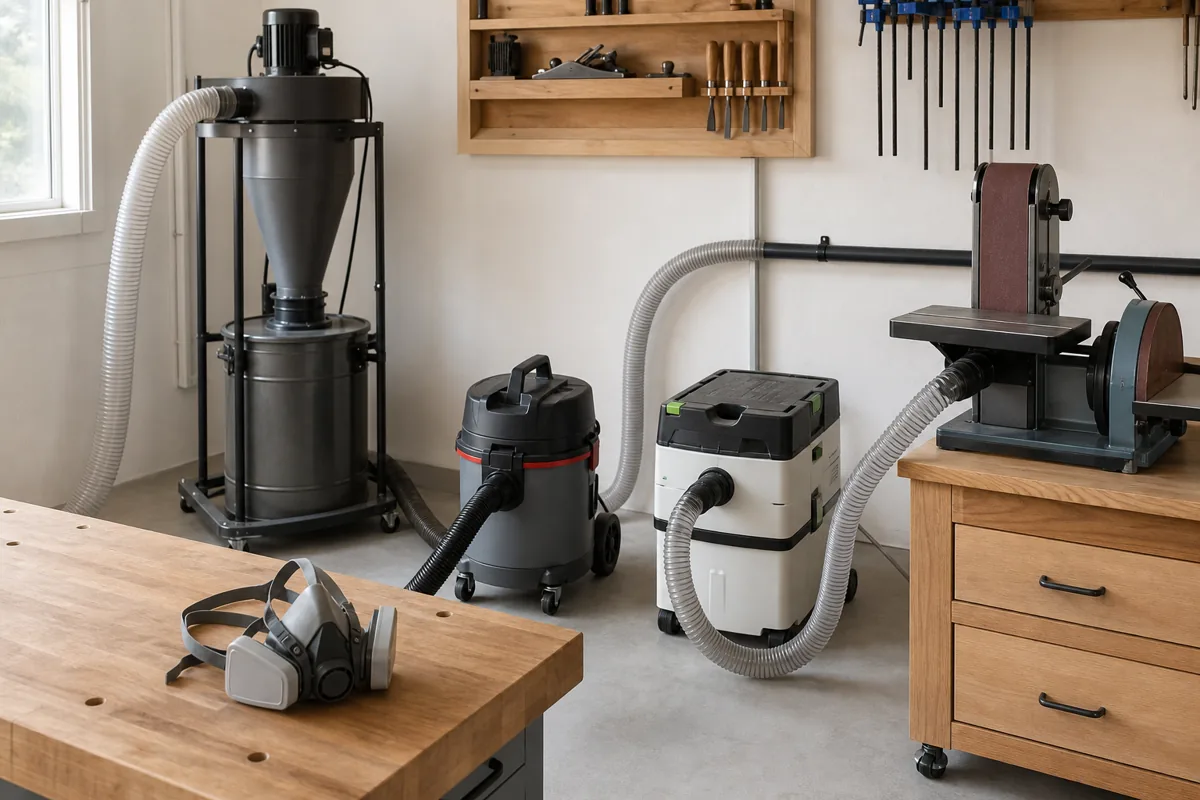
| Shop vacuum with cyclone separator | Sanders, routers, track saws, cleanup | Low volume, high suction | Tiny, rolls under a bench |
| 1 to 1.5 HP portable collector | One machine at a time, short hose | Moderate | Small footprint, wheels |
| 1.5 to 2 HP wall-mount or canister collector | Ducted garage shop, table saw and planer | Good with proper duct | Wall space, vertical |
| Wall-mounted air cleaner | Fine airborne dust after the fact | Room air turnover | Ceiling hung, no floor space |
Note that these are not competitors so much as different jobs. A random orbit sander and a 13 inch planer do not want the same machine. The sander produces fine dust through a small port and genuinely benefits from high static pressure, which is shop vac territory. The planer throws a river of shavings and wants volume. Most well-sorted small shops end up running both, and that is not redundancy, it is matching the tool to the physics.
Wall-Mount Dust Collector, 1.5 to 2 HP
For a one-car garage shop, a wall-mount unit is usually the smartest buy because it takes zero floor space and sits high enough to run a short duct run downhill to your machines. Look for a canister or pleated filter rather than a plain cloth bag, and check the inlet size before you buy so you are not immediately adapting down.
Filtration: Where Cheap Systems Quietly Fail
A collector has two jobs. Move chips, and keep the fine dust out of the air you breathe. Small shops often nail the first and ignore the second, which is backwards from a health standpoint, because the visible chips on the floor are the harmless part.
The particles that matter are the ones you cannot see. Fine wood dust in the single-digit micron range stays airborne for a long time and travels deep into your lungs. Hardwood dust is classified as a carcinogen by several health bodies, and it does not care that you only work weekends.
This is why the standard 30 micron cloth bag that ships with budget collectors is a problem. It catches the shavings and passes the dangerous fraction straight through, effectively turning your collector into a dust distribution system. Upgrading to a pleated canister filter rated in the 1 to 2 micron range is one of the highest-value modifications in a small shop. The pleats also add surface area, which lowers resistance and helps your CFM at the same time.
Two more mechanism notes worth knowing. First, a cyclone or separator ahead of the filter matters because it drops the heavy material out before it can pack against the filter media. A loaded filter is a static pressure penalty that grows every hour you run. Second, an overhead air cleaner is not a substitute for capture at the source. It cleans the room after the dust has already been in your breathing zone. Useful, but it is the backup, not the plan.
- ✔ Pleated canister filters capture fine dust and reduce airflow resistance
- ✔ Cyclone separators keep filters clean and extend filter life
- ✔ Wall-mount and ceiling-mount units free up scarce floor space
- ✔ Source capture protects your lungs better than any air cleaner
- ✘ Good ductwork often costs as much as the collector itself
- ✘ Cyclone units need vertical clearance many garages do not have
- ✘ Higher CFM means more noise, often in the 80 to 90 decibel range
- ✘ A dust collector is not a shop vac and will not do fine sanding well
A Sane Build Order For A One-Car Garage
You do not have to buy everything at once, and the order matters more than the budget. Start where the mechanism gives you the biggest return.
Step one, separate the two jobs. Get a shop vac paired with a small cyclone separator for sanders, routers, and cleanup. This is the cheapest meaningful improvement and it protects the vac filter.
Step two, buy the collector for your worst offender. Usually that is the planer or the jointer, since they generate the most material by volume. Size it for that machine, not for the average.
Step three, spend real money on the duct path. Smooth pipe, sweeping bends, blast gates at each drop, and flex hose only at the machine. This is where the printed CFM number either survives or dies.
Step four, upgrade the filter if the unit came with a cloth bag, and add an overhead air cleaner if you spend long sessions in the shop.
Step five, wear a respirator anyway during sanding. No collection system captures everything, and an N95 or better costs almost nothing compared to the alternative.
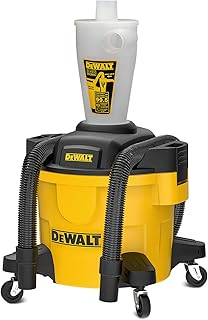
Cyclone Separator For Shop Vacuums
A cyclone separator drops heavy chips into a bucket before they reach your vacuum, which keeps suction consistent through a whole session instead of fading after ten minutes. If you own a shop vac and nothing else, this is the first thing to add. Check that the inlet matches your hose diameter.
Frequently Asked Questions
How much CFM do I actually need in a small shop? It depends on the machine, not the shop. Small tools like sanders and routers are satisfied with modest airflow, while planers, jointers, and table saws are the demanding ones and are commonly cited as needing several hundred CFM at the port. The catch is that the rating on the box is measured with no ductwork attached, so plan for real-world losses and buy with headroom rather than exactly at the number.
Can I just use my shop vacuum for everything? For sanders, routers, track saws, and cleanup, yes, and it will often do better than a dust collector because those tools need suction more than volume. For a planer or jointer, no. The small hose cannot pass enough air volume to keep heavy shavings moving, and it will clog. Different physics, different tool.
Is a wall-mounted air cleaner worth it if I already have a collector? It helps, but understand what it does. It filters room air on a cycle, catching fine dust that escaped capture at the tool. It does nothing about the cloud in front of your face at the moment you create it. Treat it as a second layer after good source capture and a proper respirator, not as a replacement for either.
The Short Version
Dust collection is an airflow problem wearing a suction costume. Match the machine to the job, spend on smooth ductwork and a fine filter rather than raw horsepower, and remember that the dust you cannot see is the part that matters. A modest, well-plumbed system in a two-car garage will beat an oversized collector fed through thirty feet of flex hose every single time.
Check prices on Amazon →
0 Comments