Key takeaways
- Chips on the floor were never the danger; here is how airflow, duct size, and filtration really work so your garage dust collection system captures the fine dust you cannot see.
What's inside
As an Amazon Associate I earn from qualifying purchases. This post may contain affiliate links at no extra cost to you.
Sweeping up chips feels like dust collection, but the pile on the floor was never the hazard. A working garage dust collection system targets what you cannot see: the 1 to 10 micron flour that hangs in the air for hours, drifts under the door into the house, and settles on your car as a gray film. If your floor looks clean while the air still glows in a shaft of afternoon sun, you are catching the harmless half.
Garages add their own constraints. One or two circuits, a ceiling broken up by door track, a vehicle that has to come back in, and neighbors close enough to hear a blower. Start with the mechanism, because most wasted money in home dust collection comes from misreading two numbers.
As an Amazon Associate we earn from qualifying purchases at no extra cost to you.





| Approach | Best at | Typical duct | Real limitation |
|---|---|---|---|
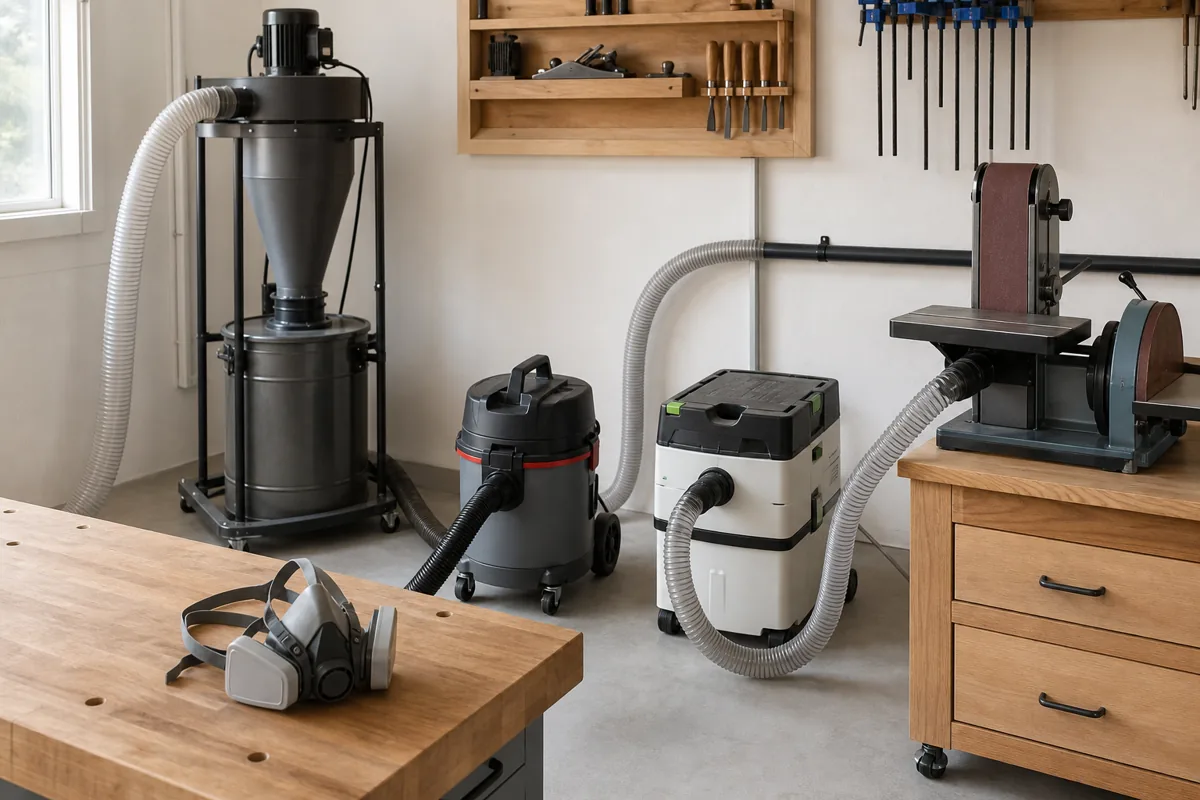
| Shop vac plus cyclone separator | Sanders, routers, track saw | 2.5 in hose | Fierce suction but low volume, chokes on a planer |
| Portable single-stage, 1 to 1.5 HP | Table saw, bandsaw, small jointer | 4 in flex, short runs | Stock bag passes fine dust, must be rolled around |
| Wall-mount cyclone, 1.5 to 2 HP | Ducted shop, heavy chip makers | 5 to 6 in smooth pipe | Costs more, often wants 240V, eats headroom |
| Ambient air cleaner | Dust already loose in the room | None | Captures nothing at the tool |
Why Your Garage Dust Collection System Fails: Volume vs. Suction
Blowers are described by two figures. CFM is volume, how much air moves per minute. Static pressure is the force available to drag that air through resistance. Picture a drinking straw next to a stovepipe. The straw generates fierce suction and moves almost nothing. The stovepipe barely pulls at your hand yet shifts a room’s worth of air. A shop vacuum is the straw. A dust collector is the stovepipe. They are not the same tool in two sizes.
Here is the misconception to kill first: horsepower is not suction at the tool. The motor rating describes the impeller under ideal conditions. What reaches your table saw port is whatever survives the plumbing. Put a 2 HP collector on twenty feet of 4 inch flex with three elbows and you paid for 2 HP while receiving a fraction of its airflow. The fan is not weak, it is climbing a hill you built. Capture is also a threshold, not a slope. Common guidance puts a table saw or bandsaw near 350 to 400 CFM at the port, with planers and jointers wanting more. Below that, the airstream cannot lift the particle.
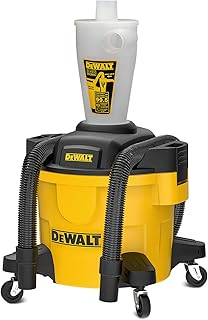
Cyclone dust separator for a shop vacuum
If a shop vac is all you own, this is the highest return upgrade available. Chips drop into a bucket before they reach the filter, so suction holds steady through a long sanding session instead of fading in five minutes. It does not add airflow, it stops you from losing it.
The Ductwork Is the Real Machine
Resistance is where hobby systems die, and flexible hose is the usual culprit. Every corrugation is a speed bump, which is why flex is commonly estimated at roughly three times the resistance of smooth pipe of the same diameter. A tight 90 degree elbow adds the equivalent of several more feet. Use flex for the last foot or two where the connection has to move, then run smooth pipe for everything else.
Diameter is the other lever, and intuition reverses here. Wider mains help a strong collector because area grows quickly with diameter. But oversized pipe on an undersized blower is a trap. Chips stay airborne only above a transport velocity somewhere in the 3500 to 4000 feet per minute range. Hang a 6 inch main on a collector that cannot fill it and the air slows, chips settle inside the pipe, and you eventually own a plugged ceiling run. Match duct to the airflow you have, not the number on the box.
Related misconception: leaving several blast gates open does not spread the work. Air takes the easy path, so three open gates elsewhere means most of your air is vacuuming empty pipe. Gate every branch and run one machine at a time.
Filtration: A Bag Is Not a Filter
The felt bag shipped with budget single-stage collectors is often rated around 30 microns. Read that plainly: it catches chips and passes the entire size class that reaches the deep lung. Such a machine is a fan pointed at your face with a chip strainer in front of it. It leaves the floor cleaner and the air worse, which is why so many shops believe their dust collection is fine.
The fix is a pleated canister with a rated medium, or a two-stage cyclone that spins nearly everything into a bin before the filter sees it. Pleats add surface area, so resistance climbs slower as the filter loads. Venting the blower outdoors beats both, but you are then exhausting conditioned air and pulling makeup air in, which matters in January and matters more if a combustion appliance shares the space.
Single-stage dust collector with canister filter
For a one-car garage, a 1 to 1.5 HP mobile collector sold with the canister already fitted is the practical sweet spot. It runs on a household circuit, rolls to whichever machine is running, and saves the filter upgrade you would buy later. Check the inlet, since a lone 4 inch port caps you regardless of motor rating.
Building It in Stages Without Wasting Money
Stage one: shop vac, cyclone separator, good cartridge filter, aimed at small ports like sanders, routers, and a track saw. High suction, low volume, correct for a 2.5 inch fitting. Stage two: a mobile collector with a canister for the machines that make volume. Stage three: fixed smooth duct with gates, and only then does a wall-mounted cyclone earn its footprint.
- ✔ Grab a tool and cut without dragging hose across the floor
- ✔ Real airflow at the port instead of whatever survives the flex
- ✔ A cyclone chip bin empties in under a minute
- ✔ Fine dust stays out of the house and off the car
- ✘ Needs ceiling height and a corner you give up for good
- ✘ Larger cyclones often mean adding a 240V outlet
- ✘ Duct and gates can cost as much as the collector
- ✘ Loud enough that Sunday sessions annoy the neighbors
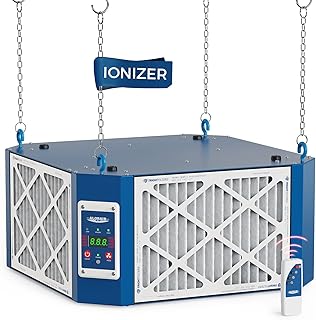
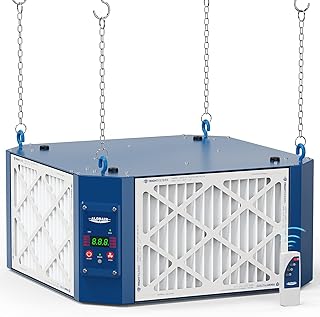
Ceiling-mounted air filtration unit
An air cleaner scrubs what escaped at the tool, which beats waiting for particles to settle in a closed garage. Hang it so the discharge sweeps along the ceiling, and leave it running after you shut off the lights.
No hood captures everything. Sanding throws dust past any shroud, so an ambient air cleaner plus a fitted N95 or P100 while you make fine dust belongs in the plan, not beside it.
Frequently Asked Questions
Do I need a 240V circuit? Not for the tier most garages should start with. Collectors in the 1 to 1.5 HP class usually run on 120V, ideally on their own breaker so saw and blower are not sharing. Larger cyclones commonly want 240V, so confirm before ordering.
Can one collector run two machines at once? Realistically no. Two open ports split the airflow so neither reaches capture velocity. Blast gates and a one-at-a-time habit cost far less than a machine that could truly do both.
Is a HEPA shop vac enough for a whole shop? For hand tools and small ports, yes. For a planer, jointer, or table saw, no. A vac moves too little volume to keep chips moving through a 4 inch duct and will clog quickly. Different physics, different machine.
Check prices on Amazon →
0 Comments