What's inside
As an Amazon Associate I earn from qualifying purchases. This post may contain affiliate links at no extra cost to you.
Best Vacuum Pumps for CNC Routers: Sizing, Plumbing, and Picks
The best vacuum pump for a CNC router depends on how much air your setup leaks: choose a regenerative blower for a large, leaky spoilboard, a rotary-vane pump for smaller well-sealed parts, and a purpose-built CNC vacuum pump when you need production-duty capacity and can support its electrical and plumbing requirements.
Choose by workholding situation
- Large spoilboard, nested sheets, frequent cutting: A regenerative (side-channel) blower is often the practical choice. It moves a high volume of air through leaks, though it produces less vacuum than a rotary-vane pump.
- Small parts, gasketed zones, or a well-sealed pod: A rotary-vane pump can generate deeper vacuum with lower airflow. It is a poor match for a wide, porous spoilboard unless the surface is carefully sealed and leakage is controlled.
- Regular production with demanding duty cycles: Consider an industrial liquid-ring pump or a packaged CNC vacuum system sized by the manufacturer for the table and material. These can suit high-throughput shops but bring added cost, maintenance, and utility needs.
- Occasional hobby use: A small pump may be adequate for fixtures or compact, gasketed work. Avoid assuming a small HVAC service pump or general-purpose vacuum pump is suitable for continuous CNC work; check its rated airflow, duty cycle, and cooling requirements.
Airflow matters as much as vacuum level
A pump’s maximum vacuum reading is usually measured with little or no airflow. On a CNC router, the spoilboard, porous stock, uncovered zones, and imperfect seals let air in continuously. Under those conditions, the useful question is how much airflow the pump can deliver while maintaining enough pressure difference to hold the work.
As an Amazon Associate we earn from qualifying purchases at no extra cost to you.
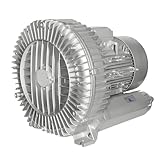
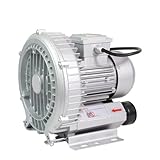

Vacuum force is approximately the pressure difference multiplied by the sealed area. For example, a 12-by-12-inch part has one square foot of area. At a 5 psi pressure difference, the theoretical holding force is 720 pounds (5 psi × 144 square inches). Real holding force is lower and depends on leakage, cutter direction, acceleration, material, and seal quality. Treat this calculation as a way to compare setups, not a guarantee against part movement.
For a porous MDF spoilboard, leakage can dominate. A bigger pump will not fix an uncovered table that freely pulls air through every unused area. Use gasketed zones, masking or sacrificial covers, and a surfaced spoilboard to reduce leakage before buying more capacity.
Representative pump types compared
The ranges below are typical sizing examples, not specifications for every model. Verify the manufacturer’s performance curve at the vacuum level you expect to use; airflow and vacuum figures are not interchangeable.
| Type | Typical airflow range | Typical vacuum range | Best fit | Ownership trade-off |
|---|---|---|---|---|
| Small regenerative blower | About 50–150 CFM | About 3–8 inHg | Compact table, moderately leaky fixtures | Continuous airflow; can be loud and needs clear cooling air |
| Industrial regenerative blower | About 150–500 CFM | About 5–12 inHg | Large spoilboard or frequent sheet work | Often requires a dedicated circuit; filter and silencer add cost |
| Rotary-vane pump | About 5–50 CFM | About 20–29 inHg | Sealed pods, small parts, nonporous stock | Oil changes and filtration; leakage can overwhelm the lower airflow |
| Liquid-ring pump | About 100–600 CFM | About 15–27 inHg | Production systems needing substantial capacity | Water management, more complex installation, and higher utility demand |
These broad ranges help narrow the type, not select an exact pump. For a specific CNC vacuum pump, compare the pump curve at operating vacuum, continuous-duty rating, motor voltage and current, and required inlet filtration.
Picks by shop and workpiece
Large, leaky spoilboard: regenerative blower
For nested sheets on a sizable MDF table, prioritize airflow at working vacuum. A regenerative blower is often the most forgiving CNC vacuum pump choice when small leaks are unavoidable. Choose a model with a published curve, continuous-duty motor, and inlet protection. If you only cut a small zone, divide the table into independently valved sections rather than pulling air across the entire spoilboard.
Small sealed fixtures: rotary-vane pump
For pods, gasketed jigs, and smaller nonporous workpieces, a rotary-vane pump can provide strong holding force from a compact sealed area. It is less attractive on porous stock or a large uncovered spoilboard because its lower airflow may not keep up with leakage. Look for a suitable continuous-duty rating and plan for oil inspection and changes as specified by the manufacturer.
Busy production cell: industrial package or liquid-ring system
When the router runs for long shifts, uptime and service access matter as much as peak performance. A packaged CNC vacuum system or appropriately sized liquid-ring pump may make sense if the shop can handle its water, power, ventilation, and maintenance requirements. Get the supplier to size it against your actual table area, material porosity, and zoning—not just router-bed dimensions.
Occasional hobby work: start by sealing, then size
For intermittent use, improve the fixture first: cover unused spoilboard, use a gasket around the part, and keep the spoilboard flat. A modest pump may then work well on a small sealed area. If you need to hold large sheets regularly, the cost of a suitably sized blower and electrical circuit may be more sensible than repeatedly losing parts to inadequate hold-down.
Size a system in four steps
- Define the active area. Measure the largest area you need to hold at once, not just the machine bed.
- Estimate leakage. Solid plastic or a gasketed fixture leaks relatively little; raw MDF and porous sheet goods leak much more. Include uncovered table area in the estimate.
- Choose the pump type. Favor airflow for leaky, broad surfaces and vacuum level for well-sealed, smaller fixtures. Use manufacturer curves to check performance at the intended operating point.
- Confirm utilities. Check voltage, phase, full-load current, breaker requirements, duty cycle, ambient temperature limits, and ventilation. Large blowers and production pumps can require more than a standard shop receptacle can supply.
Plumbing, noise, and upkeep
Keep the inlet line short and adequately sized: restrictive hoses and tight elbows reduce effective airflow. Add an isolation valve for each table zone, a vacuum gauge near the plenum, and a filter or separator appropriate to the pump. MDF dust can damage equipment, while chips can clog valves and passages; never rely on the pump itself as a dust collector. Follow the pump maker’s instructions for filter placement and allowable inlet contamination.
Blowers can be notably loud, especially at continuous duty. A properly designed silencer or remote installation can help, but do not enclose a motor without preserving its cooling airflow. Check motor temperature and keep the intake clear. Rotary-vane systems are often quieter in pitch but need oil and exhaust management; liquid-ring systems require attention to water quality and discharge.
Common ownership failures are predictable: clogged filters, leaks at fittings, a warped or over-sanded spoilboard, and running an undersized pump across too much open area. Inspect seals and filters regularly, surface the spoilboard when it loses flatness, and verify vacuum at the table—not only at the pump. A gauge reading that collapses when a zone opens is useful evidence of leakage or insufficient airflow.
Bottom line
For a large, porous CNC table, start with a regenerative blower sized for airflow at operating vacuum. For small, sealed work, a rotary-vane pump may deliver more useful holding force. Production shops should compare complete systems against their real leakage, duty cycle, power supply, and maintenance capacity. The best vacuum pump for CNC router work is the one that maintains a stable pressure difference on the actual workpiece without exceeding the shop’s noise, plumbing, and electrical limits.
0 Comments