Key takeaways
- Airflow and sealed suction are the two specs that decide whether a shop vac works with your tools, and neither one is printed as peak horsepower on the box.
What's inside
As an Amazon Associate I earn from qualifying purchases. This post may contain affiliate links at no extra cost to you.
Walk down the vacuum aisle and every tank shouts a horsepower number and a gallon count. Neither one tells you whether that machine will pull sanding dust through a 15 foot hose or lift water out of a flooded basement. Learning how to choose a shop vac comes down to two specs most boxes bury: airflow and sealed suction. Everything else is packaging.
Here is the picture that makes the rest simple. Put a straw in your mouth and blow with the far end wide open. That is airflow, measured in cubic feet per minute, and it is what carries loose sawdust up a wide nozzle. Now have somebody pinch the straw shut and pull as hard as you can. That is static pressure, listed on good spec sheets as air lift or sealed suction in inches of water. Every vacuum is built toward one end of that range, and none is great at both.
As an Amazon Associate we earn from qualifying purchases at no extra cost to you.




| Machine | Airflow | Sealed suction | What it is really for |
|---|---|---|---|
| Compact 2-5 gallon | Low | Moderate | Benchtop cleanup, truck, one small sander |
| Full-size 8-16 gallon wet/dry | Moderate | High | General shop duty, water, demo debris |
| HEPA dust extractor | Moderate | High | Tracksaws, sanders, drywall, masonry |
| Cyclone dust collector | Very high | Very low | Table saw, jointer, planer chip volume |
Peak Horsepower Is the One Spec You Can Ignore
That 6.5 peak HP sticker is not quite a lie, but it describes a moment you never use. Peak horsepower is measured as the motor spins up or stalls, before the vacuum does any work. A 15 amp household circuit at 120 volts delivers about 1,800 watts, roughly 2.4 horsepower on paper before you subtract heat and motor losses. Anything larger came off a test bench, not your garage. When a box lists only peak HP and gallons, assume the airflow is ordinary.
How to Choose a Shop Vac for the Work You Actually Do
Restriction decides everything. A wide floor nozzle on a 2-1/2 inch hose is an open pipe, so airflow wins and modest suction is plenty. A 1-1/4 inch sander hose or a 35 mm tracksaw port is a bottleneck, and forcing air through a bottleneck takes pressure, not volume.
Sort your work first. Sweeping chips and general housekeeping reward airflow and a big tank. Hooking to a sander, router, or tracksaw rewards sealed suction, because the tool port is narrow by design. Water and slurry need suction plus a wet rating and a float shutoff. Plenty of shops end up with two machines: a full-size wet/dry unit for messy work, and a small vac that lives near the sanding station.
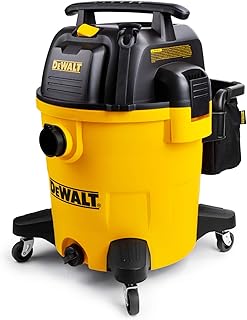
Full-Size Wet/Dry Shop Vacuum, 8 to 16 Gallon
The workhorse category. Look for a 2-1/2 inch hose, a published air lift figure, and rubber or steel casters instead of small hard plastic wheels. Buy the fine filter and a box of bags with it.
Filters Decide How Long Your Suction Lasts
A pleated cartridge filter is a paper accordion. The folds pack a lot of surface area into a small can and catch every chip you can see. What they miss is the fine fraction, roughly the particles under 10 microns that hang in the air for hours. Sanding dust, joint compound, and concrete slurry are mostly that fraction, which is why a vacuum can fill its tank while the room stays hazy.
Two upgrades fix different halves of the problem. A fine or sub-micron cartridge traps smaller particles. A collection bag is not a filter at all, it is a pre-filter that keeps debris off the cartridge so the cartridge keeps breathing. Run both. A bagged vac holds strong suction through a whole project while a bare tank starts choking twenty minutes into drywall sanding.
Which explains the most common misdiagnosis in a home shop: my vacuum lost power. It almost never did. The filter loaded, pressure drop across the media climbed, and airflow collapsed. Tap the cartridge out, or rinse and fully dry it if it is the washable type, and the machine comes back.
HEPA Ratings and Where They Leak
A filter can be HEPA rated while the vacuum around it is not. Fine dust escapes at the cartridge seal, at a loose hose cuff, and out the exhaust. A true dust extractor is built as a sealed system with gasketed joints, and the better ones pulse air backward through the filter so it never fully loads. If you cut masonry or work in pre-1978 housing where lead paint is possible, that sealed design is the reason to spend more.
- ✔ Sealed filtration keeps the dust you cannot see out of the air
- ✔ Automatic filter pulsing holds suction steady through long sanding sessions
- ✔ Variable suction stops thin stock and sanding pads from sticking down
- ✔ Antistatic hose and a tool-triggered outlet come standard
- ✘ Costs several times what a comparable wet/dry vac costs
- ✘ Smaller tanks mean more trips to the dumpster on demo work
- ✘ Not every model is rated for wet pickup
- ✘ HEPA cartridges and bags are an ongoing expense
HEPA Dust Extractor with Automatic Filter Cleaning
Worth the money if you sand indoors, run a tracksaw, or touch drywall and masonry. The sealed housing and self-cleaning filter are what you are paying for, not raw suction. Confirm the hose diameter matches your tool ports.
Hose Diameter, Tank Size and the Details That Wear on You
Hose size matters more than people expect, because airflow follows cross-sectional area rather than diameter. Stepping from 1-1/4 inch to 2-1/2 inch does not double your capacity, it roughly quadruples the open area. Length costs you too, since every foot adds friction. If you have to run long, run fat.
Tank size is a tradeoff, not a number to maximize. A big drum means fewer trips to the trash and more weight to wrestle, and 16 gallons of wet debris is genuinely hard to lift. Check the casters, since small hard wheels are why vacuums tip over on extension cords.
Extras worth real money: an antistatic hose, because dry dust moving through plastic builds a charge that will bite you, a tool-triggered outlet, and onboard storage that keeps the wands from wandering off.
A Shop Vac Is Not a Dust Collector
This mix-up costs people money. A shop vac is high pressure and low volume, generally somewhere around 60 to 100 inches of sealed lift but only in the neighborhood of 100 to 150 CFM. A dust collector is the mirror image: several hundred CFM or more, with single-digit inches of lift. So a shop vac clamped to the 4 inch port on a planer falls behind immediately, and a dust collector hooked to a sander does close to nothing.
The useful bridge is a cyclone pre-separator, a cone that sits between hose and vacuum. Air spins, heavy particles drop out, and most of your debris never reaches the filter. You give up a little suction and gain a lot of filter life.
Cyclone Pre-Separator for Shop Vacuums
The cheapest real upgrade for a vac you already own. Match the inlet and outlet to your hose size, keep the connections short, and expect to empty a bucket instead of beating out a filter.
Shop Vac FAQ
Are more gallons always better? No. Tank volume has nothing to do with suction, and a full big tank is heavy and awkward on stairs. Match capacity to how far you are willing to carry it.
Can I pick up water with the paper filter installed? No. Wet debris turns a paper cartridge to mush and can push water toward the motor housing. Remove the filter or fit a foam sleeve, and check that the vac is rated for wet pickup.
Will a shop vac replace a dust collector on my table saw? Not really. It can catch some above-table dust at the blade guard, but it cannot move the chip volume off a 4 inch cabinet port. Use it for tools with small ports and add a collector when you buy stationary machines.
Choose by the restriction the machine has to fight, not the sticker on the tank. Narrow tool ports and water want sealed suction. Open nozzles and floor sweeping want airflow. Spend what is left on filtration and hose quality, since that is what decides whether the vac still pulls hard next year.
Check prices on Amazon →
0 Comments