Key takeaways
- A mechanism-first look at cordless shop vacs: why CFM beats water lift for cleanup, how filters throttle suction, and which battery platform choices actually pay off.
What's inside
As an Amazon Associate I earn from qualifying purchases. This post may contain affiliate links at no extra cost to you.
Most people shopping for a cordless shop vac are chasing the wrong number. They read “peak horsepower” or a big water lift figure on the box, buy the vac, and then spend twenty minutes pushing sawdust around the shop floor while the battery dies. That disappointment is not a defect. It is a mismatch between what the tool was engineered to do and what the buyer assumed it would do. This cordless shop vac review starts with the mechanism, because once you understand how a vacuum actually moves debris, the shopping decision takes about five minutes.
Here is the short version. A vacuum has two competing specs: airflow (measured in CFM) and sealed suction (measured in inches of water lift). Airflow is the river. Water lift is how hard the pump can pull against a closed pipe. Shop cleanup, which is mostly sweeping up chips, drywall dust, and general floor mess, is an airflow job. Pulling water out of a wet floor or extracting through a long narrow hose is a water lift job. Cordless vacs, running off battery packs with a hard ceiling on watts, cannot max out both. Every one of them picks a lane, whether the marketing admits it or not.
As an Amazon Associate we earn from qualifying purchases at no extra cost to you.




The Misconception That Wastes the Most Money
The misconception is this: more suction equals better cleanup. People test a vac by clapping a palm over the hose end. It feels strong, so they assume it will clean well. That test measures sealed suction with zero airflow, which is the one condition you will never actually vacuum in.
Think of it like a shop fan versus a straw. A box fan moves enormous air volume but almost no pressure, so it cannot pull a chip up a hose. A straw generates real pressure but almost no volume, so it can lift one wood shaving at a time. A good cleanup vac sits nearer the fan side of that spectrum with enough pressure to keep debris moving. When a cordless vac has aggressive sealed suction and modest airflow, it will grab a single screw off the bench beautifully and then take forever to clear a pile of planer shavings.
The practical consequence: for shop floor and workbench duty, look for larger hose diameter, short hose runs, and a wide floor nozzle. Those three things preserve airflow. A skinny 1-1/4 inch hose stretched to eight feet strangles the very thing you need most.
| Vac type | What it is actually good at | Realistic runtime expectation | Best fit |
|---|---|---|---|
| Handheld cordless (small battery) | Bench dust, car interiors, drill dust at the hole | Short bursts, minutes not hours | Quick cleanup between cuts |
| Compact cordless canister (1-3 gal) | Floor sweeping, tool triage, dust extraction on small tools | Moderate, scales with battery amp-hours | One-person shop, jobsite trim work |
| Mid-size cordless wet/dry (4-6 gal) | Mixed debris, spills, general shop duty | Good with high-capacity packs | Primary shop vac if you accept the tradeoff |
| Corded shop vac (any size) | Sustained cleanup, dust extraction, wet pickup | Unlimited | Stationary tools, drywall, big messes |
Cordless Shop Vac Review: How Battery Platform Changes Everything
A cordless vac is not really a vacuum purchase. It is a battery platform purchase with a vacuum attached. This is the single biggest lever on your satisfaction, and it has almost nothing to do with the vac’s own specs.
Motors in these vacs pull real current. That means amp-hours matter far more than they do on a drill. A small compact pack on a mid-size vac will give you a genuinely short session. A high-capacity pack on the same vac transforms it. If you already own a platform, whether that is DeWalt’s 20V MAX and FlexVolt line, Milwaukee’s M18 with FUEL tools, Makita LXT, or Ryobi ONE+, buying into that same platform is almost always the correct answer even if a competing vac spec sheet looks slightly better on paper. The spare packs you already own are worth more than a few CFM.
The other mechanism worth understanding: brushless motors matter here more than in most tools. A brushless motor wastes less energy as heat, and in a device that runs continuously for minutes at a time under steady load, that efficiency shows up directly as runtime. This is one category where paying up for the premium motor line is not just marketing.
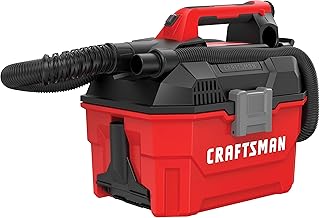
Cordless Wet/Dry Shop Vacuum (Bare Tool, Your Platform)
Buy the bare tool and use packs you already own. Bare-tool pricing is dramatically better than a kit, and a vac is exactly the kind of tool where you want your highest amp-hour battery in it anyway. Check that the model you pick lists a HEPA or fine-dust filter option before you commit.
Filters: The Part That Quietly Ruins Suction
Filtration is where most cordless vacs get honest about their limits. A filter is a restriction by definition. The finer the filter media, the more pressure drop it creates, and pressure drop eats airflow. On a corded vac with a 12-amp motor, you have headroom to spare, so a fine filter costs you performance you never notice. On a battery vac with a tighter power budget, that same fine filter is a much larger percentage of your total capability.
This creates a real tradeoff that no spec sheet will spell out for you. If you are vacuuming drywall dust or fine sanding dust, you need fine filtration or the dust simply passes through the filter and blows back into the room, which is worse than not vacuuming at all. But that fine filter will visibly slow the vac. The fix is not a coarser filter. The fix is a bag or pre-separator so the fine media stays clean.
A loaded filter is the number one cause of “my vac lost suction.” Not the motor. Not the battery. Dust cakes into the pleats, airflow collapses, and people assume the tool failed. Tap it out or replace it and the vac comes back. Buy the model with easy filter access and keep a spare on the shelf.
- ✔ Grab-and-go with no cord to drag or unplug
- ✔ Excellent for cleanup at the tool, right where debris is made
- ✔ Doubles as a wet pickup for small spills on most wet/dry models
- ✔ Fits the way most one-person shops actually work: short frequent cleanups
- ✘ Runtime is the hard limit, and big messes will outlast a pack
- ✘ Lower airflow than a comparable corded vac at any given size
- ✘ Small tank means frequent emptying on chip-heavy work
- ✘ Fine filtration costs noticeably more performance than it does on corded vacs
Matching the Vac to the Job You Actually Have
Be honest about your dominant use case, because the categories barely overlap.
Cleanup between operations. This is the strongest case for cordless. You make a cut, you clear the bench, you move on. Short sessions, small volume, high convenience value. A compact canister on a mid-size battery is close to ideal, and you will use it ten times a day.
Dust extraction while cutting. Cordless works on small tools like a random orbit sander or a compact router, and hooking a vac to a track saw is transformative for visibility. But be aware you are running the vac continuously, which means you are burning battery the entire time you work. Some people keep a dedicated pack just for this.
Big cleanup and stationary tool collection. Cordless is the wrong tool. A table saw or planer generates volume that no battery vac can keep up with, and a dust collector or corded extractor is the right answer. The best shops I have seen run both: a corded unit or collector plumbed to the machines, plus a cordless for everything else.
Wet pickup. Verify the model is rated wet/dry, and understand you must remove the dry filter first on most designs. Water lift matters here, so this is the one job where the sealed-suction number is the one to read.
Compact Cordless Handheld Shop Vacuum
If your real need is clearing sawdust off a bench or pulling chips out of a mortise, a handheld on your existing platform costs a fraction of a canister and gets grabbed far more often. It will not clean a floor. Know that going in and it will not disappoint you.
What to Check Before You Buy
Skip the horsepower claims entirely; peak HP figures on vacuums are measured under conditions that do not resemble use. Instead, look for hose diameter and length listed in the specs, whether a fine or HEPA filter is available for the model, tank capacity in gallons, whether it accepts high-capacity packs from your platform, an onboard place to store the hose and nozzles, and a blower port if you want the extra function. Also check whether the drain or dump design lets you empty it without wearing the contents.
One overlooked detail: the latch and lid design. You will open a shop vac hundreds of times. A stiff, fiddly lid means you delay emptying it, which means you run it full, which means it does not work well. Boring ergonomics beat impressive specs over a year of ownership.
Cordless Vac Accessory and Filter Kit
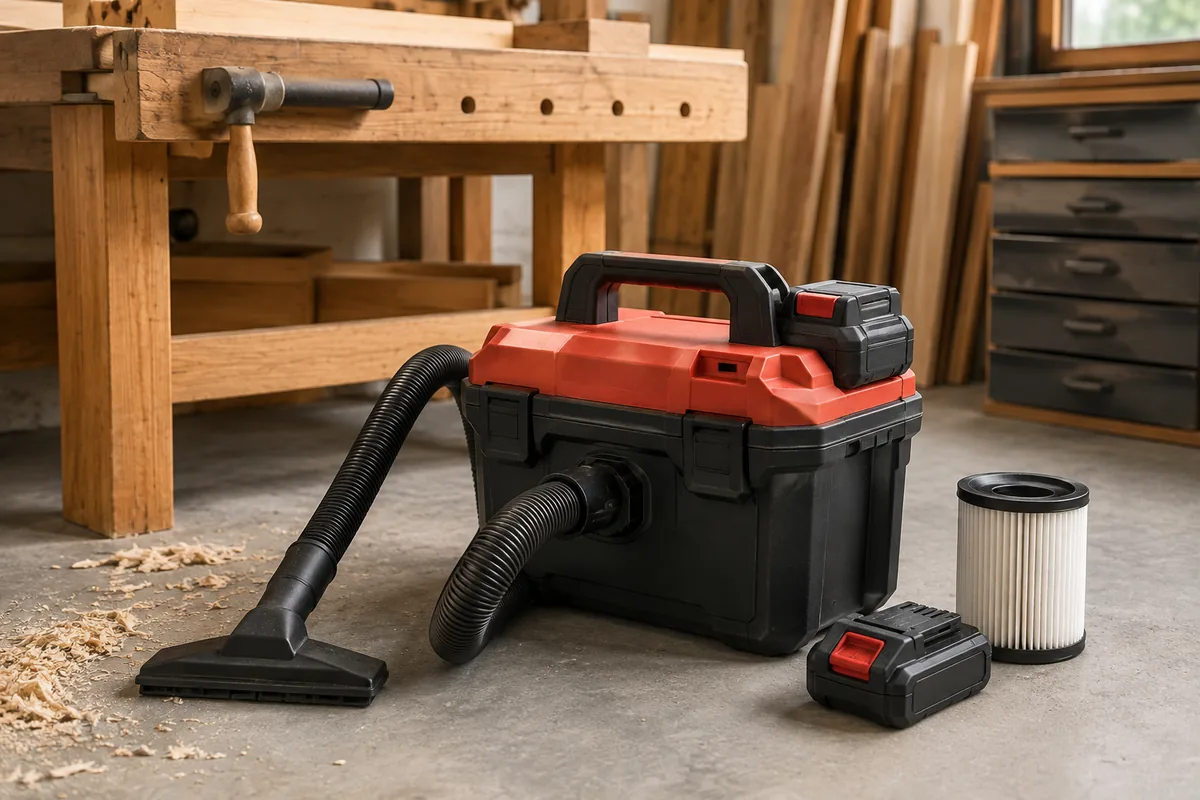
A spare filter and a pack of collection bags will do more for your vac’s performance than any upgrade. Bags keep the filter media clean, which keeps airflow up. Confirm fitment against your specific model number before ordering.
Frequently Asked Questions
Can a cordless shop vac replace my corded one? For most shops, no, and that is fine. Cordless wins on convenience for frequent short cleanups; corded wins on sustained airflow and unlimited runtime. If you only own one, and you have stationary machines, keep the corded unit. If you already have collection on the machines, a cordless becomes the vac you actually reach for.
Why does my cordless vac feel weaker than the specs suggest? Check the filter first, then the hose. A dust-loaded filter or a long, narrow, kinked hose will cut real-world airflow dramatically while the spec sheet stays unchanged. Also confirm you are running a high-capacity pack; voltage sag under load on a small compact battery shows up as reduced performance, not just shorter runtime.
Do I need HEPA filtration in a home shop? If you sand, cut drywall, or work with MDF, fine filtration is genuinely worth it because the particles that damage your lungs are the ones you cannot see. Pair it with collection bags so the filter stays clean, and accept a modest loss of airflow as the cost of not breathing the dust.
Buy the vac that matches your dominant job, put your biggest battery in it, and keep the filter clean. That combination outperforms a spec-sheet winner used the wrong way, every time.
Check prices on Amazon →
0 Comments