Key takeaways
- The best shop vac for woodworking is decided by hose diameter and filter staging, not by the peak horsepower sticker on the drum.
What's inside
As an Amazon Associate I earn from qualifying purchases. This post may contain affiliate links at no extra cost to you.
Here is the usual sequence. You hook a random orbit sander to a five gallon vac, and for ten minutes it looks like magic. Then the sander starts smearing dust across the board, the motor note climbs, and by evening there is a gray film on the bandsaw table and your safety glasses. Nothing failed. The vac did what its design allows, and that design was aimed at wet basements and car interiors, not wood. Choosing the best shop vac for woodworking has little to do with the horsepower number on the drum and everything to do with what happens between the tool port and the filter.
So this guide runs mechanism first, recommendation second. Once you understand why suction dies and why the fine stuff escapes, the shopping part takes about five minutes.
As an Amazon Associate we earn from qualifying purchases at no extra cost to you.


| What you are hooking up | What actually matters | Practical size | Hose |
|---|---|---|---|
| Sanders, routers, track saw | Suction through a small hose | 4 to 8 gallons | 1-1/4 in. antistatic |
| Miter saw, benchtop planer | Raw airflow volume | 12 to 16 gallons | 2-1/2 in. |
| Table saw cabinet, jointer | Airflow a vac cannot supply | Dust collector instead | 4 in. duct |
| Shop and floor cleanup | Capacity and filter area | 12 gallons and up | 2-1/2 in. with wands |
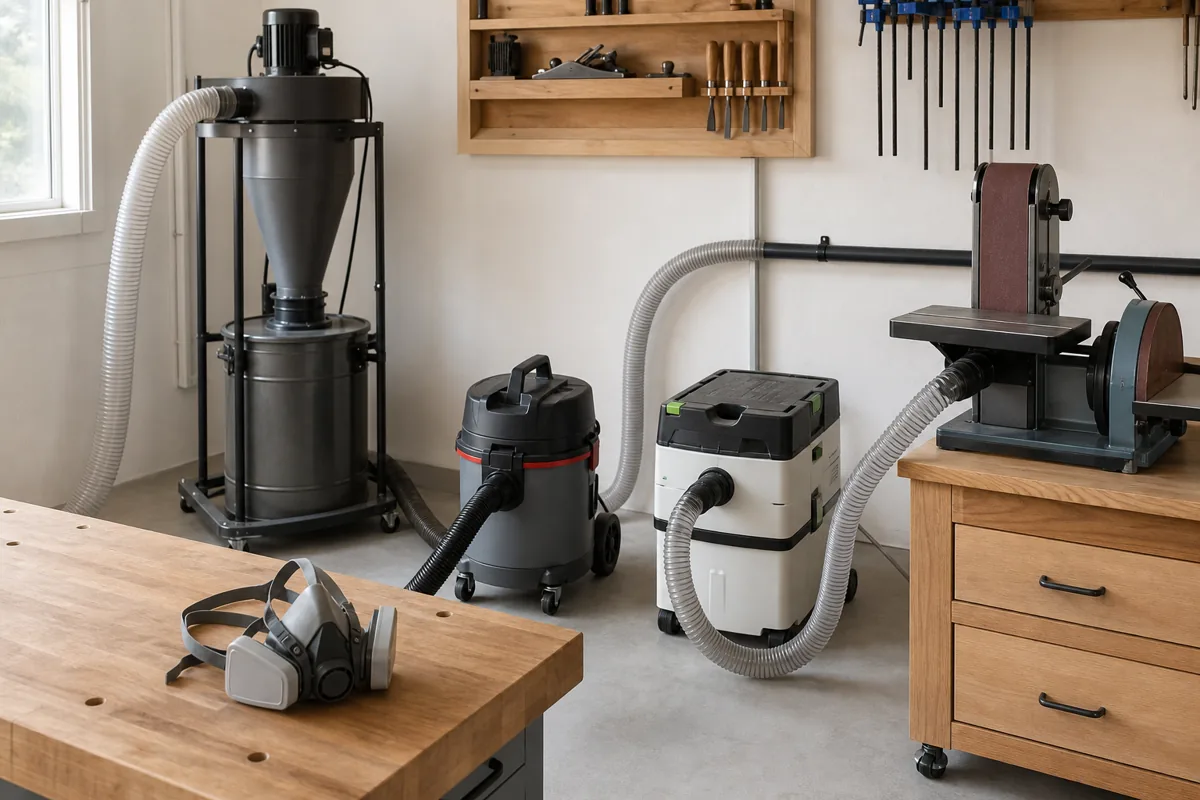
Airflow and suction are two different jobs
Every vacuum gets described by two numbers that pull against each other. Sealed suction, or water lift, is how hard it pulls when you cover the hose with your palm. Airflow, in CFM, is how much air it moves with the hose wide open. Think grip strength versus how many buckets you can carry across the shop in a minute. A strong grip does not make you fast, and speed does not make you strong.
A shop vac is a high suction, low volume machine because it works through a hose the size of a garden hose. A dust collector is the reverse: modest suction, huge volume, four inch duct. So a vac shines at a sander port, where dust appears in one small spot, and struggles at a miter saw, where chips fly out in a wide cone and only air volume catches them.
Hose diameter matters more than people expect. Area scales with the square of diameter, so a 2-1/2 inch hose has roughly four times the opening of a 1-1/4 inch hose. Length and bends cost you too. A 25 foot hose coiled twice with two step down adapters is a weaker machine than eight feet running straight to the tool.
The misconception: that peak horsepower tells you how well a vac collects dust. Peak horsepower is measured at the instant the motor stalls, for a fraction of a second, and no vac sustains it. On a 15 amp household circuit the watts for six continuous horsepower are simply not there. Ignore the sticker and look at airflow, lift, or at least amp draw.
Filtration is where most shop vacs let woodworkers down
Chips fall out of the air on their own. Fine dust does not. Particles small enough to reach the deep lung can hang in shop air for hours after the tool shuts off, which is why the film turns up on surfaces nowhere near the saw.
Here is the mechanism people miss. Run a bare pleated cartridge with no bag and the media builds a cake of packed dust. That cake filters better than clean media, but it also chokes airflow, so the vac goes quiet and weak right when your sander needs the most air. The fix is staging. A cyclone separator or a fleece bag catches the bulk first, and the cartridge only handles what slipped past.
The misconception: that a HEPA label means the air coming out is clean. HEPA describes the filter media, not the machine. A leaking lid gasket, a cracked hose cuff, or an exhaust blowing across a dusty floor undoes the rating. Look for sealed system language and a real gasket, and aim the exhaust away from your bench.
Compact HEPA Dust Extractor With Tool Start Outlet
If you sand more than you sweep, buy into this category. Extractors in the DeWalt, Makita, Bosch and Festool lines give you variable suction, an outlet that starts the vac with the tool, and filtration built for fine dust rather than nails and water. Expect to pay several times big box money.
The best shop vac for woodworking depends on what you feed it
There is no single winner, only three fairly clear lanes.
Handheld power tools. Sanders, routers, jigsaws and track saws have small ports and want high suction through a 1-1/4 inch hose. A four to eight gallon extractor with variable suction and an auto start outlet is the right answer. Auto start sounds like a gimmick until you use it.
Chip throwing benchtop machines. Miter saws, planers and drum sanders make volume. A 12 to 16 gallon vac on full 2-1/2 inch hose does respectable work at a miter saw if you add a shroud behind the blade to give the air somewhere to go. Bare port and no shroud, you will still be sweeping.
Cleanup and wet work. Big drum, long hose, plenty of filter area, drain plug. Nothing exotic needed, and this is where inexpensive big box vacs earn their spot.
- ✔ High suction pulls dust from small tool ports a dust collector cannot serve
- ✔ Cheap to start, and it handles wet spills and cleanup too
- ✔ Rolls to the job site or tucks under a bench
- ✔ Upgrades cheaply with a separator and better bags
- ✘ Not enough airflow for a table saw cabinet, jointer or big planer
- ✘ Loud enough that many models demand hearing protection
- ✘ Small filter area means suction fades as the bag fills
- ✘ Bags, filters and specialty hoses add up over time
12 to 16 Gallon Shop Vacuum With Fine Dust Filter
For general shop duty, get a mid size drum with a good pleated cartridge and buy a case of fleece bags with it. Check consumable prices first, because bags and filters lock you to a platform. Judge hose diameter, casters and cord length, not the blower port.
Small details that decide whether you actually use it
Noise. Plenty of drum vacs run loud enough that you should already have hearing protection on. If the shop shares a wall with the house, either buy one of the quieter variable speed extractors or park the vac in a closet and run longer hose, trading some airflow for peace.
Static. Dry dust sliding through plastic hose strips electrons and builds a charge. The misconception: that this touches off a dust explosion in your two car garage. In a hobby shop the real penalties are painful shocks and dust clinging to the hose. An antistatic hose or a grounded wire inside it handles the problem.
Fittings. The quiet tax on every purchase. Ports and cuffs are barely standardized, so budget for an adapter kit and expect tape. If you already run a tool platform, that brand’s vac usually clicks straight onto the tool.
Cyclone Separator And Antistatic Hose Upgrade
Before replacing a working vac, put a cyclone separator in front of it. Inertia throws heavy chips into a bucket so the filter stays open and suction holds steady all session. Add an antistatic hose and a fleece bag and an ordinary drum vac behaves like a pricier one.
Frequently Asked Questions
Can a shop vac replace a dust collector? For handheld power tools, yes, and it does the job better. For a table saw cabinet, jointer or full size planer, no. Those want air volume through four inch duct, and a vac cannot move that much air however strong it feels at the nozzle.
Do I really need a HEPA filter for wood dust? If you sand indoors or share air with living space, that filtration is worth paying for. Just treat it as one link in a chain, because a HEPA cartridge behind a leaking lid or with no bag ahead of it clogs fast and leaks fines anyway.
Why does my vac lose suction halfway through a project? Almost always a loading filter or a full bag, not a dying motor. Check the filter cake, then the bag, then the hose for a plug. A separator upstream prevents it, since the bulk never reaches the media.
Buy for the tool you use most, stage the filtration so the cartridge stays open, and keep the hose as short and as fat as the port allows. That combination beats any horsepower claim printed on a drum.
Check prices on Amazon →
0 Comments