What's inside
As an Amazon Associate I earn from qualifying purchases. This post may contain affiliate links at no extra cost to you.
Our Top Picks
 1/2 pt Minwax 13407 Clear Pre-Stain Wood Conditioner1/2 Pint3 x 3.25 x 3 inches0 PoundsCheck on Amazon
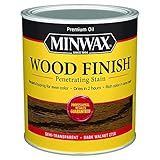
 Varathane Total Control Dark Walnut Gel StainHalf Pint (Pack of 1)2.88 x 2.88 x 2.97 inchesCheck on Amazon


Start with the finished look
A deep stain is not the same as an even stain. Dark pigment can make pale sapwood, knots, and changing grain stand out more, not less. The easiest route to a consistent result is to choose wood with a fairly uniform color and pore structure, then prepare it carefully. If you’re buying lumber or a project blank, inspect it before choosing a stain color.
For a smooth, dark finish, alder and poplar are often practical choices for indoor furniture and trim. Cherry can take a rich brown finish, but it darkens naturally with age. Oak has bold, open grain that remains visible under stain; that’s a feature if you want a pronounced grain pattern, not a flaw to eliminate. Pine is inexpensive and widely available, but its alternating soft and hard growth bands can absorb stain unevenly.
As an Amazon Associate we earn from qualifying purchases at no extra cost to you.


Compare common species
These are general tendencies, not guarantees. Lumber varies by board, and the stain formula and preparation matter as much as the species.
| Species | Typical stain behavior | Good fit | Watch for |
|---|---|---|---|
| Alder | Relatively even; can take medium and dark colors well | Furniture, cabinet parts, trim | Color and grain vary; test for blotching |
| Poplar | Usually fairly uniform, but can have green or purple streaks | Paint-grade work or dark indoor finishes | Natural color variation may show through a transparent stain |
| Red oak | Absorbs readily through open pores; grain stays prominent | Traditional, grain-forward finishes | Dark stain emphasizes pores and grain contrast |
| Hard maple | Dense and fine-grained; can resist stain or look uneven | Light finishes or controlled, tested processes | Dark colors may look muddy or show handling marks |
| Pine | Soft bands absorb more than hard bands | Budget projects or rustic looks | Blotches and strong growth-ring contrast |
| Cherry | Can take stain, but changes color with age and light | Warm, brown-toned furniture | Freshly stained color may not match its later tone |
Choose for grain and natural color
First decide whether you want the grain to show. Open-grained oak produces a textured look; a dark stain settles into the pores and makes them more noticeable. Fine-grained alder gives a quieter surface. If you want a solid, uniform dark color with almost no natural character showing, a film-forming paint is usually a more predictable choice than a transparent stain.
Check a board for sapwood, knots, mineral streaks, and color shifts. A stain does not reliably hide them. For a matched set of doors or a tabletop, buy enough lumber from the same batch and compare the boards before cutting. Avoid mixing dramatically different boards when a uniform appearance matters.
When buying, ask whether the lumber is solid wood or veneer. A thin veneer can be sanded through, especially at edges; don’t use aggressive sanding to correct a color mismatch. For a large surface, buying one extra offcut for testing is often cheaper than redoing the whole piece.
Test the entire finishing schedule
Use offcuts from the actual boards. Sand them with the same tools and grit sequence planned for the project, then apply the stain and topcoat. A stain sample on raw wood is not a reliable preview of the final appearance: the topcoat often deepens the color and adds sheen.
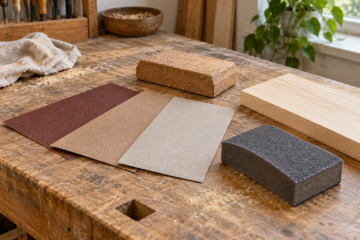
For many furniture projects, sanding through 120 or 150 grit and finishing at 180 grit is a reasonable starting point. Follow the stain maker’s instructions; some products call for a different final grit. Sanding too fine can burnish the surface and reduce absorption, while coarse scratches can become obvious under a dark color. Vacuum dust and wipe the surface as directed by the product label. Water-based products may raise grain, so a light pass with fine sandpaper after the first coat can help; avoid cutting through the stain.
On blotch-prone pine, maple, and some cherry, test a compatible conditioner or a thin washcoat before staining. A wood stain conditioner can reduce differences in absorption, but it can also make the final color lighter. Follow its timing directions and use the same schedule on the sample and project.
Choose stain by how it colors
Penetrating oil stains are familiar and easy to wipe, but they can accentuate uneven absorption on soft or blotchy woods. Water-based stains generally dry faster and come in many colors, but a fast-drying surface can leave lap marks if you work slowly or in sections. Gel stains sit closer to the surface and can be useful on blotchy woods, though they may obscure more grain and require careful, even wiping. None makes every species behave identically.
For a deep color, build toward it with a tested formula rather than assuming several coats will fix a pale result. Additional coats may not penetrate evenly and can leave a muddy or streaked surface. A dark gel stain is worth testing when a conventional penetrating stain looks patchy, but it is not a shortcut around sanding or sample boards.
Avoid common failures
Blotches usually come from differences in absorption, often made worse by uneven sanding, glue residue, or patches of burnished wood. Check joints and edges for dried glue before staining: glue left on the surface blocks color and may appear as a pale spot. A light mist of water can reveal some glue smears on bare wood, but let the piece dry fully before sanding and staining.
Lap marks happen when stain begins drying before the next area is blended. Work in manageable sections, keep a wet edge where the label allows, and wipe excess consistently. Don’t leave a thick puddle in corners or on end grain. End grain absorbs more and can turn much darker; a light pre-seal or careful test may help it match adjacent faces.
Use a compatible clear finish after the stain has dried for the time stated on its label. A topcoat can change both color and sheen, so test it too. For a small, low-stakes project, inexpensive pine and a conditioner may be perfectly adequate if you accept a rustic result. For broad, dark surfaces where even color matters, choosing alder or carefully selected boards—and testing the full process—is usually the more dependable buy.
0 Comments