What's inside
As an Amazon Associate I earn from qualifying purchases. This post may contain affiliate links at no extra cost to you.
Larch and Douglas fir are both practical choices for exterior siding, but they behave differently under stain. Larch is generally denser and more naturally durable; Douglas fir is often easier to find in clear, wide boards and can be less expensive. Neither is maintenance-free, and neither will hold a finish well if it is installed wet or coated with the wrong product.
As an Amazon Associate we earn from qualifying purchases at no extra cost to you.
Quick comparison
| Factor | Larch | Douglas fir |
|---|---|---|
| Natural durability | Heartwood is relatively durable; sapwood is less so | Heartwood has moderate durability; sapwood is less durable |
| Density and handling | Usually dense and hard; can be demanding to cut and fasten | Moderately dense; generally easier to work |
| Stain appearance | Strong grain and pronounced color variation; can absorb unevenly | Prominent straight grain; often gives a more even look, depending on grade |
| Best fit | Exposed locations where durability and character matter | Budget-conscious jobs, protected walls, and readily available clear stock |
| Maintenance | Still needs inspection and recoating | Needs careful moisture detailing and regular finish maintenance |
Durability and moisture exposure
Species alone does not make siding rot-proof. The heartwood of larch is generally more decay-resistant than its sapwood, while Douglas fir heartwood is commonly rated moderately resistant and its sapwood less resistant. The amount of heartwood in a board varies, so ask what grade and cut you are buying rather than assuming every board has the same durability.
Installation details matter more than a small difference in species. Keep siding clear of soil and roofs, use a drained and ventilated wall assembly, and protect end grain, joints, and cut edges. A rain screen gap of roughly 3/8 to 3/4 inch is common when the wall design allows it; follow local code and the siding manufacturer’s instructions. Siding that stays wet behind a tight, poorly drained assembly can fail even if it is larch.
For a shaded, rain-exposed elevation or a wall close to the ground, larch is the safer material choice if the boards are sound and mostly heartwood. On a sheltered wall with generous eaves and good drainage, Douglas fir can be a sensible lower-cost option.
Stain, grain, and appearance
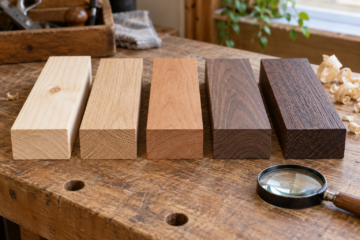
Both species have strong grain, so a transparent or semi-transparent stain will not hide board-to-board variation. Larch often shows bold grain and warm color, but its density and resinous areas can lead to uneven absorption. Douglas fir’s straight grain can look more uniform, especially in a clear grade, though knots and color changes still show through.
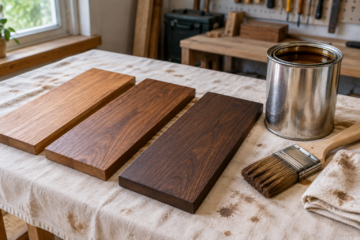
Do a sample on the actual siding, using the same sanding, primer or conditioner, and number of coats planned for the job. Check it in sun and shade after it dries. A tinted exterior stain with some pigment usually gives better UV protection than a clear finish. Clear finishes can look natural at first but typically need more frequent upkeep because they provide less protection from sunlight.
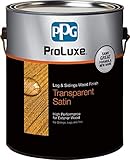
Choose a finish made for exterior wood siding, and check that its label allows use on the species and exposure you have. For a penetrating, lower-build finish, compare exterior wood siding stains. If you want a more opaque appearance, look at exterior wood primers and paints; paint hides more of the grain and usually requires more involved scraping and repainting when it eventually fails.
Preparation and application
Install and coat siding at the moisture content specified by the supplier and finish manufacturer. As a practical target, many exterior coating instructions call for wood around 15% moisture or lower, but use the product label as the deciding limit. Coating damp boards can trap moisture and contribute to peeling, mildew, or movement cracks.
Sand only as much as needed to remove mill glaze, raised grain, and handling marks. A starting point of 80 grit followed by 100 or 120 grit is reasonable for many siding profiles; sanding much finer can reduce stain uptake. Remove dust, let the surface dry, and apply the finish within its stated temperature and weather window. Coat all faces before installation where the product allows, especially end grain and concealed edges. Follow the label for coat count and recoat timing rather than assuming a second coat is always better.
Use stainless-steel or suitably corrosion-resistant fasteners. Wet wood, tannins, and ordinary steel can leave dark streaks, and dense larch may split if boards are nailed too close to an end without predrilling. Follow the siding supplier’s fastening schedule and keep fasteners out of edges.
Common failures to avoid
Peeling often points to moisture, a dirty or overly smooth surface, or incompatible coatings—not simply the wrong species. Dark stains around fasteners usually indicate corrosion. Patchy color can come from mixed board moisture, resin pockets, or uneven sanding. Cupping and open joints often mean the boards were installed too wet, insufficiently fastened, or exposed to repeated wetting on one face.
Inspect the siding at least once a year, paying attention to lower courses, end grain, corners, and south- and west-facing walls. Recoat when the finish is thinning or water no longer beads as expected, not after bare wood has weathered gray across the whole wall. A wood moisture meter helps distinguish a dry surface ready for coating from boards that need more time.
Which should you buy?
Choose larch for a more exposed wall, a long service-life priority, or the look of its pronounced grain—provided you can get sound, well-dried stock and are prepared to sort boards and apply stain carefully. Choose Douglas fir when it is substantially cheaper, the wall is reasonably sheltered, and you can inspect the boards for defects and sapwood. In either case, a well-detailed wall with dry, properly prepared siding will outperform a premium species installed without drainage or maintained with the wrong finish.
0 Comments