What's inside
As an Amazon Associate I earn from qualifying purchases. This post may contain affiliate links at no extra cost to you.
Fine-profile picture frames have narrow beads, coves, and sharp corners that show every defect after painting. Choose wood that cuts cleanly, holds its shape, and doesn’t force you to spend the job filling torn grain or sanding away fuzz. For most painted frames, poplar is the practical default; basswood suits delicate profiles, while finger-jointed pine can save money on simpler trim.
As an Amazon Associate we earn from qualifying purchases at no extra cost to you.


Our Top Picks


What matters in a fine profile
Paint hides color differences, but it does not hide a chipped bead, a dent, or a fuzzy edge. Soft wood can compress under a cutter or sanding block; brittle wood can splinter at a narrow ridge. Knots, pitch pockets, and uneven grain create extra work and can show through primer or paint.
Also consider the stock’s stability. Frame rails are usually narrow, and a slight bow or twist makes accurate miters difficult. Buy straight, dry lengths and check them along both edges before cutting. For a small frame, a few inches of cupping may be enough to open a visible gap at a corner.
Wood options compared
| Wood | Fine detail | Cost and availability | Best use |
|---|---|---|---|
| Poplar | Good; cuts cleanly, though grain hardness varies | Moderate; widely sold in paint-grade boards | Most painted profiles and general frame work |
| Basswood | Very good for small beads and delicate cuts | Often pricier per board foot; less common in long molding lengths | Small frames, carving, or profiles with fragile ridges |
| Finger-jointed pine | Fair to good; joints and soft spots can interrupt machining | Usually economical and easy to find as primed trim | Budget frames with broader, simpler profiles |
| Solid pine | Variable; soft earlywood and knots are common | Low cost | Basic frames where careful board selection is possible |
| MDF | Consistent when factory-molded, but edges are vulnerable | Often inexpensive as ready-made molding | Stable, straight trim kept indoors and away from moisture |
Poplar: the safest all-around choice
Poplar is a dependable choice when you are cutting or routing your own molding. It is generally stable, machines cleanly, and takes primer well. Its hardness varies within a board: a profile may cut smoothly in one section and show slight fuzz or tear-out where the grain changes. Use a sharp bit or molding cutter, take a light finishing pass, and inspect the narrow details before assembly.
Poplar can have green, gray, or purple streaks. Those colors matter under a clear finish but are irrelevant beneath an opaque paint system. Fill small dents and open defects with a paintable filler, then sand flush. For a small shop-made frame, poplar offers a useful balance of price, availability, and crisp detail.
Basswood: for especially delicate profiles
Basswood is softer and more uniform than most poplar. It is easy to carve and can leave clean edges on tiny beads that might chip in harder or more variable stock. That softness is also its drawback: it dents readily during clamping, handling, and sanding. Use light clamp pressure and support narrow strips on a flat surface while working.
Choose basswood when the profile itself is unusually fine or you are making a small frame by hand. For ordinary painted trim, it may cost more than the improvement justifies. A well-cut poplar profile is usually adequate.
Pine, finger-jointed stock, and MDF
Solid pine is the cheapest option in many lumberyards, and it can work well if you select clear, straight boards. Avoid knots near miters and profile edges. Pine’s alternating soft and hard grain can sand unevenly: if you press hard, the softer bands dish while the harder bands remain proud. Sand with a backing block and modest pressure rather than trying to erase every mark in one pass.
Finger-jointed pine is a reasonable budget choice for wider, uncomplicated profiles. Its joined sections can include changes in grain or hardness, so test a short offcut before routing. Factory-primed trim saves preparation time, but check for raised fibers, damaged primer, or poorly filled joints. MDF gives consistent molded detail and stays straight indoors, but its edges soak up paint and its corners can crush. Keep it dry, seal cut ends, and don’t expect it to tolerate bumps like solid wood.
Prepare the surface before painting
Cut and dry-fit the miters before finishing. A sharp fine-tooth saw helps limit splintering; a small test cut tells you whether the stock is likely to chip at the profile. Glue the joints with a suitable woodworking adhesive, keeping squeeze-out off the visible face. Dried glue blocks paint and can leave a shiny patch, so remove it while wet or scrape it carefully after it hardens.
Sand the face and profile with 150- or 180-grit paper, then finish with 220 grit if the surface needs it. Use folded abrasive or a shaped sanding block on coves and beads; avoid rounding over sharp ridges. On soft woods, stop as soon as the surface is smooth. Over-sanding can flatten a delicate detail in minutes.
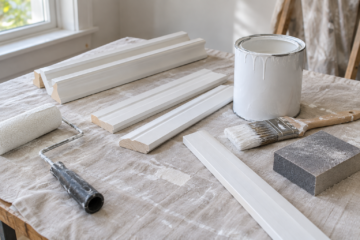
Fill nail holes, tiny chips, and miter gaps with a paintable filler, allow it to dry fully, and sand it flush. Prime bare wood with a primer suited to the paint system and substrate. MDF edges may need a sealing coat or extra primer because they absorb more than the faces. After the primer dries, lightly sand raised grain with 220 grit and remove dust before painting. If knots or resinous spots are present in pine, use an appropriate stain-blocking primer; ordinary primer may not prevent discoloration from bleeding through.
What to buy
For a custom profile, start with straight, clear poplar boards or molding stock and make a short test piece before producing the full run. Compare paint-grade poplar boards if local stock is limited. For a very small carved or unusually delicate profile, basswood boards may be worth the added cost.
If you are painting ready-made molding rather than making it, finger-jointed pine or MDF can be the better buy when the profile is simple and the pieces are straight. Choose poplar when crisp machined detail and easy repair matter more than the lowest price. Whatever the species, a clean test cut and careful surface preparation usually matter more to the finished frame than a small difference in wood cost.
0 Comments